Page loaded successfully. Showing biography for Damien Hirst.
Damien Hirst BIOGRAPHY
Born 1965 Bristol, England. Known for: Conceptual life and death themed installations.
Damien Hirst is known for his conceptual works with medical, pharmaceutical, animal and life-cycle themes. His unique installations, often noted for their shock arousal, first got public attention in... Read full biography
Damien Hirst is known for his conceptual works with medical, pharmaceutical, animal and life-cycle themes. His unique installations, often noted for their shock arousal, first got public attention in the 1990s, when he became part of a group of avant-garde men and women known as 'Young British... Read full biography
Damien Hirst is known for his conceptual works with medical, pharmaceutical, animal and life-cycle themes. His unique installations, often noted for their shock arousal, first got public attention in the 1990s, when he became part of a group of avant-garde men and women known as 'Young British Artists'. From the 1990s, his reputation has grown to international recognition, especially from 1994 with a one-person exhibition titled "Some Went Mad, Some Ran Away". During this show, an angry artist... Read full biography
Damien Hirst is known for his conceptual works with medical, pharmaceutical, animal and life-cycle themes. His unique installations, often noted for their shock arousal, first got public attention in the 1990s, when he became part of a group of avant-garde men and women known as 'Young British Artists'. From the 1990s, his reputation has grown to international recognition, especially from 1994 with a one-person exhibition titled "Some Went Mad, Some Ran Away". During this show, an angry artist vandalized one of the pieces, Away From The Flock, by pouring ink into the formaldehyde, which was preserving the body of a sheep. Hirst successfully prosecuted the man and was reimbursed for the damage, but, in fact, realized much more than... Read full biography
Damien Hirst is known for his conceptual works with medical, pharmaceutical, animal and life-cycle themes. His unique installations, often noted for their shock arousal, first got public attention in the 1990s, when he became part of a group of avant-garde men and women known as 'Young British Artists'. From the 1990s, his reputation has grown to international recognition, especially from 1994 with a one-person exhibition titled "Some Went Mad, Some Ran Away". During this show, an angry artist vandalized one of the pieces, Away From The Flock, by pouring ink into the formaldehyde, which was preserving the body of a sheep. Hirst successfully prosecuted the man and was reimbursed for the damage, but, in fact, realized much more than financial remuneration because the 'attack' focused initial widespread attention on his unique approach to fine art.... Read full biography
Artist Biography
Biography page for Damien Hirst ((Born 1965)), known for Conceptual life and death themed installations. Showing 5 biographical entries and 0 sample artworks.
Damien Hirst - Artist Info
About Damien Hirst
Biography from the Archives of askART
 Damien Hirst is known for his conceptual works with medical, pharmaceutical, animal and life-cycle themes. His unique installations, often noted for their shock arousal, first got public attention in the 1990s, when he became part of a group of avant-garde men and women known as 'Young British Artists'. From the 1990s, his reputation has grown to international recognition, especially from 1994 with a one-person exhibition titled "Some Went Mad, Some Ran Away". During this show, an angry artist vandalized one of the pieces, Away From The Flock, by pouring ink into the formaldehyde, which was preserving the body of a sheep. Hirst successfully prosecuted the man and was reimbursed for the damage, but, in fact, realized much more than financial remuneration because the 'attack' focused initial widespread attention on his unique approach to fine art.
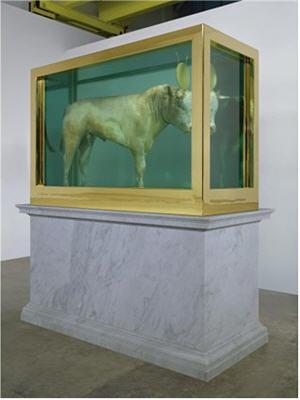
And more publicity followed. The next year, New York City officials banned his encased rotting cow and bull because they feared it would cause "vomiting among the visitors." (Guardian) During this period, Charles Saatchi, prominent British collector and dealer, promoted Hirst and other members of the Young British Artists, and that relationship with Hirst continued until 2003. A 2004 fire in a warehouse holding many works by Saatchi, destroyed 17 pieces by Hirst. From that time, major exibitions featuring Hirst have been held in New York City, and in Mexico, where a 2006 exhibition was the first time his work had been shown in Latin America.
Although Damien Hirst does spin paintings on circular surfaces and spot paintings, which are colored circles randomly arranged in rows, his signature works are installations addressing themes of life and death, and usually have animal bodies preserved in formaldehyde and encased in vitrines. Among his subjects are tiger sharks, cows, calves and sheep. His work, The Physical Impossibility of Death in the Mind of Someone Living, is a 14-foot tiger shark, which sold in 2004 at a price "that made him the second most expensive living artist after Jasper Johns. In June, 2007, Hirst became the most expensive living artist" with the sale of a medicine chest, Lullably Spring, at Sotheby's London. (Alberge)
Damien Hirst was born in Bristol, England, and grew up in Leeds. His father, an auto mechanic and car salesman, abandoned the family when Damien was age 12. He became a 'wild' youth, abusing drugs and alcohol and getting arrested several times for petty thievery. This lifestyle challenged his conservative mother whose encouragement of his art talent led to the path that brought him positive attention. By 2002, when he was in his late 30s, he had forsaken his earlier lifestyle and was leading a quiet existence in a 300 year-old farmhouse in a remote part of north Devon, England with his wife, Maia Norman, and their three sons.
He studied at Leeds College of Art and Design, and from 1986 to 1989, was a student at Goldsmith's College, University of London where he received a fine art degree. During that period, he worked in a mortuary, which influenced his subsequent art expression. In 1988, while at Goldsmith's, he converted an abandoned London Docklands warehouse into an exhibition and curated the Freeze exhibition that featured other young independent, conceptual artists. Hirst's entry was a pile of cardboard boxes painted with household paint. This event first brought him to the attention of Charles Saatchi, and two years later at a warehouse show, Saatchi purchased Hirst's first major dead animal work, A Thousand Years. The piece, whose theme is life cycles, is an encased severed, rotting cow's head with maggots that after feeding on the head, turn into flies. Reportedly, it left Saatchi, who arrived in a Rolls Royce "open mouthed with astonishment".
In 1992, Saatchi then included A Thousand Years at his London gallery at the event that was the first exhibition of the Young British Artists. The next year, the 1993 Venice Biennale had the Damien Hirst entry, Mother and Child Divided, which was a sectioned cow and calf exhibited in separate vitrines. His reputation grew steadily from that time, aided by the above descriptions of Saatchi's support and exhibition controversies. However, he generated much negative perception towards himself because of his remarks, carried by the BBC News Online, about the World Trade Center attacks of September 11, 2001: "The thing about 9/11 is that it's kind of like an artwork in its own right ... Of course, it's visually stunning and you've got to hand it to them on some level because they've achieved something which nobody would have ever have thought possible - especially to a country as big as America. So on one level they kind of need congratulating, which a lot of people shy away from, which is a very dangerous thing." Hirst later apologized for grief his comments might have caused the victims' families.
Like many highly productive contemporary artists whose work is in high demand, Hirst has assistants and production methods perceived by some critics as more of a factory than a studio. However, Hirst claims that the act of creativity is conception and not completion. Elaborating on his theories and describing events of his life, he wrote a biography which was published in 1998 with the title: I Want to Spend the Rest of my Life Everywhere, with Everyone, One to One, Always, Forever, Now.
Sources:
Dalya Alberge, "Pills lift Hirst to top of art World's Most Expensive List", The New York Times, June 22, 2007
www.damienhirst.com
The Guardian, London, October 6, 2001
http://en.wikipedia.org/wiki/Damien_Hirst#LifeBiography from GallArt.com
 Damien Hirst was born in Bristol, United Kingdom in 1965. He attended Goldsmith's College and in 1988 curated the student exhibition Freeze, bringing together a group of young British artists that would become renowned contemporary artists in the 1990s. In 1992, the Saatchi Gallery displayed the ground breaking show Young British Artists in which Hirst exhibited Physical Impossibility of Death in the Mind of Someone Living, consisting of a tiger shark in a glass tank of formaldehyde. In 1995, Hirst won the Turner Prize—an annual prize named after painter J.M.W Turner presented to a British artist under the age of 50-years-old, for their work.
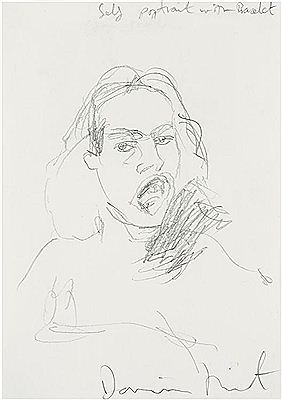
Hirst explores human experiences such as love, life, death, loyalty and betrayal through a variety of media, including painting (Spot paintings and Spin paintings), medicine cabinet sculptures, glass tank installations, and drawings.
Hirst has participated in numerous solo and group exhibitions at major institutions such as P.S.1 Contemporary Art Center, New York; Tate Britain, London; TateModern, London; Pinchuk Art Centre, Kiev; Astrup Fearnley Museet für ModerneKunst, Oslo; Milwaukee Art Museum, Wisconsin; Dallas Museum, Texas; LACMA, Los Angeles; Museum of Contemporary Art, Los Angeles; Museum of Modern Art, New York; Solomon R. Guggenheim Museum, New York; and the Museum of Fine Art, Boston.
The artist currently works and lives in London and Devon, United Kingdom.Biography from Phillips London
There is no other contemporary artist as maverick to the art market as Damien Hirst. Foremost among the Young British Artists (YBAs), a group of provocative artists who graduated from Goldsmiths, University of London in the late 1980s, Hirst ascended to stardom by making objects that shocked and appalled, and that possessed conceptual depth in both profound and prankish ways.
Regarded as Britain's most notorious living artist, Hirst has studded human skulls in diamonds and submerged sharks, sheep and other dead animals in custom vitrines of formaldehyde. In tandem with Cheyenne Westphal, now Chairman of Phillips, Hirst controversially staged an entire exhibition directly for auction with 2008's "Beautiful Inside My Head Forever," which collectively totalled £111 million ($198 million).
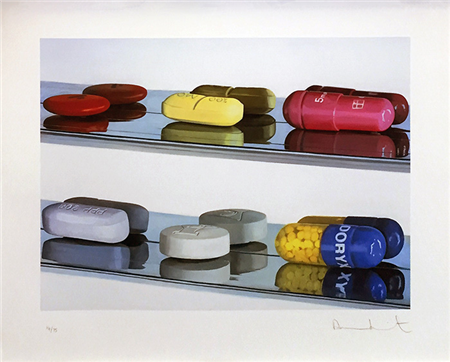
Hirst remains genre-defying and creates everything from sculpture, prints, works on paper and paintings to installation and objects. Another of his most celebrated series, the 'Pill Cabinets' present rows of intricate pills, cast individually in metal, plaster and resin, in sterilized glass and steel containers; Phillips New York showed the largest of these pieces ever exhibited in the United States, The Void, 2000, in May 2017.Biography from Auctionata, Inc. (CLOSED)
Damien Hirst was born in Bristol in 1965. He first gained public attention in 1988, when he conceived and curated “Freeze.” "Freeze" was an exhibition of his work and that of his fellow students at Goldsmiths College, London.
In the years following that show, Hirst has become one of the most prominent artists of his generation. Many of his works are widely recognized, from the shark suspended in formaldehyde, to his spot, spin and butterfly paintings, through later works such as the diamond skull.
The artist was included in the 1992 Young British Artists exhibition at Saatchi Gallery, London. In 1995, he won the Turner Prize. Solo exhibitions of Hirst’s work have been held at Museo Archeologico Nazionale, Naples (2004), Astrup Fearnley Museet fur Moderne Kunst, Oslo (2005), Rijksmuseum, Amsterdam (2008), Galerie Rudolfinum, Prague (2009), The Wallace Collection, London (2009–10), the Oceanographic Museum, Monaco (2010), the Museo di Palazzo Vecchio, Florence (2010) and Tate Modern, London (2012).
The artist lives and works in Devon and London, U.K.Biography from Auctionata
Damien Hirst (born 1965) . From 1986 to 1989, the British artist studied art at Goldsmiths College in London without wishing to be bound to an art form. The exhibition ‘Freeze’ that he organized in 1988 in an unused warehouse in London's port district showing his own works and works of his fellow students brought him public attention. Hirst, who often employs in his works with themes of death and life, religion and consumer culture became famous in the 1990s through his works of animal bodies preserved in formaldehyde. Also, the diamond adorned platinum cast of a human skull, that Hirst exhibited in 2007 and sold the same year to a record price, caused a stir. Damien Hirst is one of the most influential artists of his generation.