Page loaded successfully. Showing biography for Dan Christensen.
Dan Christensen BIOGRAPHY

1942 Cozad, Nebraska - 2007 East Hampton, New York. Known for: Minimal color field imagery painting, abstraction.
DAN CHRISTENSEN CAPTURED THE HARMONIOUS TURBULENCE OF THE 'UNIVERSE' IN HIS PAINTINGS. By L. Kent Wolgamott, Lincoln Journal Star, October 31, 2009. When Dan Christensen was attending Chadron State... Read full biography
DAN CHRISTENSEN CAPTURED THE HARMONIOUS TURBULENCE OF THE 'UNIVERSE' IN HIS PAINTINGS. By L. Kent Wolgamott, Lincoln Journal Star, October 31, 2009. When Dan Christensen was attending Chadron State College in the late 1950s, art instructors there recognized the young painter's talent and encouraged... Read full biography
DAN CHRISTENSEN CAPTURED THE HARMONIOUS TURBULENCE OF THE 'UNIVERSE' IN HIS PAINTINGS. By L. Kent Wolgamott, Lincoln Journal Star, October 31, 2009. When Dan Christensen was attending Chadron State College in the late 1950s, art instructors there recognized the young painter's talent and encouraged him to attend the Kansas City Art Institute. Fifty years later, Christensen, who died in 2007 at age 64, is a highly regarded painter, likely the most noted, important Nebraska native artist of his... Read full biography
DAN CHRISTENSEN CAPTURED THE HARMONIOUS TURBULENCE OF THE 'UNIVERSE' IN HIS PAINTINGS. By L. Kent Wolgamott, Lincoln Journal Star, October 31, 2009. When Dan Christensen was attending Chadron State College in the late 1950s, art instructors there recognized the young painter's talent and encouraged him to attend the Kansas City Art Institute. Fifty years later, Christensen, who died in 2007 at age 64, is a highly regarded painter, likely the most noted, important Nebraska native artist of his era. "That's the way I'd see it," said Lincoln painter Keith Jacobshagen, who was at the Kansas City Art Institute with Christensen in the early 1960s. "Of that era, he was the only one to come out of the state that gained a national reputation.".... Read full biography
DAN CHRISTENSEN CAPTURED THE HARMONIOUS TURBULENCE OF THE 'UNIVERSE' IN HIS PAINTINGS. By L. Kent Wolgamott, Lincoln Journal Star, October 31, 2009. When Dan Christensen was attending Chadron State College in the late 1950s, art instructors there recognized the young painter's talent and encouraged him to attend the Kansas City Art Institute. Fifty years later, Christensen, who died in 2007 at age 64, is a highly regarded painter, likely the most noted, important Nebraska native artist of his era. "That's the way I'd see it," said Lincoln painter Keith Jacobshagen, who was at the Kansas City Art Institute with Christensen in the early 1960s. "Of that era, he was the only one to come out of the state that gained a national reputation.". Sheldon Museum of Art curator Sharon Kennedy concurs with Jacobshagen's assessment. "I... Read full biography
Artist Biography
Biography page for Dan Christensen ((1942 - 2007)), known for Minimal color field imagery painting, abstraction. Showing 6 biographical entries and 0 sample artworks.
Dan Christensen - Artist Info
About Dan Christensen
Name variants
Daniel James Christensen
Biography from the Archives of askART
 DAN CHRISTENSEN CAPTURED THE HARMONIOUS TURBULENCE OF THE 'UNIVERSE' IN HIS PAINTINGS
By L. Kent Wolgamott, Lincoln Journal Star, October 31, 2009
When Dan Christensen was attending Chadron State College in the late 1950s, art instructors there recognized the young painter's talent and encouraged him to attend the Kansas City Art Institute.
Fifty years later, Christensen, who died in 2007 at age 64, is a highly regarded painter, likely the most noted, important Nebraska native artist of his era.
"That's the way I'd see it," said Lincoln painter Keith Jacobshagen, who was at the Kansas City Art Institute with Christensen in the early 1960s. "Of that era, he was the only one to come out of the state that gained a national reputation."
Sheldon Museum of Art curator Sharon Kennedy concurs with Jacobshagen's assessment. "I can't think of anyone else," she said. "He was important because he stuck with painting at a time when painting was "dead" in so many eyes. He was innovative, a really dedicated painter."
Born in Cozad in 1942, Christensen moved frequently as a child. At 16, he left home to attend commercial art school in Denver, where he initially encountered live music that would influence his paintings. He also learned of Jack Kerouac and the Beats and, most importantly, saw his first Jackson Pollock painting.
After graduating from high school in North Platte, Christensen went to Chadron for college, then transferred to the Kansas City Art Institute, where he graduated as class valedictorian in 1964.
"I had a pretty strong sense he was one of the talents," Jacobshagen said. "He had a real nice sense of skill and of touch. He was painting figuratively at that time. It wasn't until he moved to New York and was influenced by the city and the art world that he started doing abstraction."
Christensen moved to New York in 1965, working as a carpenter, bartender, social worker and darkroom assistant while starting his painting career.
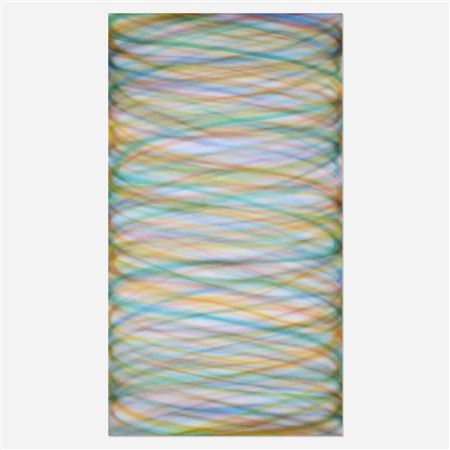
In 1967, making the move from figuration to abstraction, he began using spray guns to draw colorful stacks, loops and lines on his paintings, an original style that earned him instant notice and a solo exhibition at the Andre Emmerich Gallery, the first of dozens of such shows in his career.
In 1969, he picked up a squeegee and created geometric "plaid" paintings, such as Lisa's Red, one of the prominent works featured in "Dan Christensen: Forty Years of Painting," an exhibition of more than 30 of his works from 1966 to 2006 on view at Sheldon Museum of Art through Jan. 31.
By the 1970s and throughout the '80s, Christensen was an acclaimed painter, at least in New York.
"He was highly regarded in New York, probably not so much out here," Jacobshagen said. "I don't know how many people even knew who he was out here in the '70s and '80s. Probably nobody."
Now, as the exhibition indicates, Christensen is highly regarded everywhere. Artforum magazine listed the show as one of the top offerings at museums this summer, when it was at Kansas City's Kemper Museum of Contemporary Art. Christensen's paintings are widely held by museums and collectors.
"He could have been better recognized earlier," Kennedy said. "Today I feel like he's gotten some credit for his perseverance."
Kennedy, who researched Christensen's early life and work for an essay in the exhibition catalog, said there is a direct connection between Christensen and Sheldon architect Philip Johnson. "Philip Johnson was one of the first people to give Christensen support," she said. "He bought paintings. He gave one to Sheldon and another piece was given to the Museum of Modern Art. They're both in the show."
Long associated with color field painting, Christensen's lyrical abstraction is distinctly personal, an expression made through use of line and color.
Pressed about the meaning of his work, Christensen coined or borrowed the term "the harmonious turbulence of the universe," turning the saying into a mantra, according to Douglas Drake, a veteran Kansas City art dealer writing in the retrospective catalog. That "harmonious turbulence" came out of an improvisational, exploratory approach to the work.
"You have to surprise yourself," Christensen told Drake. "If the surprise holds up, maybe you've got something."Biography from the Archives of askART
 The following was written and compiled by Jean Ershler Schatz, artist and researcher from Laguna Woods, California:Dan Christensen was born in Lexington, Nebraska in 1942. He was raised in North Platte; he attended Chadron State College and he graduated from the Kansas City Art Institute with a Bachelor of Fine Arts degree in 1964. He taught at the School of Visual Arts from 1978 to 1982. He is the winner of many grants and fellowships.
Primarily an abstract painter, Christensen has greatly varied his style. His paintings have employed a variety of tools, including spray guns, trowels and squeegies. The constant in his art is the importance of color and his work shows a continual exploration of the possibilities of color.
Sources include:
Who's Who in American Art, 1993-4
American Artists, Les Krantz, PublisherBiography from Spanierman Gallery (retired)
Among America's leading abstract artists, Dan Christensen was devoted over the course of forty years to exploring the limits, range, and possibilities of paint and pictorial form. Although his art belongs within the category defined by the influential art critic Clement Greenberg as Color Field or Post-Painterly Abstraction, he both carried on the legacy of this approach while stepping outside of it, through drawing from a wide variety of Modernist sources, using many idiosyncratic techniques, and employing methods more commonly associated with the action painting techniques of Abstract Expressionism. The result is a distinctive body of artwork that is original, surprising, and filled with joy, exuberance, and pleasure in the act of painting.
Born in Cozad, Nebraska, in 1942, the son of a farmer and truck driver, Dan Christensen chose to become an artist when, as a teenager, he saw the work of Jackson Pollock on a trip to Denver. After receiving his B.F.A. from the Kansas City Art Institute, Missouri, in 1964, he moved to New York City. His "spray loop" paintings, produced by using a spray paint gun, were a fascinating embodiment of the reductive abstract tendencies in 1960s American art, and of the interest of the time in innovative applications of new techniques.
With their powerful ribbon-like configurations, and shimmering allover surface effects, these works won the attention of Greenberg, who became an enthusiastic supporter of Christensen's art. Dan Christensen had his first solo exhibition in New York in 1967. Two years later he was given his first one-person show at the Andre Emmerich Gallery, joining this important showcase for color-field painting, where works by artists such as Kenneth Noland, Jules Olitski, and Helen Frankenthaler were also shown.
Christensen soon started to be invited to participate in major museum shows, including the Whitney Annuals in New York and the Corcoran Gallery's Biennials, in Washington, D.C. From the 1970s until his death in 2007, Dan Christensen was unrelenting in his exploration of new techniques as well as in his return in new ways to treat forms that had held his attention in the past.
In 2001 the unique approach to line and shape of Dan Christensen was highlighted in the survey of his art held at the Butler Institute of American Art, Youngstown, Ohio. He received several awards, including a National Endowment Grant, 1968, a Guggenheim Fellowship Theodoran Award, 1969, a Gottlieb Foundation Grant, 1986, and a Pollock-Krasner Foundation Grant, 1992.
Christensen's art is included in many important public collections, including The Butler Institute of American Art, Youngstown, Ohio; Eversen Museum of Art, Syracuse, New York; the Albrecht Art Gallery, St. Joseph, Missouri; the Albright-Knox Gallery, Buffalo, New York; the Museum of Fine Arts, Boston; the Art Institute of Chicago; the Dayton Art Institute, Ohio; the Denver Museum of Art; the Edmonton Art Gallery, Alberta, Canada; the Fine Arts Museums of San Francisco; the Greenville County Museum of Art, South Carolina; the Solomon R. Guggenheim Museum, New York; the High Museum, Atlanta, Georgia; the Hirshhorn Museum and Sculpture Garden, Washington, D.C.; the Houston Museum of Fine Arts, Texas; Indianapolis Museum of Art; the Johnson Museum of Art, Cornell University, Ithaca, New York; the Kemper Museum of Contemporary Art, Kansas City, Missouri; the Ludwig Collection in the Wallraf-Richartz Museum, Cologne, Germany; the Metropolitan Museum of Art, New York; the Museum of Art, Fort Lauderdale, Florida; the Museum of Contemporary Art, Chicago; the Museum of Modern Art, New York; Nelson-Atkins Museum, Kansas City, Missouri; the Robert Rowan Collection, Pasadena, California; St. Louis Art Museum, Missouri; the Seattle Art Museum, Washington; the Sheldon Memorial Art Gallery, University of Nebraska, Lincoln; the Telfair Museum of Art, Savannah, Georgia; the Toledo Museum, Ohio; and the Whitney Museum of American Art, New York.
Dan Christensen, who began visiting eastern Long Island in the 1960s, lived as an artist in East Hampton until his death in 2007.
RC/ LNP
©The essay herein is the property of Spanierman Gallery LLC and is copyrighted by Spanierman Gallery LLC and may not be reproduced in whole or in part, without written permission from Spanierman Gallery LLC nor shown or communicated to anyone without due credit being given to Spanierman Gallery LLC.Biography from LewAllen Galleries
 With work in many leading American museums and private collections, Dan Christensen is well known as a color abstractionist. The New York critic Clement Greenberg described him in 1990 as "one of the painters on whom the course of American art depends." Greenberg viewed Christensen as an exemplar of "post-painterly abstraction"—a term he coined for the movement that followed Abstract Expressionism in modernist progress towards what Greenberg regarded as an ultimate "pure art" that would eschew subject matter, spatial illusion and an artist's expressive persona in favor of revealing the "truthfulness" of the canvas.
Never departing from his dedication to the medium of paint, Christensen was at the center of many of the more important developments, innovations and currents in American abstract painting after the mid-20th century. Starting in the '60s, he used spray guns to draw colorful acrylic stacks, loops and lines on canvas. These "ribbon" and "loop" paintings were among the more original abstract paintings of the decade.
In the '70s, he picked up a squeegee to create a series referred to as his "plaid" paintings and, later, a series of all-over paintings with off-white or near-black top layers known as the "slab" paintings. In the '80s, he began using spray again, both over and under a layer of thick paint he scored with expressive marks and reveals. Late in the decade he began a new series of "loop" paintings, eventually settling on a centered, circular motif.
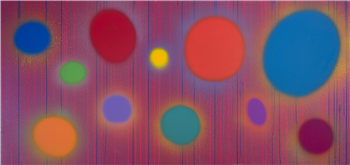
In the '90s, he created vibrant variations on this motif, with stacked orbs and oblique ovals hovering on brushed or dripped painterly fields of electric and often luminescent color. These "circle" paintings are among the most celebrated paintings of his career.
By the early years of this century, he was resuming some of his trademark motifs. Loops and curved lines reappeared but in the form of dribbled, interlaced arabesques of radiant color on a white, black or brightly colored ground. Many viewers regard his most recent paintings as having a sense of the free energy and joyful confidence Christensen retained at what would be the premature end of his painting life.
Dan Christensen was born in Cozad, Nebraska, in 1942, and received his BFA in 1964 from the Kansas City Art Institute. He began exhibiting in New York City in 1966 and achieved success at an early age—he was in two Whitney Biennials before the age of 26. He won numerous awards, including a National Endowment Grant in 1968 and the Guggenheim Fellowship Theodora Award in 1969.
His work appeared in more than 60 solo exhibitions and hundreds of important group shows; and each turn in his creative path drew the attention of critics in publications.
Christensen's paintings are in such institutions as the Guggenheim, the Whitney Museum of American Art, the Metropolitan Museum of Art and the Museum of Modern Art in New York; the Albright-Knox Gallery; the Hirshhorn Museum of the Smithsonian Institution; the Butler Institute of American Art; the Chicago Art Institute; the Houston Museum of Fine Arts; the Seattle Art Museum; and the Fine Arts Museum of San Francisco, among many others.
An iconic modernist painter of the late 20th century, Dan Christensen died at home in East Hampton, New York, on January 20, 2007.Biography from Boca Raton Museum of Art
Dan Christensen's abstract paintings first came to national prominence in the 1960s, and since then, his elusive and often difficult-to-grasp work has continued to explore the multiple legacies of Color Field painting - a school of abstract painting developed in the late 1940s and early 1950s in which the entire canvas typically consisted of large expanses of unmodulated color.
Since the 1960s, Christensen has explored compositions with looping ribbons of spray-painted color and/or floating geometric abstract shapes. Built up in varying textures and activated by vibrant color, Christensen's work over the years has made reference to Jackson Pollock's allover webs of abstract patterns while exploring a simpler, more minimalist approach in keeping with what art critic Clement Greenberg called "post-painterly abstraction." By the 1990s, circular and centering images began to appear in the work, and Christensen's linear "ribbons" and post-"post painterly" abstract color shapes reached a balance in which drawing and painting shared equally in importance.
Holiday in Blue, from 1993, crystallizes the polarities that have come to characterize Christensen's unique vision: light, dark; line, shape; and the appropriation of sometimes painterly forms, sometimes more linear compositions.
Christensen received his BFA in 1964 from the Kansas City Art Institute, and has won numerous awards including a National Endowment Grant (1968) and a Guggenheim Fellowship (1969). His paintings are a part of major national and international museum collections such as the Chicago Art Institute, the Hirshhorn Museum, Washington DC, the Whitney Museum of American Art, the Guggenheim and the Metropolitan Museum of Art, New York City.
By The Boca Raton Museum of Art
Catalina Torres (Intern)Biography from Modern Art Dealers
Dan Christensen was an American abstract artist. An art critic, Clement Greenberg, described Dan Christensen’s art as Color Field or Post-Painterly Abstraction. One of the American leading abstract artists, Dan Christensen art was expressed through the use of both line and color. But apart from being abstract, Dan Christensen art and paintings offer a wide variety of styles, including modernism.
Inspired by the artwork of Jackson Pollock at an early age, artist Dan Christensen spent 40 years painting. And not only painting, but exploring everything connected to the art of painting. As a result, Dan Christensen art and paintings were original, joyful and surprising. He was innovative at the time when painting was dead. He was also a truly dedicated artist and his work meant a lot to him. Dan Christensen artist and painter, came up with the term “the harmonious turbulence of the universe”. This turbulence came from his exploratory approach to creating artwork.
Artist Dan Christensen was born in Cozad, Nebraska, in 1942. He graduated from high school in North Platte, and later attended Chadron State College in the late 1950s, where his artistic talent was first recognized by his professors. He transferred to the Kansas City Art Institute, where he graduated as class valedictorian in 1964.
In 1964, artist Dan Christensen moved to New York, where he worked at various jobs – as a bartender, carpenter and many other things, while starting his career as an artist. It happened then and there that Dan Christensen art was influenced by the city and the art world of New York.
In 1967, Dan Christensen art made the move from figuration to abstract painting. He started producing paintings with a spray gun, giving them the definition of abstract and original. He drew loops, lines and colorful stacks on his paintings, which made his art instantly noticeable and got him his first artwork exhibition at the Andre Emmerich Gallery.
Two years later, in 1969, Dan Christensen art took a new course. He started creating geometric “plaid” paintings, and had a first one-person show at the same Andre Emmerich Gallery, along with the prominent Kenneth Noland, Jules Olitski and Helen Frankenthaler. One of Dan Christensen most famous paintings, Lisa’s Red is from this period. This painting was included in an exhibition of his work from 1966 to 2006. The exhibition was held at Sheldon Museum and was titled “Dan Christensen: Forty Years of Painting”.
In the 1970s and 80s, artist Dan Christensen was exploring new techniques. At that time, Dan Christensen was already an acclaimed artist in New York. But as Jacobshagen said, outside New York, probably nobody knew him. Keith Jacobshagen, a Lincoln painter, had a good feeling about Dan Christensen’s artistic talent from the very first beginning of his career as an artist. He was at the Kansas City Art Institute with Christensen in the early 1960s and said – “He had a real nice sense of skill and of touch. He was painting figuratively at that time. It wasn’t until Dan Christensen moved to New York and was influenced by the city and the New York art world that he started painting abstraction.”
Along with Jacobshagen, Kennedy, the curator of Sheldon Museum of Art supported Dan Christensen’s art. He described artist Dan Christensen as innovative and a really dedicated artist. Both of them consider that no one but Dan Christensen managed to gain a national reputation at that time, and no one but he was supposed to. But before them, there was an architect, Philip Jonson, who supported his art from his early steps. He bought some Dan Christensen art and even gave one painting to the Museum of Modern Art.
Fifty years later, in the 2000s, Dan Christensen is the most noted Nebraska native artist of his era, and a highly regarded artist and painter. Artist Dan Christensen’s unique approach to line and shape was even researched at the Butler Institute of American Art, Ohio. Dan Christensen art is now highly regarded everywhere. His paintings are highly collectible and widely held by both art collectors and museums. It can now be difficult to find Dan Christensen art for sale, and Kennedy, the curator of the Sheldon Museum of Art, claims that Dan Christensen should have been recognized much earlier.
Artist Dan Christensen spent his whole life creating art. From the 1970s to the very end of his life he was exploring new art and painting techniques.
Dan Christensen spent the end of his life in East Hampton. He died in 2007, but Dan Christensen art is now more alive than ever. The collectors are buying his art and the exhibitions of his work are being held around the USA.
Dan Christensen Art Awards & Grants:
National Endowment Grant, 1968
Guggenheim Fellowship Theodoran Award, 1969
Gottlieb Foundation Grant, 1986
Pollock-Krasner Foundation Grant, 1992
Dan Christensen Artwork in Public Collections:
The Butler Institute of American Art; Youngstown, Ohio
Eversen Museum of Art; Syracuse, New York
Museum of Fine Arts, Boston
Art Institute of Chicago
Dayton Art Institute; Ohio
Denver Museum of Art
Edmonton Art Gallery; Alberta, Canada
Fine Arts Museums of San Francisco
Greenville County Museum of Art; South Carolina
Solomon R. Guggenheim Museum; New York
The High Museum; Atlanta, Georgia
Hirshhorn Museum and Sculpture Garden; Washington, D.C.
Houston Museum of Fine Arts; Texas
Indianapolis Museum of Art
Johnson Museum of Art – Cornell University; Ithaca, New York
Kemper Museum of Contemporary Art; Kansas City, Missouri
Metropolitan Museum of Art; New York
Museum of Art; Fort Lauderdale, Florida
Museum of Contemporary Art; Chicago
Museum of Modern Art; New York
The Robert Rowan Collection; Pasadena, California
St. Louis Art Museum; Missouri
The Seattle Art Museum; Washington
The Toledo Museum; Ohio
Addison Gallery of American Art; Andover, Massachusetts
Smith College Museum of Art; Northampton, Massachusetts
Mead Art Museum, Amherst College; Massachusetts
Whitney Museum of American Art; New York