Page loaded successfully. Showing biography for Daniel Seiter.
Daniel Seiter BIOGRAPHY
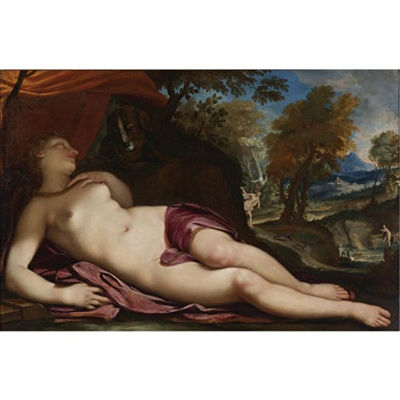
1649 Vienna, Austria - 1705 Turin, Italy. Known for: Baroque style religious painting, pen and ink drawing.
Daniel Seiter was born in 1649. He was an Austrian by birth who entirely adopted the Italian manner and lifestyle during his lifelong stay in Venice, Rome, and Turin, where he created important works... Read full biography
Daniel Seiter was born in 1649. He was an Austrian by birth who entirely adopted the Italian manner and lifestyle during his lifelong stay in Venice, Rome, and Turin, where he created important works and was considered an Italian painter.) . Daniel Seiter had left Vienna for Venice after a duel,... Read full biography
Daniel Seiter was born in 1649. He was an Austrian by birth who entirely adopted the Italian manner and lifestyle during his lifelong stay in Venice, Rome, and Turin, where he created important works and was considered an Italian painter.) . Daniel Seiter had left Vienna for Venice after a duel, and he became a student of Johann Carl Loth. Later on, Seiter went to Rome, where he was apprenticed to Carlo Maratta and became a member of the Accademia di San Luca. In 1688, he was called to Turin by... Read full biography
Daniel Seiter was born in 1649. He was an Austrian by birth who entirely adopted the Italian manner and lifestyle during his lifelong stay in Venice, Rome, and Turin, where he created important works and was considered an Italian painter.) . Daniel Seiter had left Vienna for Venice after a duel, and he became a student of Johann Carl Loth. Later on, Seiter went to Rome, where he was apprenticed to Carlo Maratta and became a member of the Accademia di San Luca. In 1688, he was called to Turin by Vittorio Amedeo II; who appointed him Knight of the Order of Saints Mauritius and Lazarus and first court and chamber painter. In spite of the artist's Austrian origins, Seiter's work shows few specifically German traits. His art is rooted in the... Read full biography
Daniel Seiter was born in 1649. He was an Austrian by birth who entirely adopted the Italian manner and lifestyle during his lifelong stay in Venice, Rome, and Turin, where he created important works and was considered an Italian painter.) . Daniel Seiter had left Vienna for Venice after a duel, and he became a student of Johann Carl Loth. Later on, Seiter went to Rome, where he was apprenticed to Carlo Maratta and became a member of the Accademia di San Luca. In 1688, he was called to Turin by Vittorio Amedeo II; who appointed him Knight of the Order of Saints Mauritius and Lazarus and first court and chamber painter. In spite of the artist's Austrian origins, Seiter's work shows few specifically German traits. His art is rooted in the Venetian tradition, imparted to him by Loth, whose generous and dynamic compositions, broad painterly treatment, and effective colour... Read full biography
Artist Biography
Biography page for Daniel Seiter ((1649 - 1705)), known for Baroque style religious painting, pen and ink drawing. Showing 2 biographical entries and 0 sample artworks.
Daniel Seiter - Artist Info
About Daniel Seiter
Name variants
Daniel Salter, Daniel Seyter
Biography from the Archives of askART
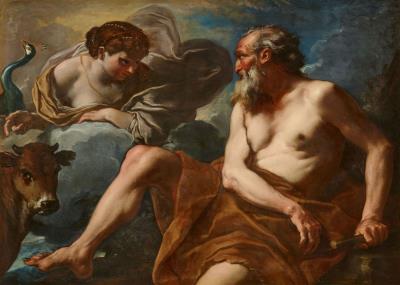 Daniel Seiter was born in 1649. He was an Austrian by birth who entirely adopted the Italian manner and lifestyle during his lifelong stay in Venice, Rome, and Turin, where he created important works and was considered an Italian painter.)
Daniel Seiter had left Vienna for Venice after a duel, and he became a student of Johann Carl Loth. Later on, Seiter went to Rome, where he was apprenticed to Carlo Maratta and became a member of the Accademia di San Luca. In 1688, he was called to Turin by Vittorio Amedeo II; who appointed him Knight of the Order of Saints Mauritius and Lazarus and first court and chamber painter.
In spite of the artist's Austrian origins, Seiter's work shows few specifically German traits. His art is rooted in the Venetian tradition, imparted to him by Loth, whose generous and dynamic compositions, broad painterly treatment, and effective colours he adopted. Works by Daniel Seiter are to be found in Roman churches, in Trento, in the Palazzo Reale in Turin, in Venice, and in numerous major museums, such as in Berlin, Braunschweig, Avignon, Bamberg, Dresden, Düsseldorf, Marseille, and Munich.
Many of his drawings are characterized by spontaneous and fluent use of pen and ink within the context of a complete composition, bordered by pen and ink framing lines. Many of the artist's drawings are also enriched by generous white heightening to contrast with the background of the colored paper; see, for example three such drawings in the Royal Collection at Windsor Castle.
Although born in Vienna, Daniel Seiter passed his whole professional life in Italy, and is widely regarded as an Italian artist.
He has large group of representations of Biblical and mythological figures. They are always conceived as half-length or three-quarter figures which fill the picture space and are embedded within a powerful tenebroso. Confirmation of the authenticity of this painting is based on the great stylistic quality of execution. This includes the use of light, which is characterised by a powerful contrast of light and dark, although the passages from light to shadow are extraordinarily subtle being rendered in a painterly fashion.
Corresponding with this is the application of paint which is markedly impasto and laid down with a broad brush. This results in a very pasty, somewhat fleshy casting of faces and body parts. Characteristic of the artist's work is the balanced contrast with powerfully rendered drapery. Also typical is the simple colour palette, limited to blue and red, the subtle gradation of which is achieved by the light-dark contrasts.
Source:
DorotheumBiography from the Archives of askART
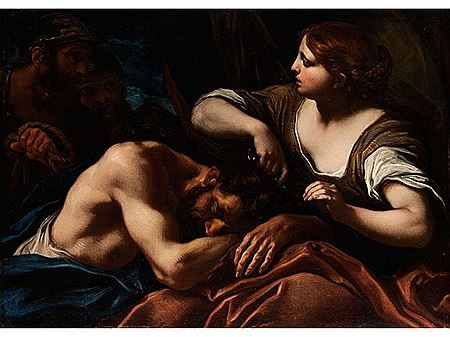 Daniel Seiter, Saiter, or Seyter (c.1642/1647–1705) was a Viennese-born painter of the Baroque, who trained and worked in Italy/ According to Arnold Houbraken, Seiter was born on the border of Switzerland and brought up in Vienna. It is unknown who his first teacher was, but as a young man he crossed the alps to Venice, where he apprenticed with Johann Carl Loth. He copied his style so well, that even at the time Houbraken was writing (1718), it was impossible to tell whether a painting was by him or Lott.
Seiter then moved to Rome to work in the studio of Carlo Maratta, and while there, he joined the Bentvueghels and received the bent nickname of Morgenstar. His Martyrdom of St Catherine (1685) and Martyrdom of St Lawrence remained on its original place, the side walls of the vestibule of the Cybo Chapel in Santa Maria del Popolo.
Becoming successful in Rome, he married a bookseller's daughter and won a lucrative commission from Charles Emmanuel II, Duke of Savoy. The Duke's son Victor Amadeus II of Sardinia commissioned him in turn to decorate the Royal Palace of Turin in 1675, when he became duke after his father died. He liked Seiter's work so much that he knighted him. Today there is still a gallery there named after him. He also helped decorate in fresco the cupola of the chapel of the Ospedale Maggiore.
Seiter also followed Victor Amadeus on his travels, and painted in Brunswick and Dresden.
In his biography of Seiter, Houbraken tells a curious anecdote about the Duke and Seiter, saying that Seiter was given a walking cane with diamonds on the head of it, to use as a maulstick to rest his hand on while painting. This story was told to him by a painter named Le Blon. When Seiter was done painting he tried to give it back, but the Duke's guard told him to keep it as a token of regard. A similar expensive gift (it was solid gold) was given to Daniel Seghers by Frederick Henry, Prince of Orange in exchange for a garland painting that hangs today in the Mauritshuis museum.
Though details of his career are sketchy, Seiter became a painter for the Dukes of Savoy much later than 1655, and thus was not a witness to his patron's murderous massacre of the Vaudois, which the poet John Milton memorialized in his On the Late Massacre in Piedmont.
Seiter died in Turin, Italy.
Source:
"Daniel Seiter," Wikipedia, Web, Feb. 6, 2016