Page loaded successfully. Showing biography for Daniel Walbidi.
Daniel Walbidi BIOGRAPHY
Born 1983. Known for: Aboriginal art.
Daniel Walbidi (b. 1983). 'I paint to educate people about my culture and our history, and where we come from, so to give people understanding. I also paint so I can learn about my culture from the... Read full biography
Daniel Walbidi (b. 1983). 'I paint to educate people about my culture and our history, and where we come from, so to give people understanding. I also paint so I can learn about my culture from the old people. It is important for me to paint so I can keep my culture strong and living so it can be... Read full biography
Daniel Walbidi (b. 1983). 'I paint to educate people about my culture and our history, and where we come from, so to give people understanding. I also paint so I can learn about my culture from the old people. It is important for me to paint so I can keep my culture strong and living so it can be carried on into the future.'1 . Walbidi's parents migrated from their traditional country in the Great Sandy Desert after a widespread drought during the 1960s dramatically altered the landscape. As... Read full biography
Daniel Walbidi (b. 1983). 'I paint to educate people about my culture and our history, and where we come from, so to give people understanding. I also paint so I can learn about my culture from the old people. It is important for me to paint so I can keep my culture strong and living so it can be carried on into the future.'1 . Walbidi's parents migrated from their traditional country in the Great Sandy Desert after a widespread drought during the 1960s dramatically altered the landscape. As lakes and rock pools completely desiccated, many Aboriginal people moved from the desert to Bidyadanga or La Grange Mission, a coastal community south of Broome. Having spent his entire life in Bidyadanga, Walbidi grew up listening to the Dreaming... Read full biography
Daniel Walbidi (b. 1983). 'I paint to educate people about my culture and our history, and where we come from, so to give people understanding. I also paint so I can learn about my culture from the old people. It is important for me to paint so I can keep my culture strong and living so it can be carried on into the future.'1 . Walbidi's parents migrated from their traditional country in the Great Sandy Desert after a widespread drought during the 1960s dramatically altered the landscape. As lakes and rock pools completely desiccated, many Aboriginal people moved from the desert to Bidyadanga or La Grange Mission, a coastal community south of Broome. Having spent his entire life in Bidyadanga, Walbidi grew up listening to the Dreaming stories from his traditional lands, an unknown and foreign place that he had never la... Read full biography
Artist Biography
Biography page for Daniel Walbidi ((Born 1983)), known for Aboriginal art. Showing 1 biographical entries and 0 sample artworks.
Daniel Walbidi - Artist Info
About Daniel Walbidi
Biography from Deutscher and Hackett Melbourne
Daniel Walbidi (b. 1983)
'I paint to educate people about my culture and our history, and where we come from, so to give people understanding. I also paint so I can learn about my culture from the old people. It is important for me to paint so I can keep my culture strong and living so it can be carried on into the future.'1
Walbidi's parents migrated from their traditional country in the Great Sandy Desert after a widespread drought during the 1960s dramatically altered the landscape. As lakes and rock pools completely desiccated, many Aboriginal people moved from the desert to Bidyadanga or La Grange Mission, a coastal community south of Broome. Having spent his entire life in Bidyadanga, Walbidi grew up listening to the Dreaming stories from his traditional lands, an unknown and foreign place that he had never laid eyes upon. Drawn to these tales, Walbidi's imagination ran wild with images of the desert, providing inspiration for his artistic practice.
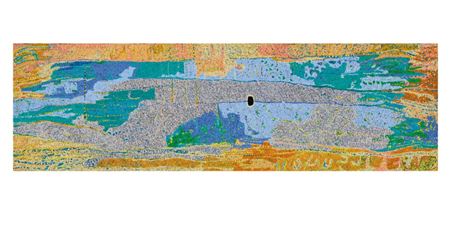
At the young age of 16, Walbidi was keenly aware of the cultural displacement of his people. He approached Short Street Gallery in Broome in the hope that an artistic community could be established, reviving the tradition and heritage of his people. For the first time, a generation of elders worked with modern art materials, resulting in the Bidyadanga art movement.2 It was in 2007 that Walbidi first encountered his traditional lands around Winpa and Kirriwirri on a trip with senior artists, including his father. Deeply inspired, it was this significant trip that marked the transition in Walbidi's career, evident in works like Kirriwirri. Walbidi immediately began to paint with a tighter composition and with blocks of bright patchwork colors that simultaneously explored his traditional and adopted lands; the desert and the coast. '... colors compressed to such an extent that the energy bursts off the canvas'.3
Francesca Cubillo examines four important works titled Kirriwirri that featured in the 2nd National Indigenous Art Triennial, unDisclosed: 'Walbidi's early paintings are panoramas of his Country seen from afar. Viewed from a distance, the painted forms appear large and merge one into another. Walbidi's recent experiences revealed to him the wondrous details of his Country, which he incorporates into his paintings today.'4
1. Walbidi, cited in Cubillo, F., 'Daniel Walbidi,' in unDisclosed: 2nd National Indigenous Art Triennial, Lane, C., and Cubillo, F., (eds), National Gallery of Australia, Canberra, 2012, p. 122
2. Rohr, E., 'Bidyadanga', in Beyond Sacred: Australian Aboriginal Art, The Collection of Colin and Elizabeth Laverty, Kleimeyer Industries, Melbourne, 2011, p. 160
3. Cubillo, F., 'Daniel Walbidi,' in unDisclosed: 2nd National Indigenous Art Triennial, Lane, C., and Cubillo, F., (eds), National Gallery of Australia, Canberra, 2012, p. 124 4. ibid.