Page loaded successfully. Showing biography for Daro Flood.
Daro Flood BIOGRAPHY
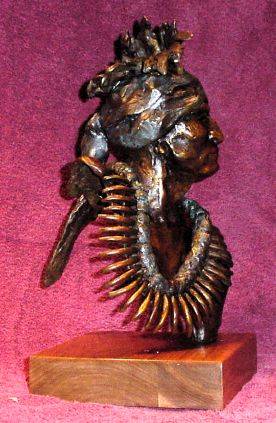
1954 - 2017 Wilson, Wyoming. Known for: Portrait bust Indian and cowboy sculpture.
Daro Flood was a jeweler who made the decision to fully dedicate himself to realist sculpture. His studio is in Arizona, and he derives his subject matter from personal experiences depicting the... Read full biography
Daro Flood was a jeweler who made the decision to fully dedicate himself to realist sculpture. His studio is in Arizona, and he derives his subject matter from personal experiences depicting the people and places with which he has had contact. American Indians of the western United States are a... Read full biography
Daro Flood was a jeweler who made the decision to fully dedicate himself to realist sculpture. His studio is in Arizona, and he derives his subject matter from personal experiences depicting the people and places with which he has had contact. American Indians of the western United States are a favorite subject, and he has received commissions for public art. Source:. www.lakesart.org/va/collections/pearson/flood.htm... Read full biography
Daro Flood was a jeweler who made the decision to fully dedicate himself to realist sculpture. His studio is in Arizona, and he derives his subject matter from personal experiences depicting the people and places with which he has had contact. American Indians of the western United States are a favorite subject, and he has received commissions for public art. Source:. www.lakesart.org/va/collections/pearson/flood.htm... Read full biography
Daro Flood was a jeweler who made the decision to fully dedicate himself to realist sculpture. His studio is in Arizona, and he derives his subject matter from personal experiences depicting the people and places with which he has had contact. American Indians of the western United States are a favorite subject, and he has received commissions for public art. Source:. www.lakesart.org/va/collections/pearson/flood.htm... Read full biography
Artist Biography
Biography page for Daro Flood ((1954 - 2017)), known for Portrait bust Indian and cowboy sculpture. Showing 3 biographical entries and 0 sample artworks.
Daro Flood - Artist Info
About Daro Flood
Biography from the Archives of askART
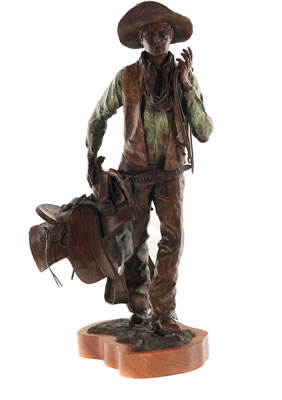 Daro Flood was a jeweler who made the decision to fully dedicate himself to realist sculpture. His studio is in Arizona, and he derives his subject matter from personal experiences depicting the people and places with which he has had contact.
American Indians of the western United States are a favorite subject, and he has received commissions for public art.
Source:
www.lakesart.org/va/collections/pearson/flood.htmBiography from Booth Western Art Museum
Longtime Jackson resident Daro M. Flood died Dec. 23, 2018 at his home in Jackson. He was 63.
His family and friends provided the following. Daro Flood was born Aug. 24, 1954, to Dick Flood Sr. and Geraldine Flood, in Jackson Hole, WY. His older brother was Dick Flood II. After finishing high school in Scottsdale, Arizona, Daro was appointed conservator of the museum collections of the Alaska State Museum in Juneau, Alaska. Art was a mainstay of Daro’s life. His father opened the first art gallery in Jackson, Trailside Gallery, and his brother owned Main Trail Gallery. Daro himself was best known for his sculptures and paintings, but was hailed as a multitalented artist.
Two longtime friends offered the following words on Daro:
“Daro is a very special person. In my 50-plus years of being with and working with very creative people, including accomplished artists, versatile artisans and highly capable craftsman, I have never known anyone who mastered so many aspects of all those endeavors. He truly was a many-faceted, amazingly capable artist, artisan and craftsman all rolled into one. He spent his whole life learning and mastering skills that for the most part are rarely mastered by very many people nowadays. He is the only person I have ever met that I would truly call a Renaissance Man — with capital letters.
He was ‘a man apart’ in terms of modern society, but in a good way. He had great skills with his hands, but he also had the closest thing these days to a 19th century sensibility about nature and the natural world around him. He knew and understood things that few modern people do. He was one of the few people I have ever known that could be dropped into the middle of the wilderness and make do for himself just fine. His great excitement and enthusiasm for making things was infectious and marvelous. I’m all the sadder that I was not able to spend more time with him. I will miss him always.”
— Patrick Stewart, former senior curator at Amon Carter Museum of American Art in Fort Worth, Texas.
“I have known Daro Flood since he was a gleam in his dad’s eye. I remember some of his early art ventures — kindergarten stuff — but already showing promise of talent far above the norm. By the time that I became deeply involved in the Montana Historical Society and was editing “Montana: the Magazine of Western History,” [a state] where the Flood family were frequent visitors, I had no doubt that Daro someday would become ‘the closest counterpart to C.M. Russell in 20th century Western art.’
In 1972 Daro, age 18, came to live with our family in Juneau, Alaska, where I was director of the Alaska State Museum. Even though our families had been friends for many, many moons, his was not a social visit. Against the advice of my curatorial staff, Daro was hired as a special conservator, entrusted with some of our most priceless but deteriorating ancient Eskimo ivory and Aleut artifacts. Daro demonstrated that he could restore ivory, wood, skin-sewing, basketry and literally anything that ancient man had created since the first hunters of the hairy mammoth and the saber-toothed tiger began crossing the Bering Sea land bridge to populate the American continent.
In less than a year Daro accomplished a conservation miracle. He literally ‘saved for posterity’ some of Alaska’s most priceless and irreplaceable cultural objects — Old Bering Sea and Punuk-period ivory art, Aleut headdresses, harpoons and utensils, ancient Athapascan quill-work and birchbark objects, priceless Tlingit, Haida and Copper River Indian artifacts, which could be exhibited in the museum displays and archaeological and anthropological study collection for the first time. From that time on, Daro to me was the re-creation of “Kid” Russell. Now, though his magnificent sculpture, he reveals that promise.
In my judgement Daro is the best Western sculptor of any I have known in the past 50 years, including Remington, Proctor, Borglum and Weaver. Daro Flood, without imitation, comes closest to Charles Marion Russell. His research is impeccable, his skill and technique, like Russell, intuitive and true. He has not yet reached his creative pinnacle. Every time I visit Daro and see his latest creations I see discernible improvement in technical perfection and inspiring artistry. I am not aware of any other contemporary American artist whose work is appreciating at such a pace. The collector who acquires a bronze by Daro Flood not only gains substantially with every passing year in every enhancing value but, even more importantly, with an art form of unimpeachable integrity and joy to behold now and forever.”
— Michael Stephen Kennedy, former state historian for Alaska. Kennedy wrote this letter about Daro in the 1970s.
Daro is survived by his wife of 34 years, Teresa Arliskas Flood, they visited Daro’s hometown every summer, and eventually relocated to Jackson Hole full time 13 years ago, 2005.
Source: From the obituary on the artist Daro Flood as it ran in the Jackson Hole newspaper on Jan. 2019.
Submitted by: Seth HopkinsBiography from Booth Western Art Museum
Daro Flood
When Daro Flood passed away in 2017, he was immediately hailed by collectors, curators, and fellow artists as a “true Renaissance man,” as someone who, as one curator observed, “had the closest thing these days to a 19th century sensibility about nature and the natural world around him. He knew and understood things that few modern people do. He was one of the few people I have ever known that could be dropped into the middle of the wilderness and make do for himself just fine.”
Daro Flood was born into a world of western art and indigenous artifacts. His father, Dick Flood, was an old-time trader who opened the first art gallery in Jackson, Wyoming. Born and educated in Scottsdale, Arizona, by the age of 18—just out of high school—Daro Flood had mastered so many Native American skills that he was appointed conservator of the museum collections of the Alaska State Museum in Juneau, Alaska where he “literally ‘saved for posterity’ some of Alaska’s most priceless and irreplaceable cultural objects.”
Flood then went on to study sculpture and to create exceptional bronzes of Plains and Northwest Coast Indians, wrapping his impeccable research and knowledge of beadwork, wood and ivory carving, and quill and birchbark around exquisitely rendered physical forms and faces. Flood’s body of work ranks with the finest in the history of American Western bronze.
Source: From the obituary on the artist Daro Flood as it ran in the Jackson Hole newspaper on Jan. 2019.
Source: Seth Hopkins