Page loaded successfully. Showing biography for David Butler.
David Butler BIOGRAPHY
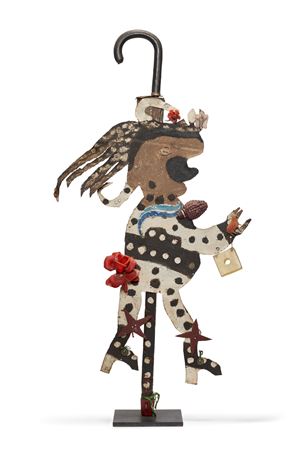
1898 Saint Mary Parish, Louisiana - 1997. Known for: Folk art sculpture, painting, yard art.
David Butler: 1898-1997, lived and worked in Patterson, Louisiana. One of the first recognized stars of Southern African-American yard art, David Butler installed a fantastic tin zoological... Read full biography
David Butler: 1898-1997, lived and worked in Patterson, Louisiana. One of the first recognized stars of Southern African-American yard art, David Butler installed a fantastic tin zoological environment on and outside his home in Patterson, Louisiana, over the course of several decades. Butler... Read full biography
David Butler: 1898-1997, lived and worked in Patterson, Louisiana. One of the first recognized stars of Southern African-American yard art, David Butler installed a fantastic tin zoological environment on and outside his home in Patterson, Louisiana, over the course of several decades. Butler turned to art in middle age, after a work-related injury at a sawmill. But he managed to bridge his private environment and the broader art world, first rising to prominence with the landmark 1982... Read full biography
David Butler: 1898-1997, lived and worked in Patterson, Louisiana. One of the first recognized stars of Southern African-American yard art, David Butler installed a fantastic tin zoological environment on and outside his home in Patterson, Louisiana, over the course of several decades. Butler turned to art in middle age, after a work-related injury at a sawmill. But he managed to bridge his private environment and the broader art world, first rising to prominence with the landmark 1982 exhibition "Black Folk Art in America, 1930-1980" at the Corcoran Gallery, Washington, DC. Only a year later, his yard environment was dismantled when illness required him to move in with family, and Butler's prolific and site-specific practice transformed... Read full biography
David Butler: 1898-1997, lived and worked in Patterson, Louisiana. One of the first recognized stars of Southern African-American yard art, David Butler installed a fantastic tin zoological environment on and outside his home in Patterson, Louisiana, over the course of several decades. Butler turned to art in middle age, after a work-related injury at a sawmill. But he managed to bridge his private environment and the broader art world, first rising to prominence with the landmark 1982 exhibition "Black Folk Art in America, 1930-1980" at the Corcoran Gallery, Washington, DC. Only a year later, his yard environment was dismantled when illness required him to move in with family, and Butler's prolific and site-specific practice transformed into the production of discrete objects intended for sale on the art market. The classic works for which he is known are brightly-c... Read full biography
Artist Biography
Biography page for David Butler ((1898 - 1997)), known for Folk art sculpture, painting, yard art. Showing 3 biographical entries and 0 sample artworks.
David Butler - Artist Info
About David Butler
Biography from the Archives of askART
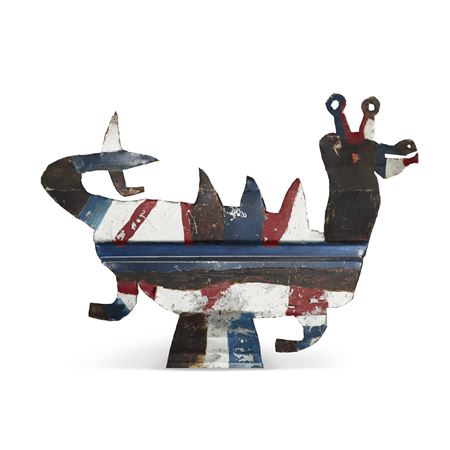 David Butler: 1898-1997, lived and worked in Patterson, Louisiana
One of the first recognized stars of Southern African-American yard art, David Butler installed a fantastic tin zoological environment on and outside his home in Patterson, Louisiana, over the course of several decades. Butler turned to art in middle age, after a work-related injury at a sawmill.
But he managed to bridge his private environment and the broader art world, first rising to prominence with the landmark 1982 exhibition "Black Folk Art in America, 1930-1980" at the Corcoran Gallery, Washington, DC. Only a year later, his yard environment was dismantled when illness required him to move in with family, and Butler's prolific and site-specific practice transformed into the production of discrete objects intended for sale on the art market.
The classic works for which he is known are brightly-colored tin cut-outs, sometimes incorporating found objects, mounted both in windows and on poles and stakes in his yard. Butler constructed a vast menagerie of creatures—which he referred to as "critters"—drawing from Biblical sources and mythological scenes alike.
His mother was a missionary, and religion motivated his artistic vision to a certain extent. In Butler's world, hydras, elephants, bicycles, and Jonah's whale coexist, all rendered in an abstracted, planar geometry. He developed kinetic sculptures in many cases, and a series of spinning "whirligigs," windmills, and weather vanes accompanied his stationary animal pieces.
Bibliography
Books and Exhibition Catalogs:
David Butler. New Orleans, LA: New Orleans Museum of Art, 1976.
The Outside Art of David Butler. Patterson, LA: The Louisiana State Museum, 2011.
Books and Exhibition Catalogs that Include Butler:
Livingston, Jane and John Beardsley. Black Folk Art in America: 1930-1980. Jackson, MS: University Press of Mississippi/Center for the Study of Southern Culture for the Corcoran Gallery of Art, 1982.
Southern Folk Images: David Butler, Henry Speller, Bill Traylor. New Orleans, LA: University of New Orelans, 1984.
A Time to Reap: Late-Blooming Folk Artists. South Orange, NJ: Seton Hall University/Museum of American Folk Art, 1985.
Muffled Voices: Folk Artists in Contemporary America. New York: Museum of American Folk Art, 1986.
Naivety in Art. Tokyo, Japan: Setagaya Art Museum, 1986.
Enisled Visions: the Southern Non-Traditional Folk Artist. Mobile, AL: Fine Arts Museum of the South, 1987.
Outside the Main Stream: Folk Art in Our Time. Atlanta, GA: High Museum of Art, 1988.
Gifted Visions: Contemporary Black American Folk Art. Storrs, CT: Atrium Gallery, University of Connecticut, 1988.
Black Art Ancestral Legacy: The African Impulse in African-American Art. New York, NY: Harry N. Abrams/Dallas Museum of Art, 1989.
Passionate Visions of the American South: Self-Taught Artists from 1940 to the Present. New Orleans, LA: New Orleans Museum of Art, 1993.
Gilman, Deborah Ann. A Study of Four Contemporary Folk Contemporary Untrained Artists from Southern Louisiana. Baton Rouge, LA: Louisiana State University/School of Art, 1993.
Trechsel, Gail Andrews, ed. Pictured in My Mind: Contemporary American Self-Taught Art from the Collection of Kurt Gitter and Alice Rae-Yelen. Birmingham, AL: Birmingham Museum of Art, in association with University Press of Mississippi, 1995.
Russell, Charles, ed. Self-Taught Art: The Culture and Aesthetics of American Vernacular Art. Jackson, MS: University Press of Mississippi, 2001.
Let It Shine: Self-Taught Art from the T. Marshall Hahn Collection. Atlanta, GA: High Museum of Art, in association with the University Press of Mississippi, Jackson, MS, 2001.
Lewis, Samella S. African American Art and Artists. Berkeley and Los Angeles, CA: University of California Press, 2003.
Umberger, Leslie. Sublime Spaces and Visionary Worlds: Built Environments of Vernacular Artists. Sheboygan, WI: John Michael Kohler Arts Center, in association with Princeton Architectural Press, 2007.
Articles:
Lora, Mary Elaine. "The Tin Man." Louisiana Life, May/June 1982, p. 110.
Lewis, Samella. "David Butler." International Review of African American Art 11, no. 1 (1993): p. 30-35.
Perry, Regenia A. "Contemporary African American Folk Art in America: An Overview." International Review of African American Art 11, no. 1 (1993): 4-30.
Selected Group Exhibitions:
Black Folk Art in America: 1930-1980. Corcoran Gallery of Art, Washington, D.C. 1982
J.B. Speed Museum, Louisville, KY, 1982
The Brooklyn Museum, New York, NY, 1982
Craft and Folk Art Museum, Los Angeles, CA, 1982-1983
The Institute for the Arts, Rice University, Houston, TX, 1983.
Solo Exhibitions:
David Butler. New Orleans, LA: New Orleans Museum of Art, 1976.
The Outside Art of David Butler. The Louisiana State Museum, Patterson, LA, 2011.
Museum Collections:
Corcoran Gallery of Art, Washington, D.C.?
The High Museum, Atlanta, GA?
Kohler Arts Center, Sheboygan, WI?
The Museum of American Folk Art, New York, NY?
Museum of International Folk Art, Santa Fe, NM?
New Orleans Museum of Art, New Orleans, LA?
The Smithsonian Institute, Washington, D.C.
Compiled by Samantha Mitchell
Source:
"David Butler," Foundation for Self Taught Artists, //foundationstart.org/artists/david-butler/Biography from the Archives of askART
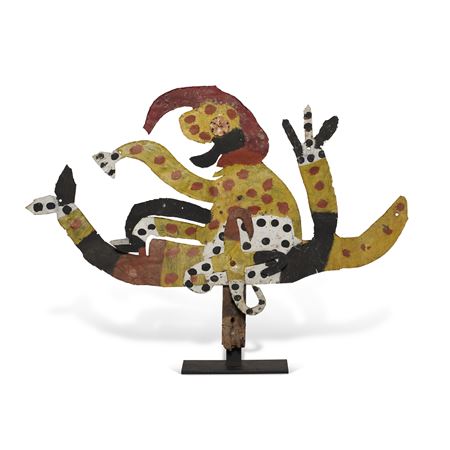 Born in Saint Mary Parish, Louisiana, David Butler settled in Patterson near Morgan City. He was illiterate, and after his retirement from a variety of menial jobs, began creating sculpture and whirligigs from discarded bits of tin. He is called an environmentalist because his art is designed to fit into the space in which he lives and to relate to others in that environment to create a conceptual whole. His small back yard became this environment, and he filled it with decorated creations of secular and Biblical subjects. He carved with tin shears and shaped with a meat cleaver. Many are embellished with found objects.
Although David Butler had drawn and carved all of his life, his career and his artistic output began in earnest in his late forties, following an injury at the sawmill where he worked. Like a number of other Self-Taught artists working in the Southeastern United States, Butler created an elaborate environment for his own enjoyment, filling his rural Louisiana home and yard with elaborate creations made of cut tin, wood, enamel and house paint.
The windows of the house were covered with sheets of tin perforated with patterns that cast elaborate shadows through the interior. Long recognized as an important artist, Butler's work was exhibited by the New Orleans Museum of Art in 1976, and was included in Black Folk Art in America 1930-1980 at the Corcoran Gallery.
Source includes
Christie's New YorkBiography from New Orleans Auction Galleries Inc
An African-American self-taught artist, David Butler was born and raised in St. Mary Parish, of south Louisiana. After his mother's unexpected death, Butler dropped out of school to care for his younger siblings while his father worked as a carpenter. Butler held a variety of jobs including working in sugar cane fields, sawmills and on shrimp boats.A work-related accident in the early 1960s forced Butler to retire, which gave him the time to create sculptures from corrugated tin roofing which he cut, folded and bent, and then enhanced with house paint and found objects. Combining images from his dreams with his religious beliefs instilled in him by his missionary mother, Butler created imaginative sculptures that decorated his home and populated his yard.Butler's whirligig sculptures were kinetic and meant to be displayed outdoors, so that a gust of wind would set them into motion. He decorated his window shades with plastic toys, bicycle reflectors, buttons and assorted found objects that were intended to keep the heat of the day as well as bad spirits from entering his home. As the sunlight passed through the window shades luminous images moved across the floors and walls of the house.