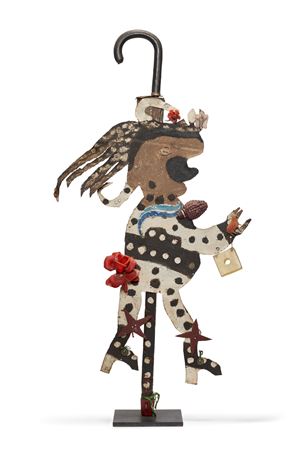
David Butler: 1898-1997, lived and worked in Patterson, Louisiana. One of the first recognized stars of Southern African-American yard art, David Butler installed a fantastic tin zoological... Read full biography
David Butler: 1898-1997, lived and worked in Patterson, Louisiana. One of the first recognized stars of Southern African-American yard art, David Butler installed a fantastic tin zoological environment on and outside his home in Patterson, Louisiana, over the course of several decades. Butler... Read full biography
David Butler: 1898-1997, lived and worked in Patterson, Louisiana. One of the first recognized stars of Southern African-American yard art, David Butler installed a fantastic tin zoological environment on and outside his home in Patterson, Louisiana, over the course of several decades. Butler turned to art in middle age, after a work-related injury at a sawmill. But he managed to bridge his private environment and the broader art world, first rising to prominence with the landmark 1982... Read full biography
David Butler: 1898-1997, lived and worked in Patterson, Louisiana. One of the first recognized stars of Southern African-American yard art, David Butler installed a fantastic tin zoological environment on and outside his home in Patterson, Louisiana, over the course of several decades. Butler turned to art in middle age, after a work-related injury at a sawmill. But he managed to bridge his private environment and the broader art world, first rising to prominence with the landmark 1982 exhibition "Black Folk Art in America, 1930-1980" at the Corcoran Gallery, Washington, DC. Only a year later, his yard environment was dismantled when illness required him to move in with family, and Butler's prolific and site-specific practice transformed... Read full biography
David Butler: 1898-1997, lived and worked in Patterson, Louisiana. One of the first recognized stars of Southern African-American yard art, David Butler installed a fantastic tin zoological environment on and outside his home in Patterson, Louisiana, over the course of several decades. Butler turned to art in middle age, after a work-related injury at a sawmill. But he managed to bridge his private environment and the broader art world, first rising to prominence with the landmark 1982 exhibition "Black Folk Art in America, 1930-1980" at the Corcoran Gallery, Washington, DC. Only a year later, his yard environment was dismantled when illness required him to move in with family, and Butler's prolific and site-specific practice transformed into the production of discrete objects intended for sale on the art market. The classic works for which he is known are brightly-c... Read full biography
David Butler - Artist Info
About David Butler: Books
Books & Publications (9)
Publications based on askART research. List may not be comprehensive.
The Artists Bluebook 34,000 North American Artists to March 2005
2005
AskART.com Inc. - Dunbier, Lonnie Pierson (Editor)
479 pages
Davenport's Art Reference: The Gold Edition
2005
Davenport, Ray
2,421 pages
With an Eye and a Passion: Selections from The Marion Collection
2003
Sherman, Charlotte (Essay)
38 pages (color)
St. James Guide to Black Artists: Published in Association with Schomburg Center for Research in Black Culture
1997
Riggs, Thomas (Editor); Howard Dobson (Preface)
625 pages
A World of Their Own: Twentieth Century American Folk Art (Newark Museum)
1995
Jacobs, Joseph
88 pages (color)
American Self-Taught: Paintings and Drawings by Outsider Artists
1993
Maresca, Frank, Roger Ricco
298 pages (color)
Baking in the Sun Visionary Images from the South (Exhibition catalog)
1987
Nasisse, Andy/M S Wahlman
146 pages (color)
American Folk Art of the Twentieth Century
1983
Johnson, Jay; William Ketchum
342 pages (color)
Black Folk Art in America, 1930-1980 (Corcoran Gallery of Art) (Exhibition catalog)