Page loaded successfully. Showing biography for David Wojnarowicz.
David Wojnarowicz BIOGRAPHY
1954 Red Bank, New Jersey - 1992 New York City. Known for: Funk-modernist figurative imagery.
"Wojnarowicz's work emerged directly from his life. He knew little art history, had no training past high school, and made a point of not trolling the galleries to see what everyone else was doing.... Read full biography
"Wojnarowicz's work emerged directly from his life. He knew little art history, had no training past high school, and made a point of not trolling the galleries to see what everyone else was doing. Exposed to unusual hardship as a boy, as a sexually active teen, and as a street person, he didn't... Read full biography
"Wojnarowicz's work emerged directly from his life. He knew little art history, had no training past high school, and made a point of not trolling the galleries to see what everyone else was doing. Exposed to unusual hardship as a boy, as a sexually active teen, and as a street person, he didn't see his experience reflected in the culture. Art was his antidote. Art was his way of witnessing." . -- C. Carr. Self-taught painter, collagist, photographer and filmmaker David Wojnarowicz was born in... Read full biography
"Wojnarowicz's work emerged directly from his life. He knew little art history, had no training past high school, and made a point of not trolling the galleries to see what everyone else was doing. Exposed to unusual hardship as a boy, as a sexually active teen, and as a street person, he didn't see his experience reflected in the culture. Art was his antidote. Art was his way of witnessing." . -- C. Carr. Self-taught painter, collagist, photographer and filmmaker David Wojnarowicz was born in 1954 in Red Bank, New Jersey, dying prematurely in 1992. A difficult childhood, brought on by an abusive family life and an emerging sense of his own homosexuality, Wojnarowicz dropped out of high school and was living on the streets by the age of... Read full biography
"Wojnarowicz's work emerged directly from his life. He knew little art history, had no training past high school, and made a point of not trolling the galleries to see what everyone else was doing. Exposed to unusual hardship as a boy, as a sexually active teen, and as a street person, he didn't see his experience reflected in the culture. Art was his antidote. Art was his way of witnessing." . -- C. Carr. Self-taught painter, collagist, photographer and filmmaker David Wojnarowicz was born in 1954 in Red Bank, New Jersey, dying prematurely in 1992. A difficult childhood, brought on by an abusive family life and an emerging sense of his own homosexuality, Wojnarowicz dropped out of high school and was living on the streets by the age of sixteen. He turned to hustling in Times Square. After hitchhiking many times across the U.S. and living for several months in San Francisco and P... Read full biography
Artist Biography
Biography page for David Wojnarowicz ((1954 - 1992)), known for Funk-modernist figurative imagery. Showing 1 biographical entries and 0 sample artworks.
David Wojnarowicz - Artist Info
About David Wojnarowicz
Biography from the Archives of askART
 "Wojnarowicz's work emerged directly from his life. He knew little art history, had no training past high school, and made a point of not trolling the galleries to see what everyone else was doing. Exposed to unusual hardship as a boy, as a sexually active teen, and as a street person, he didn't see his experience reflected in the culture. Art was his antidote. Art was his way of witnessing."
-- C. Carr
Self-taught painter, collagist, photographer and filmmaker David Wojnarowicz was born in 1954 in Red Bank, New Jersey, dying prematurely in 1992. A difficult childhood, brought on by an abusive family life and an emerging sense of his own homosexuality, Wojnarowicz dropped out of high school and was living on the streets by the age of sixteen. He turned to hustling in Times Square. After hitchhiking many times across the U.S. and living for several months in San Francisco and Paris, he settled in New York's East Village in 1978.
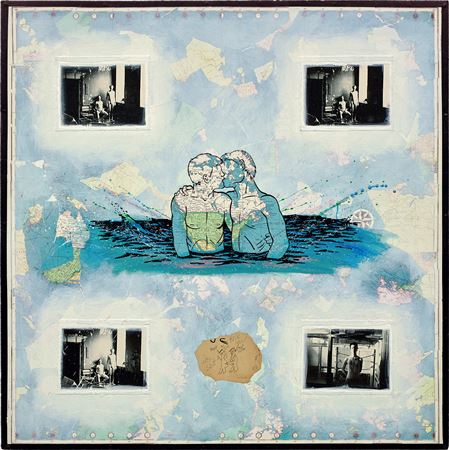
He explored the degradation of modern urban society through his role as painter, collagist, photographer and filmmaker. His collage paintings were like layers of old posters peeling off urban walls. These images were sometimes organized in quadrants or comic strip-like frames. Grocery store posters, world maps, garbage can lids and beach logs were used as the background for acrylics and spray paints, often applied with stencils to create commercial-looking images of violence. His collage methods are rooted by Bay Area assemblagist methods of the 1950s and 1960s practiced by such artists as Jess, Bruce Conner and George Herms.
The artist's subjects included the military in Central America and Vietnam, prison life, the drug culture, street murder and homosexual sadomasochism.
Wojarnowicz also painted on abandoned buildings, piers and cars in lower Manhattan, and was called "the spirit of East Village art." He published several books, including a group of monologues of boys in bus stations entitled Sounds in the Distance. He also made recordings as a member of the musical group called "3 Teens Kill 4 (No Motive)."
A member of the first wave of East Village artists, Wojnarowicz began showing his work during the early 1980s in such spaces as Civilian Warfare, Club 57, Gracie Mansion, Fashion Moda, and the Limbo Lounge. He gained prominence through his inclusion in the 1985 Whitney Biennial, and was soon showing in numerous museum and gallery exhibitions throughout the United States, Europe and Latin America. Wojnarowicz also exhibited at the Alexander Milliken Gallery, New York City.
Many of Wojnarowicz' works incorporate outsider experiences drawn from his personal history and from stories he heard from the people he met in bus stations and truck stops while hitchhiking. By the late 1970s he had, in his own words, "started developing ideas of making and preserving an authentic version of history in the form of images/writings/objects that would contest state-supported forms of 'history.'"
In such diverse works as Sounds in the Distance (1982), a collection of monologues from "people who lived and worked in the streets" and The Weight of the Earth, Part I & II (1988), an arrangement of black-and-white photographs taken during his travels and life in New York, Wojnarowicz continually returned to the personal voices of individuals stigmatized by society.
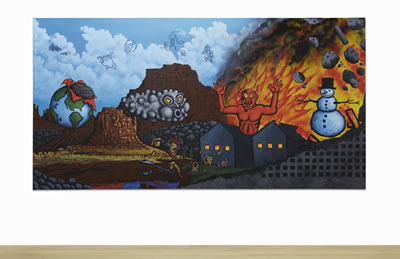
Wojnarowicz developed a distinct vocabulary of symbols that took on meaning through careful combinations that played off one another ironically and metaphorically. Iconic and idiosyncratic at the same time, his recurring cast of characters includes a burning man, a man with a target over his left eye, a cowboy riding a bull, a dinosaur, and an upside-down cow.
Two quotes by Wojnarowicz:
"Bottom line, if people don't say what they believe, those ideas and feelings get lost. If they are lost often enough, those ideas and feelings never return."
"All my life I've made things that are like fragmented mirrors of what I perceive to be the world. As far as I'm concerned the fact that in 1990 the human body is still a taboo subject is unbelievably ridiculous. What exactly is so frightening about the human body?"
In the late 1980s, after he was diagnosed with AIDS, Wojnarowicz' art took on a sharply political edge, and soon he was entangled in highly public debates about medical research and funding, morality and censorship in the arts, and the legal rights of artists.
Wojnarowicz challenged the nature of public arts funding at the National Endowment for the Arts, and initiated litigation against the American Family Association of Tupelo, Mississippi, an anti-pornography political action group that Wojnarowicz accused of misrepresenting his art and damaging his reputation. He won the lawsuit.
Wojnarowicz died of AIDS-related illness in New York City in 1992, at the age of 37. He is the author of five books. His artwork is in numerous private and public collections including the Museum of Modern Art, New York, and the Whitney Museum of American Art.
Source:
Les Krantz, American Artists, Illustrated Survey of Leading Contemporary Artists
http://www.queer-arts.org/archive/9902/wojnarowicz/wojnarowicz_bio.html