Page loaded successfully. Showing biography for Dee Flagg.
Dee Flagg BIOGRAPHY

1922 Great Falls, Montana - 1999 Scottsdale, Arizona. Known for: Western image wood carving, painting.
The following article is from the East Valley Tribune, Scottsdale, August 22, 2003 by Scott Seckel. Two weeks ago, antique dealer and inveterate junkman Neil King bought a broken down trailer for $75... Read full biography
The following article is from the East Valley Tribune, Scottsdale, August 22, 2003 by Scott Seckel. Two weeks ago, antique dealer and inveterate junkman Neil King bought a broken down trailer for $75 at a storage unit auction on Pima Road in Scottsdale. It was full of garbage bags. It looked like a... Read full biography
The following article is from the East Valley Tribune, Scottsdale, August 22, 2003 by Scott Seckel. Two weeks ago, antique dealer and inveterate junkman Neil King bought a broken down trailer for $75 at a storage unit auction on Pima Road in Scottsdale. It was full of garbage bags. It looked like a tornado had gone through it. And it was the find of a lifetime. Inside the bags of old clothes were oil paintings, jewelry, bronzes, wood carvings, pastels, sketches, photos. "It's pretty... Read full biography
The following article is from the East Valley Tribune, Scottsdale, August 22, 2003 by Scott Seckel. Two weeks ago, antique dealer and inveterate junkman Neil King bought a broken down trailer for $75 at a storage unit auction on Pima Road in Scottsdale. It was full of garbage bags. It looked like a tornado had gone through it. And it was the find of a lifetime. Inside the bags of old clothes were oil paintings, jewelry, bronzes, wood carvings, pastels, sketches, photos. "It's pretty phenomenal," the east Mesa man said. "It's probably winning the lottery. You will never see this again.". The collection is the work of the Flaggs, an eccentric family of Scottsdale art pioneers. "He's got a find," said Joanne Handley, president of the... Read full biography
The following article is from the East Valley Tribune, Scottsdale, August 22, 2003 by Scott Seckel. Two weeks ago, antique dealer and inveterate junkman Neil King bought a broken down trailer for $75 at a storage unit auction on Pima Road in Scottsdale. It was full of garbage bags. It looked like a tornado had gone through it. And it was the find of a lifetime. Inside the bags of old clothes were oil paintings, jewelry, bronzes, wood carvings, pastels, sketches, photos. "It's pretty phenomenal," the east Mesa man said. "It's probably winning the lottery. You will never see this again.". The collection is the work of the Flaggs, an eccentric family of Scottsdale art pioneers. "He's got a find," said Joanne Handley, president of the Scottsdale Historical Society. "Invaluable," she called the collection. Dee Flagg dressed Old West-style w... Read full biography
Artist Biography
Biography page for Dee Flagg ((1922 - 1999)), known for Western image wood carving, painting. Showing 2 biographical entries and 0 sample artworks.
Dee Flagg - Artist Info
About Dee Flagg
Biography from the Archives of askART
 The following article is from the East Valley Tribune, Scottsdale, August 22, 2003 by Scott Seckel
Two weeks ago, antique dealer and inveterate junkman Neil King bought a broken down trailer for $75 at a storage unit auction on Pima Road in Scottsdale.
It was full of garbage bags. It looked like a tornado had gone through it. And it was the find of a lifetime.
Inside the bags of old clothes were oil paintings, jewelry, bronzes, wood carvings, pastels, sketches, photos.
"It's pretty phenomenal," the east Mesa man said. "It's probably winning the lottery. You will never see this again."
The collection is the work of the Flaggs, an eccentric family of Scottsdale art pioneers.
"He's got a find," said Joanne Handley, president of the Scottsdale Historical Society.
"Invaluable," she called the collection.
Dee Flagg dressed Old West-style with a handlebar mustache and drove a 1914 La France fire truck around town with a wooden Indian chief he carved sitting beside him. His flamboyant brother Monte Flagg liked to dress like Buffalo Bill Cody and painted whimsical portraits of Indian children.
Herman Atkinson, owner of Atkinson's Trading Post at 3957 N. Brown Ave. in Scottsdale, was a friend of Dee Flagg's until Flagg died in 2000.
"They were all artistically inclined," Atkinson said of the family. "They lived a kind of a reclused type of life. They didn't seem to get out into the social world like a lot of artists do today. They seemed to want to stay to themselves."
The Flaggs were the family of a Great Falls, Mont., art teacher and the grandchildren of a teamster who drove freight across the Oregon Trail. They arrived in Scottsdale in the 1940s and lived on Cheney Drive in what was then the outskirts of town.
"I always felt people like that were pretty much a part of the growing up of the West, and they had the talent to put this in some form of an art," Atkinson said. "Someday they'll be recognized for that."
King's roughly 500-piece collection ranges from 1890 to 1990. He not only owns the art, including paintings by the Flaggs' father, James, he also owns Dee Flagg's wood carving tools, napkin sketches Monte Flagg did of paintings, copyright certificates for works, and photos of the artists beside their pieces.
"The paintings! The paintings! We're talking oils on canvas that have never been stretched!" King said.
King wants to sell everything as a collection. "I want it to stay here because this is Arizona," he said.
Atkinson has some Dee Flagg carvings among the jewelry and Indian pottery in his store, which he opened in Scottsdale in 1955. Dee Flagg came in to the store every two or three months.
"I don't believe he was overly educated, but he was very intelligent," Atkinson said. "He was very appreciated by people who lived here for a long time. Over the years we knew Dee, we knew him to be very much of a gentleman."
Dee Flagg went to Hollywood and carved for the stars for a time. Among King's collection are scores of Arizona Highways articles and newspaper clippings on the family. Wells Fargo Bank, Valley National Bank, Salt River Project and Arizona Public Service all commissioned work from him.
Dee Flagg carved all the famous figures of the Old West: Buffalo Bill, the Younger brothers, Billy the Kid.
"Dee represented the genre of Western art that relies on historic interpretation," said David Tatum, curator at the Arizona Historical Society Museum at Papago Park in Tempe. "He was very exacting with how he represented the accoutrements of his characters."
The entire family were Scottsdale fixtures. "A little bit of a flaky family, but they were extremely talented," Handley said. "They never married, and the four of them lived together."
Atkinson "wouldn't even start to name a price on it." Millions? "I wouldn't say it is or it isn't, but if you have the background on a person like that it makes it more valuable."
The Scottsdale Historical Society would love to have the collection, but Handley said they have no space to store it.
Tight budgets at the Arizona Historical Society mean the collection is out of their reach, Tatum said.
Dee Flagg's friends just hope his name becomes more famous.
"I hope that he gets recognition somewhere in his work," Atkinson said. "This might be the thing that gives him that particular stature in life."Biography from the Archives of askART
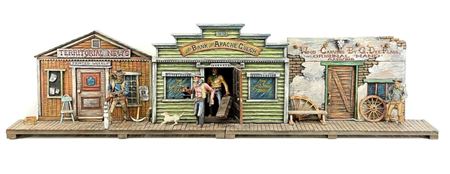 In Scottsdale and the Southwest, the name of Dee Flagg is synonymous with authentic life-size carved characters of the Old West such as Buffalo Bill and Wyatt Earp. He began carving intricate figures and Old West scenes from age 5, and in 1955, his work was first marketed by Atkinson's Indian Trading Center, then in downtown Phoenix and later in Scottsdale.
His work has also been marketed by Knott's Berry Farm in California and is in the collections of Gene Autry and Roy Rogers. He was a colorful character with handlebar mustache, often dressing like Buffalo Bill Cody, and he loved to walk the gallery district in that garb.
He died in Scottsdale on April 23, 1999.
----------------------------------------------------------------------
Excerpted from Dennis June, Bulletin to AskART:
A description of one of Flagg's works, "Taming The Open Range With Barbed Wire" is that it is carved from a single piece of basswood and portrays a Cowboy stringing frontier barbed wire. The figure is adorned in early Western outfit, including chaps, jeans, shirt (with buttons), scarf, well-worn cowboy hat and boots. Note the intricate wire bale. He wears work gloves and carries a hammer, with pliers in a rear pocket.
Flagg is noted for such intricate, imaginative and complete historical details. The 7 1/2 inch figure is a rich specimen of Flagg's mid-career works. It is oil painted in multi-layers adding realism and authenticity to the Old West characteristics of the figure.
"Dee" Flagg (1922-1999) is a woodcarving artist who carved only with hand tools (never using power), which was a source of the artist's pride. His 65-year career earned him scores of awards and artistry honors, including BEST IN SHOW at the world's largest woodcarver's exhibition in Toronto. He has been featured in print, notably "Arizona Highways", on numerous occasions.
The Scottsdale (AZ) Historical Society hosted one-man retrospective honoring Flagg's life and work In August, 1999. Each of Flagg's woodcarvings is individual, original and unique. No reproductions of his works have ever been permitted by the artist or his estate. His works are tightly held in private, civic and corporate art collections.
Collectors of Flagg's works include William S. Hart (California Museum), Gene Autry, Dale and Roy Rogers, and Russell Knott, founder of Knott's Berry Farm. His work is displayed in municipal buildings and museums throughout the West and his larger works were favorites of bank and corporate art collectors. His rendition of Christ in the West is displayed in a prominent Scottsdale, AZ church. Flagg's figures are RARELY offered on the secondary marketplace.