Page loaded successfully. Showing biography for Derek Fordjour.
Derek Fordjour BIOGRAPHY
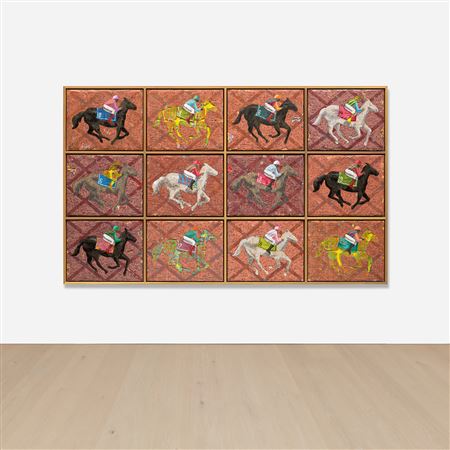
Born 1974 Memphis, Tennessee. Known for: Black racial themed art with puppets, layered texture paintings, installations, mosaics.
"Derek Fordjour, From Anguish to Transcendence", Art & Design Section, online, The New York Times, by Siddhartha Mitter, Nov. 19, 2020. Woven into his new work at Petzel Gallery are lessons drawn... Read full biography
"Derek Fordjour, From Anguish to Transcendence", Art & Design Section, online, The New York Times, by Siddhartha Mitter, Nov. 19, 2020. Woven into his new work at Petzel Gallery are lessons drawn from his own journey to art stardom, and from a year of Black grief. In a bare room upstairs from his... Read full biography
"Derek Fordjour, From Anguish to Transcendence", Art & Design Section, online, The New York Times, by Siddhartha Mitter, Nov. 19, 2020. Woven into his new work at Petzel Gallery are lessons drawn from his own journey to art stardom, and from a year of Black grief. In a bare room upstairs from his art studio inside an industrial building in the South Bronx, Derek Fordjour watched as three puppeteers brought a character drawn right out of his paintings to three-dimensional life. The artist was... Read full biography
"Derek Fordjour, From Anguish to Transcendence", Art & Design Section, online, The New York Times, by Siddhartha Mitter, Nov. 19, 2020. Woven into his new work at Petzel Gallery are lessons drawn from his own journey to art stardom, and from a year of Black grief. In a bare room upstairs from his art studio inside an industrial building in the South Bronx, Derek Fordjour watched as three puppeteers brought a character drawn right out of his paintings to three-dimensional life. The artist was forging yet another branch of his multiform practice: a live show, inspired by Japanese puppet theater, to complement work in his upcoming gallery exhibition. Mr. Fordjour often depicts Black athletes and performers — dancers, riders, rowers,... Read full biography
"Derek Fordjour, From Anguish to Transcendence", Art & Design Section, online, The New York Times, by Siddhartha Mitter, Nov. 19, 2020. Woven into his new work at Petzel Gallery are lessons drawn from his own journey to art stardom, and from a year of Black grief. In a bare room upstairs from his art studio inside an industrial building in the South Bronx, Derek Fordjour watched as three puppeteers brought a character drawn right out of his paintings to three-dimensional life. The artist was forging yet another branch of his multiform practice: a live show, inspired by Japanese puppet theater, to complement work in his upcoming gallery exhibition. Mr. Fordjour often depicts Black athletes and performers — dancers, riders, rowers, drum-majors — as strivers who navigate the ambiguities that come with their achievement, and the racial scrutiny that accompanies... Read full biography
Artist Biography
Biography page for Derek Fordjour ((Born 1974)), known for Black racial themed art with puppets, layered texture paintings, installations, mosaics. Showing 1 biographical entries and 0 sample artworks.
Derek Fordjour - Artist Info
About Derek Fordjour
Biography from the Archives of askART
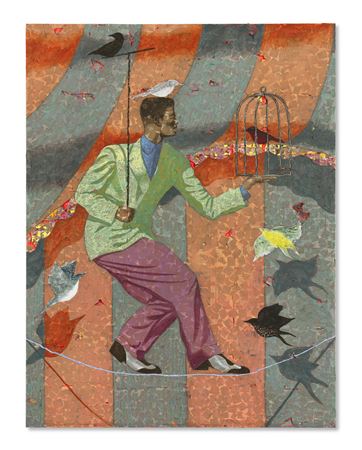 "Derek Fordjour, From Anguish to Transcendence", Art & Design Section, online, The New York Times, by Siddhartha Mitter, Nov. 19, 2020
Woven into his new work at Petzel Gallery are lessons drawn from his own journey to art stardom, and from a year of Black grief.
In a bare room upstairs from his art studio inside an industrial building in the South Bronx, Derek Fordjour watched as three puppeteers brought a character drawn right out of his paintings to three-dimensional life. The artist was forging yet another branch of his multiform practice: a live show, inspired by Japanese puppet theater, to complement work in his upcoming gallery exhibition.
Mr. Fordjour often depicts Black athletes and performers — dancers, riders, rowers, drum-majors — as strivers who navigate the ambiguities that come with their achievement, and the racial scrutiny that accompanies visibility in the mainstream culture.
The wood puppet was a vessel for these concerns. He had an athletic look, in breeches and a tunic. The top was a striped number in pink, blue, and brown, typical of the busy colors and patterns that energize Mr. Fordjour’s paintings. The character careened between triumph and slapstick abjection as the puppeteers moved him across a long table with artificial turf.
The puppet bent to pick up a ball; it stuck to his hand. As he tried to shake it off, a laugh track played — a crowd guffawing at his distress. Later he soared for a dunk, Jordan-style. He was mocked and applauded — the story suggested that what elevates Black achievers in our society can also erode their psyches.
“I love learning other ways to have a conversation,” Mr. Fordjour said after the rehearsal, a collaboration with the puppet artist Nick Lehane. “Painting has its utility, but performance is another register.”
At 46, by art-world metrics, Mr. Fordjour is already registering. He was a market sensation in 2019 with a noteworthy sale at Phillips, where “Agency and Regulation (study)” went for $137,500, double its estimate. At the Frieze art fair he sold a suite of 10 paintings to Jay-Z and Beyoncé.
This year brought his first full-fledged museum show, at the Contemporary Art Museum St. Louis, where paintings hung in a tropical environment that included corrugated metal walls and an ingenious method to replicate the sound of rain. “The idea was about creating a multisensory experience,” Wassan al-Khudhairi, the show’s curator, said of the immersive staging. She added, “He’s an extremely ambitious person; risk-taking is part of the journey.”
Mr. Fordjour’s solo show, “Self Must Die,” at Petzel Gallery is typically elaborate, with a walk-in installation, two new painting suites, a series of sculptures and the puppet show, performed twice daily.
His rise has been remarkable considering that his breakout show, in an artist-run space in Bushwick, was in 2014. Two years later, he was still completing his M.F.A. at Hunter College.
The sculptor Nari Ward, his teacher and adviser at Hunter, recalled that Mr. Fordjour, who was older than most other students — was driven with big ideas. “He came in hungry,” Mr. Ward said. “I was like, ooh, what’s going to happen to this guy?”
Woven into Mr. Fordjour’s work are lessons from his tortuous journey since committing to art back in high school, the son of Ghanaian immigrants in Memphis, Tenn.
But it was the events of 2020, between the pandemic and the police killings of George Floyd and Breonna Taylor, that took his newest work on a bleaker path, one that digs deeper into the ceremony of Black grief and mourning. The focus of his art is shifting from the complexities of performative roles to include how we mark the lives that had been lost.
A new ensemble painting, Chorus of Maternal Grief, commemorates 14 women, from Mamie Till-Mobley, Emmett Till’s mother, to Tamika Palmer, Ms. Taylor’s mother, whom bereavement forced into public roles. It is a new move for him: specific portraits rather than archetypes.
“This year, I feel like memorial is important,” he said. “Black funerary tradition is on my mind,” he added. “Thinking about all the people who were not able to have funerals.”
The T List: A weekly roundup of what the editors of T Magazine are noticing and coveting right now.
The Petzel show arrives with an epigraph from In the Wake: On Blackness and Being, a 2016 book by the scholar Christina Sharpe, who refers to “wake work” — the ensemble of activities, grand and mundane, that acknowledge and address Black death, and in doing so, affirm Black life.
She writes: “What does it look like, entail and mean to attend to, care for, comfort, and defend, those already dead, those dying, and those living lives consigned to the possibility of always-imminent death, life lived in the presence of death … it means work.”
Mr. Fordjour was taken by that concept, he said, and he has also been reading Black liberation theory, by the theologian James H. Cone, and studies of Black mourning.
The artist recalled years ago criticisms of the funeral industry for inflating its prices. “And Black funeral directors really rebuffed it,” he said. “They said, this is the opportunity to celebrate. This is our chance to be ornate.”
One work in the show, Pall Bearers, is inspired by the lavish funeral given George Floyd in Houston. Struck by Mr. Floyd’s gold-finished casket, Mr. Fordjour researched recipients of similar gold coffins and found that they included Michael Jackson and Whitney Houston.
The painting presents men in top hats, in a flattened perspective that conveys rhythm and immediacy. “But the casket is probably the subject of the painting,” he said. “A man commemorated in a gold casket, contrasting so sharply with the way his life ended.”
Mr. Fordjour plays with the ornate; he is not afraid to dazzle.
“He’s a superb colorist,” said Manon Slome, the curator who developed with Mr. Fordjour a wild, fun-house-like installation for kids (but not just) at the Sugar Hill Children’s Museum of Art & Storytelling. “There’s a theatricality in the work; they’re showmen,” she added. “The light radiates from within.”
When depicting crowds, as in Parade, Mr. Fordjour’s 2018 mosaic series inside the 145th Street subway station of the No. 3 line, the artist shows the inspiration of Jacob Lawrence and Archibald Motley, though his palette is lighter, more variegated.