Page loaded successfully. Showing biography for Dick Watkins.
Dick Watkins BIOGRAPHY
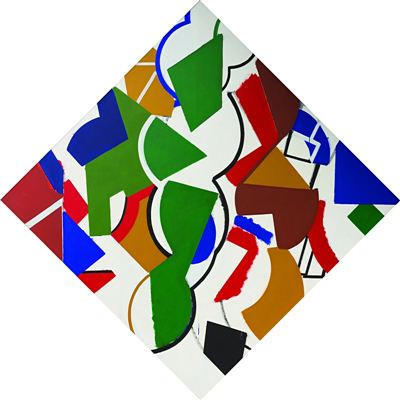
Born 1937. Known for: Painting.
Dick Watkins won his reputation in Australia in the 1960s with his large-scale, hard-edge color-field paintings. He was probably the first artist to exhibit works in this idiom in Australia, and he... Read full biography
Dick Watkins won his reputation in Australia in the 1960s with his large-scale, hard-edge color-field paintings. He was probably the first artist to exhibit works in this idiom in Australia, and he became a mainstay of the Central Street Gallery, then a by-word for tough, ambitious avant-garde art.... Read full biography
Dick Watkins won his reputation in Australia in the 1960s with his large-scale, hard-edge color-field paintings. He was probably the first artist to exhibit works in this idiom in Australia, and he became a mainstay of the Central Street Gallery, then a by-word for tough, ambitious avant-garde art. This association extended between 1966 and 1969, and in 1969 Watkins was given a retrospective exhibition at Central Street, the only artist to be accorded such an honor. Watkins had spent the years... Read full biography
Dick Watkins won his reputation in Australia in the 1960s with his large-scale, hard-edge color-field paintings. He was probably the first artist to exhibit works in this idiom in Australia, and he became a mainstay of the Central Street Gallery, then a by-word for tough, ambitious avant-garde art. This association extended between 1966 and 1969, and in 1969 Watkins was given a retrospective exhibition at Central Street, the only artist to be accorded such an honor. Watkins had spent the years 1959-62 in London, where he lived in share-houses in West Hampstead and Ladbroke Grove with other young Australian painters, notably Michael Johnson and Brett Whiteley. All three became the great white hopes of Australian art during the sixties.... Read full biography
Dick Watkins won his reputation in Australia in the 1960s with his large-scale, hard-edge color-field paintings. He was probably the first artist to exhibit works in this idiom in Australia, and he became a mainstay of the Central Street Gallery, then a by-word for tough, ambitious avant-garde art. This association extended between 1966 and 1969, and in 1969 Watkins was given a retrospective exhibition at Central Street, the only artist to be accorded such an honor. Watkins had spent the years 1959-62 in London, where he lived in share-houses in West Hampstead and Ladbroke Grove with other young Australian painters, notably Michael Johnson and Brett Whiteley. All three became the great white hopes of Australian art during the sixties. Watkins was the first of that diasporic generation to return from London (1961), holding his first s... Read full biography
Artist Biography
Biography page for Dick Watkins ((Born 1937)), known for Painting. Showing 1 biographical entries and 0 sample artworks.
Dick Watkins - Artist Info
About Dick Watkins
Name variants
Richard John Watkins
Biography from Bonhams Australia
Dick Watkins won his reputation in Australia in the 1960s with his large-scale, hard-edge color-field paintings. He was probably the first artist to exhibit works in this idiom in Australia, and he became a mainstay of the Central Street Gallery, then a by-word for tough, ambitious avant-garde art. This association extended between 1966 and 1969, and in 1969 Watkins was given a retrospective exhibition at Central Street, the only artist to be accorded such an honor.
Watkins had spent the years 1959-62 in London, where he lived in share-houses in West Hampstead and Ladbroke Grove with other young Australian painters, notably Michael Johnson and Brett Whiteley. All three became the great white hopes of Australian art during the sixties. Watkins was the first of that diasporic generation to return from London (1961), holding his first solo exhibition at Barry Stern Galleries in Sydney in 1963.
Unlike most abstract painters of the time, he did not work in series: he was conspicuous even at this early date for deliberately unsettling the appearance of consistency in his exhibitions, as Paul McGillick has noted, by always including a work or two in a contrasting style. Watkins' emblematic, compressed images from the 1960s tended to be legible in the blink of an eye. By revoking pictorial depth (or by making it indeterminate) he reduced the time it took for a viewer to assimilate an image.
However, by the time he painted Yesterday, hard-edge abstraction and most other idioms associated with art of the sixties were on the wane: iconic images (a kind of absolute) had ceded to relativity (more speculative and tenuous approaches to composition); formalism had ceded to lyricism; hard edges gave way to scatter and sprawl; the dialectic between cosmos and chaos was back on the artist's agenda; images were slower to read, more elusive, harder to "get". Jackson Pollock's visual language of wave, particle and field was full of wonder, full of challenge for Watkins who, in the early 1970s, produced many superbly accomplished works in a more-or-less "Pollock" idiom, having realized, as Daniel Thomas put it in a review, "the importance of not being too original."
Terence Maloon