Page loaded successfully. Showing biography for Dirk Van Erp.
Dirk Van Erp BIOGRAPHY
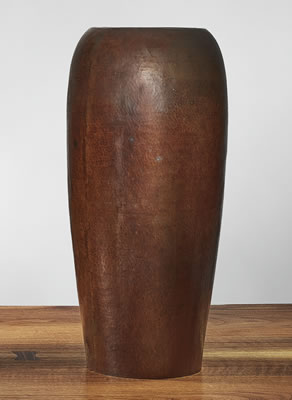
1860 Leeuwarden, Holland - 1933 San Francisco, California. Known for: Metalsmith.
Born in Leeuwarden, Holland in 1860. Van Erp came to the U.S. in 1886 and soon moved to . California. While working at the Naval Shipyard on Mare Island, he began salvaging the brass artillery shells... Read full biography
Born in Leeuwarden, Holland in 1860. Van Erp came to the U.S. in 1886 and soon moved to . California. While working at the Naval Shipyard on Mare Island, he began salvaging the brass artillery shells and hammering them into vases which he sold through Vickery, Atkins, & Torrey. He opened his first... Read full biography
Born in Leeuwarden, Holland in 1860. Van Erp came to the U.S. in 1886 and soon moved to . California. While working at the Naval Shipyard on Mare Island, he began salvaging the brass artillery shells and hammering them into vases which he sold through Vickery, Atkins, & Torrey. He opened his first shop in Oakland in 1908 with Harry S. Dixon as an apprentice. Two years later he relocated to San Francisco where Benny Bufano got his start. Van Erp died in San Francisco in 1933. Source: Edan... Read full biography
Born in Leeuwarden, Holland in 1860. Van Erp came to the U.S. in 1886 and soon moved to . California. While working at the Naval Shipyard on Mare Island, he began salvaging the brass artillery shells and hammering them into vases which he sold through Vickery, Atkins, & Torrey. He opened his first shop in Oakland in 1908 with Harry S. Dixon as an apprentice. Two years later he relocated to San Francisco where Benny Bufano got his start. Van Erp died in San Francisco in 1933. Source: Edan Hughes, author of the book "Artists in California, 1786-1940". CA&A; Antiques West, November 1986. Nearly 20,000 biographies can be found in Artists in California 1786-1940 by Edan Hughes and is available for sale ($150). For a full book description and... Read full biography
Born in Leeuwarden, Holland in 1860. Van Erp came to the U.S. in 1886 and soon moved to . California. While working at the Naval Shipyard on Mare Island, he began salvaging the brass artillery shells and hammering them into vases which he sold through Vickery, Atkins, & Torrey. He opened his first shop in Oakland in 1908 with Harry S. Dixon as an apprentice. Two years later he relocated to San Francisco where Benny Bufano got his start. Van Erp died in San Francisco in 1933. Source: Edan Hughes, author of the book "Artists in California, 1786-1940". CA&A; Antiques West, November 1986. Nearly 20,000 biographies can be found in Artists in California 1786-1940 by Edan Hughes and is available for sale ($150). For a full book description and order information please click here.... Read full biography
Artist Biography
Biography page for Dirk Van Erp ((1860 - 1933)), known for Metalsmith. Showing 2 biographical entries and 0 sample artworks.
Dirk Van Erp - Artist Info
About Dirk Van Erp
Biography from the Archives of askART
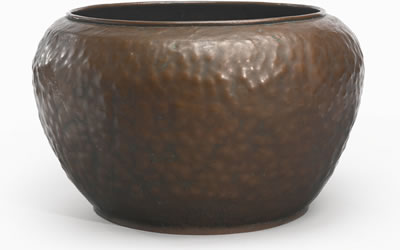 Born in Leeuwarden, Holland in 1860. Van Erp came to the U.S. in 1886 and soon moved to
California. While working at the Naval Shipyard on Mare Island, he began salvaging the brass artillery shells and hammering them into vases which he sold through Vickery, Atkins, & Torrey. He opened his first shop in Oakland in 1908 with Harry S. Dixon as an apprentice. Two years later he relocated to San Francisco where Benny Bufano got his start. Van Erp died in San Francisco in 1933.Biography from Toomey & Co. Auctioneers
Widely considered the premier Arts and Crafts coppersmith, Dirk van Erp’s lamps, vases, bowls, and other items have continued to appreciate in value over the past century given their high quality and lasting beauty. Born in Leeuwarden, Netherlands in 1862, van Erp immigrated to the United States in 1890, settling in San Francisco. Soon thereafter, he married Mary Richardson Marino and the couple had a daughter, Agatha, in 1894. After failing to make his fortune in the Klondike Gold Rush in 1898, van Erp returned to San Francisco, where he gained employment as a coppersmith at the Mare Island Naval Shipyard in Vallejo.
In 1901, the van Erp family welcomed a son, William. In his spare time, van Erp started to create vases from shell casings that he obtained at the shipyard. Leaving behind his initial, ornate Victorian style, van Erp transitioned to developing pieces with an unadorned Arts and Crafts appearance. In 1908, van Erp opened the Art Copper Shop and the following year he began an important collaboration with Elizabeth Eleanor D’Arcy Gaw, who had trained at the School of the Art Institute of Chicago.
While their partnership lasted only a year, Erp drew significant inspiration from D’Arcy Gaw for his iconic lamp designs and implemented shades with mica panels at her suggestion. Works from this period bear a stamped windmill with the names of van Erp and D’Arcy Gaw beneath. After exhibiting at the 1915 World’s Fair in San Francisco, van Erp largely curtailed his output during World War I to assist with military mobilization. Sustaining his artistic production through the 1920s, van Erp and his wife Mary both died within hours of each other on July 18, 1933. Their son William kept the Art Copper Shop open until his death in 1977.