Page loaded successfully. Showing biography for Dixie Selden.
Dixie Selden BIOGRAPHY

1871 Cincinnati, Ohio - 1936 Cincinnati, Ohio. Known for: Impressionist portrait, figure, genre and landscape painting.
Based primarily in Cincinnati, Ohio, Dixie Selden was a painter in impressionist style of portraits, genre, and landscape, and was also an illustrator. She studied at the Cincinnati Museum Art School... Read full biography
Based primarily in Cincinnati, Ohio, Dixie Selden was a painter in impressionist style of portraits, genre, and landscape, and was also an illustrator. She studied at the Cincinnati Museum Art School with Frank Duveneck, and became one of his favorite students. At his request she painted his... Read full biography
Based primarily in Cincinnati, Ohio, Dixie Selden was a painter in impressionist style of portraits, genre, and landscape, and was also an illustrator. She studied at the Cincinnati Museum Art School with Frank Duveneck, and became one of his favorite students. At his request she painted his portrait before he died. She took a summer class in Venice, Italy with William Merritt Chase. Selden was President of the Cincinnati Women's Art Club, and was active in the National Association of Women... Read full biography
Based primarily in Cincinnati, Ohio, Dixie Selden was a painter in impressionist style of portraits, genre, and landscape, and was also an illustrator. She studied at the Cincinnati Museum Art School with Frank Duveneck, and became one of his favorite students. At his request she painted his portrait before he died. She took a summer class in Venice, Italy with William Merritt Chase. Selden was President of the Cincinnati Women's Art Club, and was active in the National Association of Women Painters and Sculptors. She exhibited with those groups as well as at the Pennsylvania Academy, the Corcoran Gallery, and the Art Institute of Chicago. Selden traveled extensively, especially along the New England Coast during the summers, often with... Read full biography
Based primarily in Cincinnati, Ohio, Dixie Selden was a painter in impressionist style of portraits, genre, and landscape, and was also an illustrator. She studied at the Cincinnati Museum Art School with Frank Duveneck, and became one of his favorite students. At his request she painted his portrait before he died. She took a summer class in Venice, Italy with William Merritt Chase. Selden was President of the Cincinnati Women's Art Club, and was active in the National Association of Women Painters and Sculptors. She exhibited with those groups as well as at the Pennsylvania Academy, the Corcoran Gallery, and the Art Institute of Chicago. Selden traveled extensively, especially along the New England Coast during the summers, often with Emma Mendenhall as a painting companion. Other travel spots were Spain, Mexico, Italy and France. So... Read full biography
Artist Biography
Biography page for Dixie Selden ((1871 - 1936)), known for Impressionist portrait, figure, genre and landscape painting. Showing 4 biographical entries and 0 sample artworks.
Dixie Selden - Artist Info
About Dixie Selden
Name variants
Dixie Seldon
Biography from the Archives of askART
 Based primarily in Cincinnati, Ohio, Dixie Selden was a painter in impressionist style of portraits, genre, and landscape, and was also an illustrator. She studied at the Cincinnati Museum Art School with Frank Duveneck, and became one of his favorite students. At his request she painted his portrait before he died. She took a summer class in Venice, Italy with William Merritt Chase.
Selden was President of the Cincinnati Women's Art Club, and was active in the National Association of Women Painters and Sculptors. She exhibited with those groups as well as at the Pennsylvania Academy, the Corcoran Gallery, and the Art Institute of Chicago.
Selden traveled extensively, especially along the New England Coast during the summers, often with Emma Mendenhall as a painting companion. Other travel spots were Spain, Mexico, Italy and France.
Sources include:
Peter Falk, Who Was Who in American Art
Stuart Holman Auction catalogue, March 6, 2003Biography from Cincinnati Art Galleries
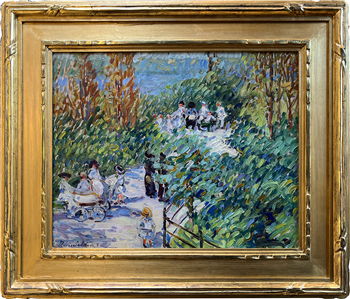 DIXIE SELDEN, 1868-1935
By Genetta McLean, Ph.D.
Dixie Selden was born on February 28, 1868 in Cincinnati, Ohio. When she was two years old, her family moved across the Ohio River to Covington, Kentucky. Selden resided in Covington with her parents until their death in 1909. She then returned to Cincinnati in 1910 where she lived until her death on November 14, 1935.
Selden attended the Art Academy of Cincinnati beginning in 1884. Her instructors included Vincent Nowottny, Henrietta Wilson, Lewis Cass Lutz, Fernand Harvey Lungren, and L.H. Meakin. When the artist Frank Duveneck (1848-1919) returned to Cincinnati after painting in Europe, Selden attended his painting classes in 1890, 1891 and 1903.
Selden’s early style was significantly influenced by Duveneck’s teaching, and she adopted his so-called Munich style as her own during her formative years. Selden soon perfected her skill as a portraitist, and in 1894 at age 26 she advertised her occupation as a portrait painter, thereby officially announcing herself as a professional painter and owner of a viable commercial business.
Although Selden made her livelihood by painting portraits of Cincinnati’s elite society, she reserved the summer and fall months for traveling and painting landscapes. She often went to Europe, always traveling with a coterie of Cincinnati friends and cousins. She also visited China, Japan, Mexico, Canada, the Middle East, and northern Africa, including Egypt. Her strongest and perhaps most popular work was produced in the 1920s in Brittany, Venice, and Spain.
Village street scenes and harbors were favorite subjects, and occasionally Selden painted portraits of local citizens dressed in festival costume. At the end of each trip, she returned with approximately twenty to thirty paintings of various sizes: small thumb-nail oil sketches, small paintings completed over two days (20 x 16 in.), and larger, more fully executed works (20 x 30 in.).
Selden’s style significantly changed in 1913 after attending a summer study course with William Merritt Chase (1849-1916) in Venice, Italy. With Chase’s encouragement she adopted a colorful Impressionist palette and painting technique, a style that contemporaries equated with her cheerful and endearing personality.
Throughout Selden’s life her paintings sold well and were widely exhibited at notable institutions including the National Academy of Design, Art Institute of Chicago, Detroit Institute of Arts, Corcoran Gallery of Art, Pennsylvania Academy of Fine Arts, and Cincinnati Art Museum. Many of her best works remain in private collections but several notable paintings are at the University of Cincinnati and Cincinnati Art Museum.
For a definitive history and catalogue raisonne see Genetta McLean, Dixie Selden: An American Impressionist from Cincinnati, 1868-1935, Cincinnati: Cincinnati Art Galleries, 2001.
Source: Genetta McLean, Dixie Selden: An American Impressionist from Cincinnati, 1868-1935, Cincinnati: Cincinnati Art Galleries, 2001.Biography from The Johnson Collection
DIXIE SELDEN (1868-1935)
Dixie Selden was the pampered daughter of a prosperous couple who indulged her interest in art, taking her on two trips to Europe before she was fifteen years old. While the Seldens had roots in Cincinnati, they favored the South and its culture, an affinity underscored by naming their daughter “Dixie” after the famous song.
Beginning in 1884, Selden enrolled at the McMicken School of Drawing and Design (later the Art Academy of Cincinnati), which was conservatively led by Thomas Satterwhite Noble. She studied there for six years and also at the Cincinnati Art Museum with Frank Duveneck, an exemplar of the Munich School who emphasized the figure, rendered with dark tonalities and ample pigment. His tenebrous approach to figure painting influenced her portraiture, which sustained her financially throughout her career. She is thought to have painted several hundred bankers, businessmen, and society women.
In many respects, Selden lived a double life. Defying convention, she was an independent, unmarried female whose paintings were exhibited at the all-male Cincinnati Art Club in 1891, and on occasion she was the sole woman represented in commercial shows. On the other hand, she was a charter member of the prototypical Woman’s Art Club, which began its exhibitions in 1893. No suffragette, Selden was basically conservative, but fully enjoyed her independence.
The year 1913 marked a stylistic turning point for the artist. As a student in William Merritt Chase’s summer course in Venice, Selden became more comfortable painting outdoor scenes, her palette lightened considerably, and her brushwork grew increasingly impressionistic. She applied this fresh approach to the many rapidly executed land- and seascapes she made on her extensive travels, both in this country and abroad. She gravitated to seaside locales such as Gloucester, Newport, and the coast of Maine, as well as Concarneau, in Brittany, and Venice.
Selden’s European scenes found an appreciative audience at home, and she enjoyed a loyal patronage among her social peers. While many of the exhibitions were local—taking place at the Woman’s Club or the Art Academy—prestigious national venues such as the National Academy of Design, the Pennsylvania Academy of the Fine Arts, the Corcoran Gallery of Art, the Art Institute of Chicago, and the Detroit Institute of Art also showed her paintings. In addition, her work was included in the 1915 Panama-Pacific International Exposition in San Francisco. Selden maintained careful records and extensive correspondence, all of which have proved useful in reconstructing her career. Today, her work is featured in several museum collections, including the Butler Institute of American Art and the Cincinnati Art Museum. The Johnson Collection, Spartanburg, South Carolina.
The Johnson Collection, Spartanburg, South Carolina
thejohnsoncollection.orgBiography from Massillon Museum
Dixie Selden was born in Cincinnati as the first child of John and Martha Selden and lived most of her childhood living in Covington. She began taking courses at the McMicken School of Design in 1884, which became the Art Academy of Cincinnati in 1885. She took classes at the Academy until 1890 and studied under Frank Duveneck while there. Later she took years of intense private study with Duveneck.
Around 1910 she went to Venice, Italy to study under William Merritt Chase and, in 1914, she began taking lessons from Henry B. Snell at St. Ives in England. These summers, spent traveling and painting with her teachers, initiated her extensive travels through Europe, the Middle East, China, Japan, Scandinavia and Mexico.
Her early career was spent painting subject matter largely reserved for amateur women artists - portraits, indoor and outdoor scenes of domestic life and flowers. As she matured, she increasingly specialized in portraiture, the means by which she claimed her status as a professional. She also developed a considerable reputation for painting the daily life and lively street scenes of the various locales she visited.