Page loaded successfully. Showing biography for Don Binney.
Don Binney BIOGRAPHY
1940 Auckland, New Zealand - 2012. Known for: Still life, native birds and figurative painting.
Don Binney is well known for his clean-edged modernist paintings of birds in the landscapes of New Zealand. In his search for subject, he is inspired by dramatic wilderness areas and environments,... Read full biography
Don Binney is well known for his clean-edged modernist paintings of birds in the landscapes of New Zealand. In his search for subject, he is inspired by dramatic wilderness areas and environments, which he draws from to express both his passion for painting and his love of ornithology and nature.... Read full biography
Don Binney is well known for his clean-edged modernist paintings of birds in the landscapes of New Zealand. In his search for subject, he is inspired by dramatic wilderness areas and environments, which he draws from to express both his passion for painting and his love of ornithology and nature. In an interview with Patricia Sarr and Tom Turner in 1977, Binney described his motivation for painting: I paint and draw because I'm thoroughly committed to and involved with environmental, natural... Read full biography
Don Binney is well known for his clean-edged modernist paintings of birds in the landscapes of New Zealand. In his search for subject, he is inspired by dramatic wilderness areas and environments, which he draws from to express both his passion for painting and his love of ornithology and nature. In an interview with Patricia Sarr and Tom Turner in 1977, Binney described his motivation for painting: I paint and draw because I'm thoroughly committed to and involved with environmental, natural stimuli - the landscape, the wild-life. you must approach the landscape or the bush with reverence. Binney's earliest paintings were predominately landscapes, the approach of which can be traced to styles found popular in America in the 1930's. This... Read full biography
Don Binney is well known for his clean-edged modernist paintings of birds in the landscapes of New Zealand. In his search for subject, he is inspired by dramatic wilderness areas and environments, which he draws from to express both his passion for painting and his love of ornithology and nature. In an interview with Patricia Sarr and Tom Turner in 1977, Binney described his motivation for painting: I paint and draw because I'm thoroughly committed to and involved with environmental, natural stimuli - the landscape, the wild-life. you must approach the landscape or the bush with reverence. Binney's earliest paintings were predominately landscapes, the approach of which can be traced to styles found popular in America in the 1930's. This style removes small detail and concentrates on landform and rhythmic curves. Rita Angus, Doris Lusk and Will... Read full biography
Artist Biography
Biography page for Don Binney ((1940 - 2012)), known for Still life, native birds and figurative painting. Showing 2 biographical entries and 0 sample artworks.
Don Binney - Artist Info
About Don Binney
Name variants
Donald Binney
Biography from International Art Centre
Don Binney is well known for his clean-edged modernist paintings of birds in the landscapes of New Zealand. In his search for subject, he is inspired by dramatic wilderness areas and environments, which he draws from to express both his passion for painting and his love of ornithology and nature.
In an interview with Patricia Sarr and Tom Turner in 1977, Binney described his motivation for painting: I paint and draw because I'm thoroughly committed to and involved with environmental, natural stimuli - the landscape, the wild-life...you must approach the landscape or the bush with reverence.
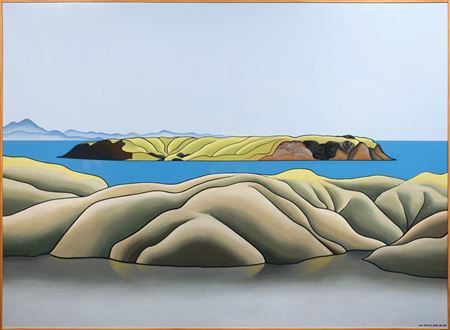
Binney's earliest paintings were predominately landscapes, the approach of which can be traced to styles found popular in America in the 1930's. This style removes small detail and concentrates on landform and rhythmic curves. Rita Angus, Doris Lusk and William Sutton also took influence from this period.
Binney's early works had an abstract feel to them, representing landscape in an almost cubist-style of brushwork. As his work matured, he began to depict birds as the central concern in this paintings, the landscape became more of a backdrop to the main focus. Eventually though, landscape and birds shared his attentions equally, and he produced many works which talk of New Zealand's environmental concerns and birdlife.
Kairarara Kaka Variant 1982 - 83 is a particularly striking work, painted with thick brushstrokes in a painterly style; in this sense it harks back to earlier pieces by Binney. The paint application is fairly patterned in areas, paint appearing quite viscous and thick, making the work just as captivating close-up as from afar. The structure of the composition allows for several focal points in the work, the eye is first drawn to the bird and then through the landscape to the fence in the fore. This same fence is depicted in a later work by the artist entitled Kaka, 1984.
Binney often included architectural structures or monuments which symbolized a human presence in his painting. It is clear that this is not an ideal land before human intervention, it is New Zealand in the time the artist painted it.
From text affixed verso -The Fisher Gallery, Pakuranga
----
Donald Hall Binney, OBE (24 March 1940[1] - 14 September 2012), was a New Zealand painter, best known for his paintings of birds.
Born and raised in Auckland, Binney was educated in Parnell, Auckland, taking classes with John Weeks and R B Sibson, who became his good friend and guide to the field of ornithology.
From 1958 to 1961, he studied at Elam School of Fine Arts in Auckland, gaining a Diploma of Fine Arts. Binney's tutors included Ida Eisa, James Turkington, Robert Ellis and Robin Wood.
In 1963, he held his first solo exhibition at Ikon Gallery, Auckland and began teaching at Mount Roskill Grammar School, where he taught until 1966. In bird watching, Binney said he discovered a passage into the landscape and the opportunity to develop a personal relationship with it.
Binney described himself as a figurative painter concerned with the psychic metaphor of the environment. Working in oil, acrylic, charcoal, ink and carbon pencil, many of his works depict the west coast of Auckland and Northland, containing sea, sky, native birds, still life and occasionally, figures. He was awarded an OBE for services to the arts in the 1995 Queen's Birthday Honours.
Binney died in September 2012, at the age of 72, and was survived by his second wife Philippa and daughter Mary. His first wife was the historian Judith Binney.
Exhibition: In 1965, Binney was included in a survey show of New Zealand painting, held in London and in the "Eight NZ Artists" touring show of Australian state galleries.
In 1967, he was the recipient of a Queen Elizabeth II Arts Council travel fellowship. He lived in Mexico, London, and Australia, but returned to teach at Elam, becoming the senior lecturer in Fine Arts in 1979.
Binney has exhibited widely throughout New Zealand and was the subject of a thirty-year survey show at the Fisher Gallery, Pakuranga in 1989. He also had a retrospective exhibition curated by Damien Skinner that toured the country from 2003 to 2004.
His work is represented in many public collections including the Auckland Art Gallery, The University of Auckland and Museum of New Zealand Te Papa Tongarewa.Biography from International Art Centre
A birdwatcher and ornithologist since his schooldays, Don Binney found the Te Henga area a happy hunting ground for his observation of birds of all kinds, which he celebrated in his art: gulls, terns, dotterels, wood pigeons (kereru), tui, bitterns (matuku), fernbirds, shags (kawaupaka), hawks (kahu), shining cuckoos (pipiwharauroa), long-tailed cuckoos (koekoea), herons, fantails, kingfishers (kotare), pied shags (karuhiruhi), rosellas, and others.
Speaking to John Daly-Peoples in 1972, Binney said, 'I see [birds] as a whole quality of existence in themselves … recurrent forms in space and in place … birds have lived in the world for so much longer than the human species … and I think we owe them tremendous respect.' Birds, he continued, ‘lived in harmony and have co-existed with the topography … of habitable earth space … and they have won their place by means of flight … nesting patterns … migration … feeding habits, and the whole way they deploy themselves against … this land and this life.'
Such a sophisticated appreciation and understanding of bird life in relation to habitat lies behind Binney’s celebrated bird paintings.
The kereru is one of Binney’s favourite bird subjects, as in Kereru over Wainamu, New Kereru at Te Henga, Lower Kauri Track and many others. What makes Under the Hill of the Homestead (1968) unusual is that the bird, though centrally placed, is relatively small within the sizeable canvas, as if viewed from a distance, whereas often in Binney’s pictures the kereru dominates the picture plane, emphasising its impressive size and weight as well as its sleek design and colouring.
The colouring depends on contrast, with the pure white of the kereru’s breast and underwings standing out strongly against the dark greys of the dune-originated hill and the blue-green of the somewhat brighter foreground. The darkness of the hill stark against the paleness of the sky provides another strong contrast, while such light and dark patterning is picked up in the pale and dark tones of the foliage of the pohutukawa as well as in the plumage of the bird.
The ‘homestead’ of the title refers to the dwelling of the pioneer family. The macrocarpas and other trees towards the top left are also signs of Pakeha habitation. Binney’s title ‘Under the hill …’ subtly suggests the complex inter-relationship between creature and environment that is such an essential feature of his approach.