Page loaded successfully. Showing biography for Earle Kulp Bergey.
Earle Kulp Bergey BIOGRAPHY

1901 Philadelphia, Pennsylvania - 1952. Known for: Theatre and magazine illustration, pulp genre, figure.
Remembered for his semi-naked women, Earle Bergey was a pulp-fiction illustrator who did many science fiction magazine covers for "Startling Stories". His female figures were "coping with the... Read full biography
Remembered for his semi-naked women, Earle Bergey was a pulp-fiction illustrator who did many science fiction magazine covers for "Startling Stories". His female figures were "coping with the vastness of space or the harshness of hostile planets dressed in litle more than their underwear---albeit... Read full biography
Remembered for his semi-naked women, Earle Bergey was a pulp-fiction illustrator who did many science fiction magazine covers for "Startling Stories". His female figures were "coping with the vastness of space or the harshness of hostile planets dressed in litle more than their underwear---albeit metallic". (29) As an illustrator of Thrilling Wonder Stories, he was dubbed "The Inventor of the Brass Brassiere" for his covers of semi-naked women with armor-appearing material covering their... Read full biography
Remembered for his semi-naked women, Earle Bergey was a pulp-fiction illustrator who did many science fiction magazine covers for "Startling Stories". His female figures were "coping with the vastness of space or the harshness of hostile planets dressed in litle more than their underwear---albeit metallic". (29) As an illustrator of Thrilling Wonder Stories, he was dubbed "The Inventor of the Brass Brassiere" for his covers of semi-naked women with armor-appearing material covering their bosoms. "The attire of his female characters was always rudimentary, no matter what kind of environment they found themselves in, or what manner of threat was posed by menacing Bug Eyed Monsters". (165). Source:. Peter Haining, "The Classic Era of American... Read full biography
Remembered for his semi-naked women, Earle Bergey was a pulp-fiction illustrator who did many science fiction magazine covers for "Startling Stories". His female figures were "coping with the vastness of space or the harshness of hostile planets dressed in litle more than their underwear---albeit metallic". (29) As an illustrator of Thrilling Wonder Stories, he was dubbed "The Inventor of the Brass Brassiere" for his covers of semi-naked women with armor-appearing material covering their bosoms. "The attire of his female characters was always rudimentary, no matter what kind of environment they found themselves in, or what manner of threat was posed by menacing Bug Eyed Monsters". (165). Source:. Peter Haining, "The Classic Era of American Pulp Magazines"... Read full biography
Artist Biography
Biography page for Earle Kulp Bergey ((1901 - 1952)), known for Theatre and magazine illustration, pulp genre, figure. Showing 2 biographical entries and 0 sample artworks.
Earle Kulp Bergey - Artist Info
About Earle Kulp Bergey
Biography from the Archives of askART
 Remembered for his semi-naked women, Earle Bergey was a pulp-fiction illustrator who did many science fiction magazine covers for "Startling Stories". His female figures were "coping with the vastness of space or the harshness of hostile planets dressed in litle more than their underwear---albeit metallic". (29) As an illustrator of Thrilling Wonder Stories, he was dubbed "The Inventor of the Brass Brassiere" for his covers of semi-naked women with armor-appearing material covering their bosoms.
"The attire of his female characters was always rudimentary, no matter what kind of environment they found themselves in, or what manner of threat was posed by menacing Bug Eyed Monsters". (165)
Source:
Peter Haining, "The Classic Era of American Pulp Magazines"Biography from The Earle K. Bergey Family
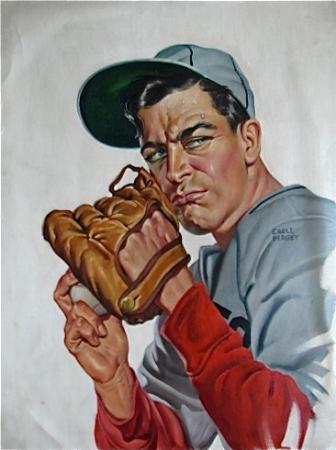 Best known for painting the celebrated cover art of Anita Loos' Gentlemen Prefer Blondes, Earle K. Bergey was a prolific American illustration artist. Bergey painted covers for a diversity of magazines and paperback books, some of which were only published after his early death in 1952.
Raised in Philadelphia, PA, Earle K. Bergey attended the Pennsylvania Academy of the Fine Arts in the 1920s. He worked for the Philadelphia Public Ledger after which time he produced covers for the Fiction House line of pulp magazines. By the mid 1930s and with relationships well established with leading publishing houses, Bergey settled in historic Bucks County, PA.
Earle K. Bergey worked as a freelance illustrator for competing publishing houses throughout the 1930s. His provocative paintings were featured on a diversity of publications from risque pin-up magazines and widely circulated pulp magazines to standard periodicals including The Saturday Evening Post.
Bergey's subjects included romance, adventure, aviation, mystery, crime noir, sports and Westerns. Bergey illustrated covers for fitness magazines, and he was one of the first significant pin-up artists in America, contributing cover art to numerous titles such as Gay Book Magazine, Snappy, and Tattle Tales. Today, it is not unusual for Bergey's unsigned pin-up art to be falsely attributed to other artists, such as Enoch Bolles, even though Bergey's treatment of flesh and the female figure makes his work uniquely recognizable.
In the 1940s, Bergey added science fiction and fantasy art to his body of work, including covers for Captain Future, Startling Stories, and Thrilling Wonder Stories. Often dubbed the "inventor of the brass brassiere," for his covers of scantily clad women menaced by monsters in space, Bergey is seen to have inspired visual culture, especially film, with his memorable, humanizing compositions of cosmic conflict.
By 1948, as the pulp magazine industry was fast approaching its end, Earle K. Bergey began producing paperback book art along with contemporaries like Rudolph Belarski. While continuing to paint pulp magazine covers until his death, Bergey contributed to the success of leading paperback publishers of the day, including Pocket Books and Popular Library.
In addition to his iconic Gentlemen Prefer Blondes, Bergey illustrated stories of established authors from Émile Zola to the Western master, Zane Grey, whose 1951 Pocket Books edition cover painting for Spirit Of The Border is a Bergey classic.
Earle K. Bergey died suddenly in 1952 at the age of 51.