Eben Van Der Merwe BIOGRAPHY
Artist Biography
Biography page for Eben Van Der Merwe ((Born 1932)), known for Landscape, portrait, figure, still life and abstract painting. Showing 2 biographical entries and 0 sample artworks.
Eben Van Der Merwe - Artist Info
About Eben Van Der Merwe
Biography from the Archives of askART
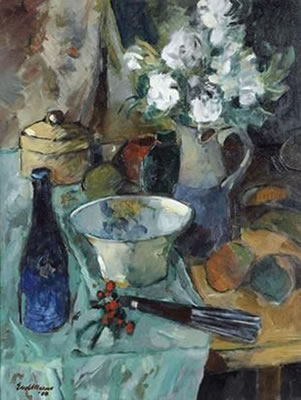
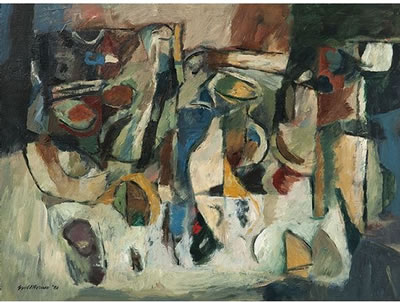 Eben van der Merwe was born in Bloemfontein in 1932. A self-taught painter of landscapes, portraits, figures, still life and abstract pictures. His early work showed influence of Gregoire
Boonzaier. He later moved toward non-figurative composition, rendered his scene in dark, rich colors, broken into segments in the manner of stained-glass. In 1958 a founder member of the Bloemfontein Group.
He moved to Johannesburg in 1961, where he worked as a typographer, a visualiser and a designer in advertising agencies, and as art director for the magazine section of Argus Group until 1970. Since 1976 a full-time artist, concentrating on painting and the design and construction of Dalle-de-Verre windows.
In 1966 he traveled to the UK and Europe to study the design and construction of slab-glass windows. In 1976 he made a study tour of the UK and Europe.
Sources include:
http://www.absolutart.co.za/contemporary-artists/eben-van-der-merweBiography from Strauss & Co Cape Town
Eben van der Merwe was a founding member of the Bloemfontein Group, which was established by Prof Frik Scott in 1958 along with fellow artists Frans Clarehout, Reneé le Roux, and Alexander and Marianne Podlashuc. In 1961, he moved to Johannesburg and worked in advertising agencies as a typographer, visualiser, and designer and as the art director for the magazine section of Argus Group. In 1971, van der Merwe became a lecturer in Painting and Applied Design at the University of Pretoria, leaving the institution in 1976 to devote himself to being a full-time artist. Recognised for his landscapes, still lifes, and abstract paintings, van der Merwe’s work shows the influence of Gregoire Boonzaier and Paul Cezanne on the artist. He was twice represented at the Venice Biennale (1964 and 1968) and twice at the Sao Paolo Biennale (1963 and 1965).
Image courtesy H. J. Strydom.