Page loaded successfully. Showing biography for Edgar Ewing.
Edgar Ewing BIOGRAPHY

1913 Hartington, Nebraska - 2006 Los Angeles, California. Known for: Modernist, post cubist figure, still life and landscape painting.
Edgar Louis Ewing (1913-2006). Painter. Born in Hartington, Nebraska on January 17, 1913, Edgar L Ewing first studied at the Art Institute of Chicago under Boris Anisfeld. Upon graduation in 1935, he... Read full biography
Edgar Louis Ewing (1913-2006). Painter. Born in Hartington, Nebraska on January 17, 1913, Edgar L Ewing first studied at the Art Institute of Chicago under Boris Anisfeld. Upon graduation in 1935, he further studied and traveled in Europe. Returning to Chicago, he taught at the Art Institute for... Read full biography
Edgar Louis Ewing (1913-2006). Painter. Born in Hartington, Nebraska on January 17, 1913, Edgar L Ewing first studied at the Art Institute of Chicago under Boris Anisfeld. Upon graduation in 1935, he further studied and traveled in Europe. Returning to Chicago, he taught at the Art Institute for several years as well as at universities in Oregon and Michigan. Throughout his career as an educator, he remained a prolific painter. His early paintings are characterized by strong Post-Cubic... Read full biography
Edgar Louis Ewing (1913-2006). Painter. Born in Hartington, Nebraska on January 17, 1913, Edgar L Ewing first studied at the Art Institute of Chicago under Boris Anisfeld. Upon graduation in 1935, he further studied and traveled in Europe. Returning to Chicago, he taught at the Art Institute for several years as well as at universities in Oregon and Michigan. Throughout his career as an educator, he remained a prolific painter. His early paintings are characterized by strong Post-Cubic tendencies. During WWII he was in Southeast Asia as a member of the Corps of Engineers. Upon discharge, he began a long stint as a member of the faculty at the University of Southern California, while spending sabbaticals in Europe, particularly Athens,... Read full biography
Edgar Louis Ewing (1913-2006). Painter. Born in Hartington, Nebraska on January 17, 1913, Edgar L Ewing first studied at the Art Institute of Chicago under Boris Anisfeld. Upon graduation in 1935, he further studied and traveled in Europe. Returning to Chicago, he taught at the Art Institute for several years as well as at universities in Oregon and Michigan. Throughout his career as an educator, he remained a prolific painter. His early paintings are characterized by strong Post-Cubic tendencies. During WWII he was in Southeast Asia as a member of the Corps of Engineers. Upon discharge, he began a long stint as a member of the faculty at the University of Southern California, while spending sabbaticals in Europe, particularly Athens, Greece. Ewing died in Los Angeles on July 3, 2006. Source: Edan Hughes, author of the book "Artists in California, 1786-1940". Nearly 20,000 biographies... Read full biography
Artist Biography
Biography page for Edgar Ewing ((1913 - 2006)), known for Modernist, post cubist figure, still life and landscape painting. Showing 3 biographical entries and 0 sample artworks.
Edgar Ewing - Artist Info
About Edgar Ewing
Biography from the Archives of askART
 Edgar Louis Ewing (1913-2006)
Painter. Born in Hartington, Nebraska on January 17, 1913, Edgar L Ewing first studied at the Art Institute of Chicago under Boris Anisfeld. Upon graduation in 1935, he further studied and traveled in Europe. Returning to Chicago, he taught at the Art Institute for several years as well as at universities in Oregon and Michigan.
Throughout his career as an educator, he remained a prolific painter. His early paintings are characterized by strong Post-Cubic tendencies. During WWII he was in Southeast Asia as a member of the Corps of Engineers. Upon discharge, he began a long stint as a member of the faculty at the University of Southern California, while spending sabbaticals in Europe, particularly Athens, Greece.
Ewing died in Los Angeles on July 3, 2006.Biography from the Archives of askART
 Edgar Louis Ewing died in June of 2006; he left his estate to the University of Southern California.
Information courtesy of Dan Jordan and Danna McCallum.Biography from Anderson Art & Appraisals
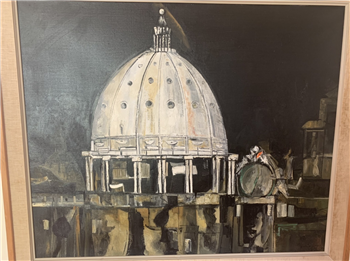 Edgar Louis Ewing was born in Hartington, Nebraska in 1913. Upon graduating high school he moved to Chicago to pursue training at the Art Institute of Chicago. Recognized as a promising young artist, he was given an art fellowship to study in Europe, where he would come to return many times over. Ewing's travels throughout his life, through Africa, Europe, and the Middle East, promoted great artistic inspiration. He was especially intrigued by the history of Ancient Greece and would eventually paint his Roman Series, one of the artist's most important works.
Ewing fought in World War II, but upon the War's end Ewing resumed working as an artist. Offered a teaching position on the West Coast the artist began teaching at the University of Southern California, where he would remain for the majority of his career. Art schools in Los Angeles were immensely important during the mid-century. Without the extensive infrastructure of museums, galleries, collectors, and criticism that existed on the East Coast, California art schools became the primary outlets of artistic innovation and collaboration. An entire school of progressive artists worked, exhibited, and taught together at Los Angeles's various art schools including Otis Art Institute (founded in 1918), Chouinard Art Institute (founded in 1921), and Jepson Art Institute (founded in 1947). Ewing was part of this community and taught alongside the important Hungarian/American artist Francis De Erdely while at USC. Edgar Ewing's artistic achievements are prolific, he exhibited widely, and received extensive critical acclaim.
by Alissa J. Anderson
Sources include:
Schaad, Bentley. The Realm of Contemporary Still Life Painting. (New York: Reinhold Pub, 1962).
Karlstrom, Paul and Susan Ehrlich. Turning the Tide: Early Los Angeles Modernists, 1920-1956. (Santa Barbara: Santa Barbara Museum of Art, 1990).
Dailey, Victoria, Natalie Shivers, and Michael Dawson. L.A.'s Early Moderns: Art, Architecture, Photography. (Los Angeles: Balcony Press, 2003).
Jerome Allan Donson. Arts of Southern California - II: Painting, (Long Beach: Long Beach Museum of Art, 1958)