Page loaded successfully. Showing biography for Edmund Daniel Kinzinger.
Edmund Daniel Kinzinger BIOGRAPHY

1888 Pforzheim, Germany - 1963 North Carolina. Known for: Modernist Indian figure, portrait and genre painting.
Edmund Kinzinger was born at Pforzheim, Grand Duchy of Baden, German empire, and attended the Knirr Schule, Munich (1908 - 1910), followed by periods at the Staatliche Akademie, Munich (19109 -... Read full biography
Edmund Kinzinger was born at Pforzheim, Grand Duchy of Baden, German empire, and attended the Knirr Schule, Munich (1908 - 1910), followed by periods at the Staatliche Akademie, Munich (19109 - 1910), and the Staatliche Akademie, Stuttgart (1910 - 1912). He was a graduate student at the Academie... Read full biography
Edmund Kinzinger was born at Pforzheim, Grand Duchy of Baden, German empire, and attended the Knirr Schule, Munich (1908 - 1910), followed by periods at the Staatliche Akademie, Munich (19109 - 1910), and the Staatliche Akademie, Stuttgart (1910 - 1912). He was a graduate student at the Academie Moderne, Paris (1912 - 1913), and a master student of Adolph Holzel at the Staatliche Akademie, Stuttgart (1913 - 1914), supporting himself by painting portraits. Entering the German army in 1914 as a... Read full biography
Edmund Kinzinger was born at Pforzheim, Grand Duchy of Baden, German empire, and attended the Knirr Schule, Munich (1908 - 1910), followed by periods at the Staatliche Akademie, Munich (19109 - 1910), and the Staatliche Akademie, Stuttgart (1910 - 1912). He was a graduate student at the Academie Moderne, Paris (1912 - 1913), and a master student of Adolph Holzel at the Staatliche Akademie, Stuttgart (1913 - 1914), supporting himself by painting portraits. Entering the German army in 1914 as a private soldier, Kinzinger rose after nearly five years at the front, and two wounds, to command an artillery unit. Released from active service in 1918, he studied as a master student of Henrich Waldschmidt, again at the Staatliche Akademie,... Read full biography
Edmund Kinzinger was born at Pforzheim, Grand Duchy of Baden, German empire, and attended the Knirr Schule, Munich (1908 - 1910), followed by periods at the Staatliche Akademie, Munich (19109 - 1910), and the Staatliche Akademie, Stuttgart (1910 - 1912). He was a graduate student at the Academie Moderne, Paris (1912 - 1913), and a master student of Adolph Holzel at the Staatliche Akademie, Stuttgart (1913 - 1914), supporting himself by painting portraits. Entering the German army in 1914 as a private soldier, Kinzinger rose after nearly five years at the front, and two wounds, to command an artillery unit. Released from active service in 1918, he studied as a master student of Henrich Waldschmidt, again at the Staatliche Akademie, stuttgart (1919 - 1921). From 1924 to 1928, Kinzinger taught in Munich, where he met Alice Fish Kinzinger, an American; they were married in 19... Read full biography
Artist Biography
Biography page for Edmund Daniel Kinzinger ((1888 - 1963)), known for Modernist Indian figure, portrait and genre painting. Showing 4 biographical entries and 0 sample artworks.
Edmund Daniel Kinzinger - Artist Info
About Edmund Daniel Kinzinger
Biography from the Archives of askART
 Edmund Kinzinger was born at Pforzheim, Grand Duchy of Baden, German empire, and attended the Knirr Schule, Munich (1908 - 1910), followed by periods at the Staatliche Akademie, Munich (19109 - 1910), and the Staatliche Akademie, Stuttgart (1910 - 1912). He was a graduate student at the Academie Moderne, Paris (1912 - 1913), and a master student of Adolph Holzel at the Staatliche Akademie, Stuttgart (1913 - 1914), supporting himself by painting portraits.
Entering the German army in 1914 as a private soldier, Kinzinger rose after nearly five years at the front, and two wounds, to command an artillery unit. Released from active service in 1918, he studied as a master student of Henrich Waldschmidt, again at the Staatliche Akademie, stuttgart (1919 - 1921).
From 1924 to 1928, Kinzinger taught in Munich, where he met Alice Fish Kinzinger, an American; they were married in 1927. Kinzinger traveled to the United States to teach at the Minneapolis Art Institute in the summer of 1928 and then at the Minneapolis Art Students League (1929 - 1930). He painted in Taxco, Mexico, in the summer of 1930. From 1930 until 1933, Kinzinger was director of the Hans Hoffman Schule fur Bildende Kuntz, Munich, and the Hoffman Self-Study Course in California. During the same period, he taught in Spain and St. Tropez, France. He also served as director of the Ecole de l'Epoque, Paris (1933 - 1934).
Fleeing Nazi Germany, Kinzinger came again to the United State,s and in 1935 became chairman of the art department at Baylor University, Waco, a position he would hold for the next thirteen years. In the years 1939 - 1942, Kinzinger attended summer sessions at the University of Iowa, Iowa City, and his dissertation - a series of paintings on a Mexican theme - earned for him in 1942 the first doctorate in fine arts conferred by the University of Iowa.
Beginning in 1944, Kinzinger painted summers in Taos. Troubled by depression for a number of years, Kinzinger was divorced in 1947 and stopped painting in 1948 when he moved to live with his son in Delavan, Wisconsin. After 1960 he was a resident of North Carolina where he died of a stroke.
From the website of David Dike Fine Art
Source:
Texas Painters, Sculptors & Graphic Artists by John and Deborah PowersBiography from the Archives of askART
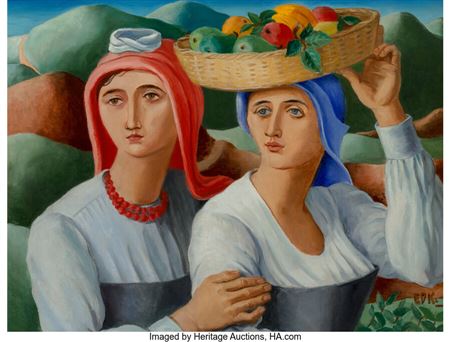 Modernist painter, sculptor and teacher Edmund Daniel Kinzinger was born to a minor aristocratic family in Germany in 1888. He studied in Germany and in Paris, France with Leger and Matisse.
He fought in World War I with the German Army, suffering shell shock. He subsequently received his Ph.D. degree from the University of Iowa, Iowa City.
In 1931-1932, Kinzinger taught at Hans Hofmann's School of Art in Munich, Germany, discussing Hofmann's theories of non-objectivity, that painting should be autonomous, without reference to reality.
He worked in Texas from 1936-1953, living in Waco and chairing the art department at Baylor University. He exhibited at the Houston Museum of Fine Art, in Texas.
His work is in the collection of the Muscarelle Museum of Art of the College of William and Mary, in Williamsburg, Virginia; and the Dallas Museum of Art, Texas.
Edmund Kinzinger died in 1963.
Source:
http://musicka.freeyellow.com/page29.htmlBiography from Foltz Fine Art
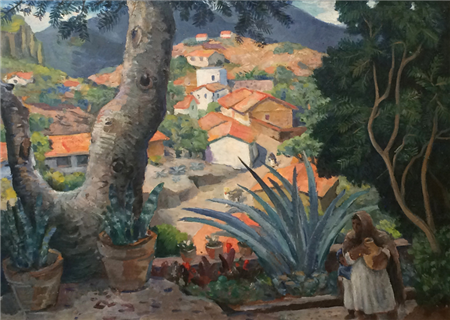 EDMUND KINZINGER (1888-1963)
Edmund Kinzinger was born in 1888 at Pforzheim, Grand Duchy of Baden, German Empire. Growing up in a minor aristocratic family, Kinzinger pursued his passion for art through a variety of schools in Germany in Paris, studying with Leger and Matisse. He was also a master student of Adolph Holzel’s during his time in Germany. In 1914, Kinzinger entered the German army as a private solider and after nearly five years at the front and two wounds, rose to command an artillery unit until his discharge in 1918.
After he returned, Kinzinger taught in Munich from 1924 to 1928. In the summer of 1928, he traveled to the United States to teach at the Minneapolis Art Institute and later the Minneapolis Students league. When he returned to Germany, Kinzinger was director of the Hans Hoffman Schule for Bildende Kuntz, Munich and the Hoffman Self-Study Course in California. During the same three year period from 1930 to 1933, he taught in both Spain and St. Tropez and served as director of the Ecole de l’Epoque in Paris.
In 1935, Kinzinger fled Nazi Germany and settled in Texas, becoming the chairman of the art department at Baylor University. Kinzinger would hold the position for the following thirteen years. From 1939 to 1942, Kinzinger attended summer sessions at the University of Iowa and his 1942 doctorate earned him the first PhD in fine arts awarded by the university. Kinzinger continued work until 1948 and moved to Wisconsin, leaving his unique Modernist mark upon the Texas art scene.
Selected Biographical and Career Highlights
1888, Born at Pforzheim, Grand Duchy of Baden, German Empire
1908-1910, Attends the Knirr Scule, Munich, Germany
1909-1910, Attends the Staatliche Akademie, Munich, Germany
1910-1912, Attends the Staatliche Akademie Stuttgart, Germany
1912-1913, Graduate student at the Academie Moderne, Paris, France
1913-1914, Master student at the Staatliche Akademie, Stuttgart, Germany
1914, Enters the German army
1918, Released from active service
1919-1921, Studies at the Staatliche Akademie, Stuttgart, Germany
1924-1928, Teaches in Munich, Germany
1935, Becomes chairman of the art department, Baylor University, Waco, Texas
1960, Dies in North Carolina
Selected Exhibitions
Art Institute of Chicago, Chicago, Illinois
Museum of Fine Arts Houston, Houston, Texas
Selected Public Collections
Dallas Museum of Art, Dallas, Texas
Muscarelle Museum of Art, College of William and Mary, Williamsburg, VA
Museum of Fine Arts, Houston, Texas
San Antonio Museum of Art, San Antonio, TexasBiography from G. Carr Ltd.
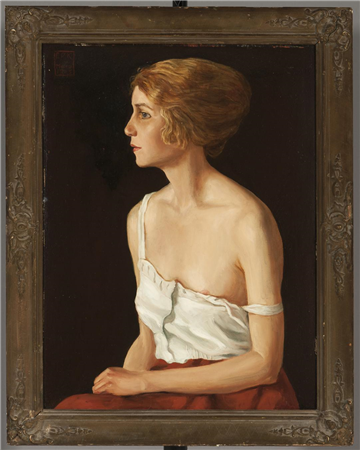 When asked about his art Dr. Edmund Daniel Kinzinger wrote [ circa 1944 ]
"In order to clarify my relationship to a school, I should call myself a follower of the intellectual principles of Cubism. I have been deeply impressed by the cubist pictures of the French school from the time I first saw them in 1910 and have worked in that direction ever since. Being of a rather romantic nature, however, and very much bound to direct impressions, my development reveals many conflicts.
It is in the character of our age that artist change their style from time to time, inclining more to abstract form at one moment and leaning more toward representation at another. In all epochs previous to the late 19th century, the understanding of other periods was restricted by lack of historical knowledge and easy communication. Therefore the isolated artist had to rely largely on his local tradition.
To day, we have a thorough knowledge not only of the contemporary art of all countries, but also of nearly all the past of human race. The resulting influences on intelligent and informed artists are manifold, and change of style, as long as it is consistent with the artist's personality, is rather a sign of spiritual flexibility than lack of conviction, as it is sometimes interpreted by unimaginative observers. Only through doubt and experiment are invention and progress possible".