Page loaded successfully. Showing biography for Edward Brodney.
Edward Brodney BIOGRAPHY
1910 Boston, Massachusetts - 2002 Lake Worth, Florida. Known for: Polo sport genre watercolor painting, child figure, landscape, camouflage artist.
The following obituary is from The New York Times. "Edward Brodney, 92, Who Painted War Scenes" by Douglas Martin, August 19, 2002. Edward Brodney, an artist assigned by the Army to paint idyllic... Read full biography
The following obituary is from The New York Times. "Edward Brodney, 92, Who Painted War Scenes" by Douglas Martin, August 19, 2002. Edward Brodney, an artist assigned by the Army to paint idyllic pictures showing World War II soldiers praying, eating and playing baseball -- anything but being blown... Read full biography
The following obituary is from The New York Times. "Edward Brodney, 92, Who Painted War Scenes" by Douglas Martin, August 19, 2002. Edward Brodney, an artist assigned by the Army to paint idyllic pictures showing World War II soldiers praying, eating and playing baseball -- anything but being blown apart by bombs -- died on Aug. 3 at his home in Lake Worth, Fla. He was 92. His daughter, Jeanne Brodney, said he had strict orders to show ''no blood or guts'' in his paintings, which were... Read full biography
The following obituary is from The New York Times. "Edward Brodney, 92, Who Painted War Scenes" by Douglas Martin, August 19, 2002. Edward Brodney, an artist assigned by the Army to paint idyllic pictures showing World War II soldiers praying, eating and playing baseball -- anything but being blown apart by bombs -- died on Aug. 3 at his home in Lake Worth, Fla. He was 92. His daughter, Jeanne Brodney, said he had strict orders to show ''no blood or guts'' in his paintings, which were reproduced and sent to newspapers throughout the United States. The essential idea, the Army's public relations department stressed, was to show Americans that the soldiers were safe, at least some of the time. But in many cases the pictures transcended their... Read full biography
The following obituary is from The New York Times. "Edward Brodney, 92, Who Painted War Scenes" by Douglas Martin, August 19, 2002. Edward Brodney, an artist assigned by the Army to paint idyllic pictures showing World War II soldiers praying, eating and playing baseball -- anything but being blown apart by bombs -- died on Aug. 3 at his home in Lake Worth, Fla. He was 92. His daughter, Jeanne Brodney, said he had strict orders to show ''no blood or guts'' in his paintings, which were reproduced and sent to newspapers throughout the United States. The essential idea, the Army's public relations department stressed, was to show Americans that the soldiers were safe, at least some of the time. But in many cases the pictures transcended their military purpose, telling far more than photographs or movies. They could freeze moments, capture moods. Mr. Brodney... Read full biography
Artist Biography
Biography page for Edward Brodney ((1910 - 2002)), known for Polo sport genre watercolor painting, child figure, landscape, camouflage artist. Showing 2 biographical entries and 0 sample artworks.
Edward Brodney - Artist Info
About Edward Brodney
Biography from the Archives of askART
 The following obituary is from The New York Times
"Edward Brodney, 92, Who Painted War Scenes" by Douglas Martin, August 19, 2002
Edward Brodney, an artist assigned by the Army to paint idyllic pictures showing World War II soldiers praying, eating and playing baseball -- anything but being blown apart by bombs -- died on Aug. 3 at his home in Lake Worth, Fla. He was 92.
His daughter, Jeanne Brodney, said he had strict orders to show ''no blood or guts'' in his paintings, which were reproduced and sent to newspapers throughout the United States. The essential idea, the Army's public relations department stressed, was to show Americans that the soldiers were safe, at least some of the time.
But in many cases the pictures transcended their military purpose, telling far more than photographs or movies. They could freeze moments, capture moods. Mr. Brodney told this story in an interview with CBS News in 1995:
''It's Sunday morning. I come out there, and the chaplain is getting ready, the men are coming down and kneeling. I looked up and that cathedral -- a jungle cathedral -- the lights were streaking down through the trees. It was magnificent. There was a holiness in this place, and it was only a jungle. But a camera would never get it.''
Edward Brodney was born in Boston on April 15, 1910. His father was a fisherman who also owned a fish store. He started formal studies at the School of the Museum of Fine Arts and at the Massachusetts College of Art while he was still at English High School in Boston. He also studied at the School of Fine Arts at Yale before finishing a six-year course at the museum school.
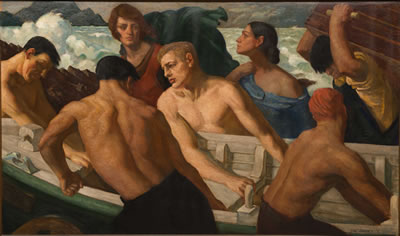
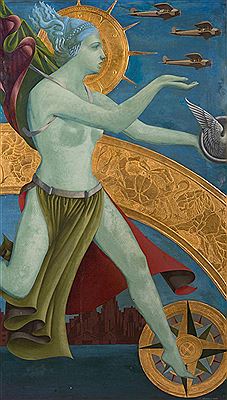
In 1936 Mr. Brodney won a competition sponsored by the Federal Works Progress Administration, which supported many artistic projects during the Depression, to paint a mural for the Massachusetts Statehouse. It was called ''Columbia Knighting Her World War Disabled,'' and he persuaded friends to pose, since the W.P.A. could not afford models.
The next year he won a competition to paint a mural for the city hall in Newton, where he lived until moving permanently to Florida several years ago. It memorialized the Rev. William J. Farrell, a heroic World War I chaplain.
Then in 1938 Mr. Brodney won another W.P.A. competition to paint a second mural in the Statehouse. Called ''World War Mothers,'' it is one of a handful of military murals with women as subjects. Mr. Brodney used poor women in settlement houses as models to capture ''a faraway look of wanting and loss.'' After federal funds ran out, he used his own money to finish the project.
In 1940 Mr. Brodney was drafted into the Army, under a program that required just one year of service. He saw it as an artistic opportunity.
''I feel it will open up a new field for my work,'' he said in an interview with The Boston Globe in 1941.
It did. He was assigned to paint ''YD,'' for Yankee Division, on what seemed like an endless inventory of trucks and jeeps at Camp Edwards on Cape Cod.
He had his release papers in hand on Dec. 7, 1941, when the Japanese bombed Pearl Harbor. He was soon on a ship to the South Pacific, where the war became real when he heard the voice of Tokyo Rose, the Japanese propaganda broadcaster, mention the name of his ship.
Mr. Brodney was among the first American troops to land on New Caledonia. Though officially a medic, he carried sketchbooks, watercolors and oil paints. When a general saw how well he had camouflaged the tents of his medical compound, he was made chief of camouflage for all of New Caledonia.
When another general saw some of his paintings, he was assigned to the public relations staff. His first job was to paint portraits of aces -- those pilots who had shot down at least five enemy planes -- to be sent to their hometown newspapers.
As the war progressed, he moved through the South Pacific with American troops. He painted many pictures of the wounded, as well as scenes of gruesome combat, which were not part of his public relations work.
After the war Mr. Brodney returned to Boston, where he married the former Libby Fireman. In addition to his wife and his daughter, who lives in Wayland, Mass., he is also survived by his brothers Oscar, of Beverly Hills, and Fred, of Newton; his sister, Betty Feldman of Martha's Vineyard; his son, Richard, of Boston; five grandchildren; and one great-grandson.
After the war he opened a gallery selling art and antiques. After almost dying of pneumonia at 65, he returned to painting full time, turning the gallery over to his son.
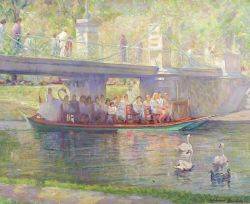
He loved to paint the sailboats and polo fields and perfect days filled with perfect light. The family did not know he had 120 paintings from World War II in his basement until someone from the Pentagon called in 1995 to ask if he kept any of his wartime work.
''All of a sudden this incredible story came out,'' his daughter said.Biography from the Archives of askART
 Edward Brodney was born in Boston, Massachusetts, in 1910. He studied art at the School of the Museum of Fine Art, Boston, and at the Massachusetts College of Art before attending Yale University where he graduated with a degree from the School of Fine Art.
At the age of twenty-six Brodney became a Works Progress Administration artist with mural commissions at the Massachusetts State House and City Hall of Newton, Massachusetts.
After wartime service where Brodney completed 120 portraits of wartime ace pilots now in the Pentagon Collection, Brodney opened a studio and antiques emporium and gallery in Boston.
At the age of sixty-five he retired to Lake Worth, Florida near Palm Beach and the city of Wellington, home to the National Horse Show, where horses and polo preoccupied his time until his death in Lake Worth in 2002.
Known as masterworks of equestrian painting, Brodney's drawings and watercolors have been reproduced in every equestrian and polo magazine in the United States and throughout the world. A large body of his estate watercolors are now in the collection of the Cici and
Hyatt Brown Museum of Art at the Museum of Arts and Sciences, Daytona Beach,
Florida.
Written and submitted by Gary R. Libby, author of Reflections II: Watercolors of Florida 1865-1965