Page loaded successfully. Showing biography for Edward Wormley.
Edward Wormley BIOGRAPHY
1907 Oswego, Illinois - 1995. Known for: Furniture design, teaching.
Lots Sold: 92%, High Price: Subscribe.
Edward J Wormley was born in 1907 in a small town outside of Chicago. While in high school, he took a correspondence course from the New York School of Interior Design. After graduating he attended... Read full biography
Edward J Wormley was born in 1907 in a small town outside of Chicago. While in high school, he took a correspondence course from the New York School of Interior Design. After graduating he attended the Art Institute of Chicago. Once his three years of study at the school were complete, he began... Read full biography
Edward J Wormley was born in 1907 in a small town outside of Chicago. While in high school, he took a correspondence course from the New York School of Interior Design. After graduating he attended the Art Institute of Chicago. Once his three years of study at the school were complete, he began training in interior design at Marshall Field & Company. He was soon designing for the Grand Rapids furniture firm of Berkey and Gay. Wormley's work for the company included reproductions of 18th century... Read full biography
Edward J Wormley was born in 1907 in a small town outside of Chicago. While in high school, he took a correspondence course from the New York School of Interior Design. After graduating he attended the Art Institute of Chicago. Once his three years of study at the school were complete, he began training in interior design at Marshall Field & Company. He was soon designing for the Grand Rapids furniture firm of Berkey and Gay. Wormley's work for the company included reproductions of 18th century English furniture. In the early 1930s, Edward Wormley took a trip to Europe that broadened his interest in design. Shortly thereafter, Wormley became a major designer for the Dunbar Furniture Company, which had been in business since 1912 and now... Read full biography
Edward J Wormley was born in 1907 in a small town outside of Chicago. While in high school, he took a correspondence course from the New York School of Interior Design. After graduating he attended the Art Institute of Chicago. Once his three years of study at the school were complete, he began training in interior design at Marshall Field & Company. He was soon designing for the Grand Rapids furniture firm of Berkey and Gay. Wormley's work for the company included reproductions of 18th century English furniture. In the early 1930s, Edward Wormley took a trip to Europe that broadened his interest in design. Shortly thereafter, Wormley became a major designer for the Dunbar Furniture Company, which had been in business since 1912 and now operated out of Berne, Indiana. Worley left Dunbar briefly during the war years to work for t... Read full biography
Artist Biography
Biography page for Edward Wormley ((1907 - 1995)), known for Furniture design, teaching. Showing 2 biographical entries and 0 sample artworks.
Edward Wormley - Artist Info
About Edward Wormley
Biography from Rago Arts and Auction
Edward J Wormley was born in 1907 in a small town outside of Chicago. While in high school, he took a correspondence course from the New York School of Interior Design. After graduating he attended the Art Institute of Chicago. Once his three years of study at the school were complete, he began training in interior design at Marshall Field & Company. He was soon designing for the Grand Rapids furniture firm of Berkey and Gay. Wormley's work for the company included reproductions of 18th century English furniture. In the early 1930s, Edward Wormley took a trip to Europe that broadened his interest in design.
Shortly thereafter, Wormley became a major designer for the Dunbar Furniture Company, which had been in business since 1912 and now operated out of Berne, Indiana. Worley left Dunbar briefly during the war years to work for the government as head of the Furniture Unit in the Office of Price Administration. He then returned to Dunbar as an independent consultant in 1944. A year later, Worley opened his own design studio in New York.
During its formative years, Dunbar became synonymous with the highest quality furniture for modern living. (1) With Worley's designs, the company could hardly have failed. His furniture fit in seamlessly with modern and traditional decor.(2) Dunbar produced two lines a year, with an average of a hundred pieces per line, for thirty-seven years. Despite all this production, Dunbar employed little automation. Finishes and designs could be customized by the client, including rare wood veneers, intricate carving, and Murano glass inlays.
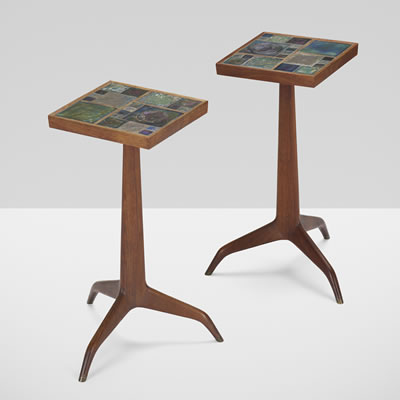
The Janus collection, introduced in 1957, was one of the most memorable Wormley/Dunbar collaborations and included inlay work of Tiffany glass tiles. During his long career, Wormley also managed to teach at the Parsons School of Design and was awarded the Elsie de Wolf award in 1962.
He died in 1995.
Footnotes:
1. Johnson, Erin. "Edward Wormley" in ed. Todd Merrill and Julie V. Iovine, Modern Americana (New York: Rizzoli, 2008) p. 218
2. Ibid, p.218Biography from Wright
Born in rural Illinois in 1907, Edward Wormley’s interest in design originated early in life and led him to later study at the School of the Art Institute of Chicago. Due to financial reasons, Wormley dropped out after 2 years and began his first job in an interior design studio before joining the Indiana-based Dunbar Furniture Company where he served as director of design for nearly 40 years.
Following World War II, Wormley became an independent consultant branching out to design textiles, globe stands, and showrooms. He designed award winning collections for Drexel Furniture Company and was included in the Good Design shows of the Museum of Modern Art, New York. Characteristic of his design elements were functional engineering, decorative laminated plywood, and unconventional upholstery. Wormley characteristically honored aesthetic qualities, following influences of Scandinavian modernism, while maintaining utilitarian qualities and “designing for the needs” of others. His work is timeless and of the highest quality.
Wormley died in 1995, but his legacy is celebrated in collections including the Museum of Fine Arts Boston and the Museum of Decorative Arts in Montreal.