Page loaded successfully. Showing biography for Edwin Tappan Adney.
Edwin Tappan Adney BIOGRAPHY
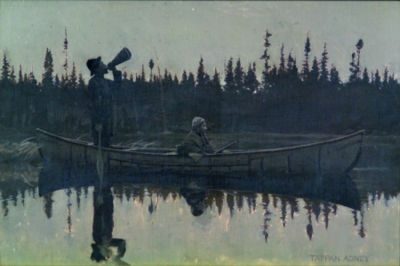
1868 Athens, Ohio - 1950 Woodstock, New Brunswick, Canada. Known for: Reportorial artist, outdoor life scene easel and mural painting, military, heraldry.
Edwin Tappan Adney was an artist, a writer, a photographer and the man credited with saving the art of birch bark canoe construction. He built more than 100 models of different types, which are now... Read full biography
Edwin Tappan Adney was an artist, a writer, a photographer and the man credited with saving the art of birch bark canoe construction. He built more than 100 models of different types, which are now housed at the Mariners' Museum in Newport News, Virginia. He authored a book, The Klondike Stampede... Read full biography
Edwin Tappan Adney was an artist, a writer, a photographer and the man credited with saving the art of birch bark canoe construction. He built more than 100 models of different types, which are now housed at the Mariners' Museum in Newport News, Virginia. He authored a book, The Klondike Stampede about the Klondike Gold Rush. He was one of the first photojournalists to pass safely through British Columbia. As a writer for Harper's Weekly, he was sent with his camera to the Yukon from 1897 to... Read full biography
Edwin Tappan Adney was an artist, a writer, a photographer and the man credited with saving the art of birch bark canoe construction. He built more than 100 models of different types, which are now housed at the Mariners' Museum in Newport News, Virginia. He authored a book, The Klondike Stampede about the Klondike Gold Rush. He was one of the first photojournalists to pass safely through British Columbia. As a writer for Harper's Weekly, he was sent with his camera to the Yukon from 1897 to 1898. His classic illustrated book concerns his experiences in the Yukon, of which numerous editions have been printed. He returned there to briefly report on the Nome Gold Rush in 1900. He retired first to Montreal, then to New Brunswick, the place... Read full biography
Edwin Tappan Adney was an artist, a writer, a photographer and the man credited with saving the art of birch bark canoe construction. He built more than 100 models of different types, which are now housed at the Mariners' Museum in Newport News, Virginia. He authored a book, The Klondike Stampede about the Klondike Gold Rush. He was one of the first photojournalists to pass safely through British Columbia. As a writer for Harper's Weekly, he was sent with his camera to the Yukon from 1897 to 1898. His classic illustrated book concerns his experiences in the Yukon, of which numerous editions have been printed. He returned there to briefly report on the Nome Gold Rush in 1900. He retired first to Montreal, then to New Brunswick, the place where his wife was born. He married Minnie Bell Sharp of Woodstock, New Brunswick in 1899. She was the subject of a trial wh... Read full biography
Artist Biography
Biography page for Edwin Tappan Adney ((1868 - 1950)), known for Reportorial artist, outdoor life scene easel and mural painting, military, heraldry. Showing 2 biographical entries and 0 sample artworks.
Edwin Tappan Adney - Artist Info
About Edwin Tappan Adney
Name variants
Tappan Adney
Biography from the Archives of askART
 Edwin Tappan Adney was an artist, a writer, a photographer and the man credited with saving the art of birch bark canoe construction. He built more than 100 models of different types, which are now housed at the Mariners' Museum in Newport News, Virginia. He authored a book, The Klondike Stampede about the Klondike Gold Rush.
He was one of the first photojournalists to pass safely through British Columbia. As a writer for Harper's Weekly, he was sent with his camera to the Yukon from 1897 to 1898. His classic illustrated book concerns his experiences in the Yukon, of which numerous editions have been printed. He returned there to briefly report on the Nome Gold Rush in 1900. He retired first to Montreal, then to New Brunswick, the place where his wife was born.
He married Minnie Bell Sharp of Woodstock, New Brunswick in 1899. She was the subject of a trial when she refused to pay her School Taxes.
In 1916, he joined the Royal Canadian Engineers. He became a Canadian citizen in 1917. He spent his World War I career as an engineering officer at the Royal Military College of Canada in Kingston, Ontario (1916 - 1919) constructing scale models of fortifications for training purposes. After the war, he created a set of three-dimensional shields of the Canadian provinces that adorn Currie Hall at Royal Military College of Canada.
In Montreal, Quebec he created heraldic art, worked for the Museum of McGill University as a consultant on aboriginal lore, and consulted to McCord Museum on canoes 1920-33.
The lobby of the Hudson's Bay Company store on the corner of Portage Avenue and Memorial Boulevard in Winnipeg, Manitoba c. 1925 was decorated with immense murals depicting scenes of the Company's early history by Edward Tappan Adney. Although one mural was removed, The Pioneer" at Fort Garry, 1861 - remains to this day.
He then moved to Montreal, Quebec 1920-33 where he created heraldic art, worked for the Museum of McGill University as a consultant on aboriginal lore, and consulted to McCord Museum on canoes.
He is buried in the Upper Woodstock Cemetery, Woodstock, New Brunswick.
Bibliography
• The Klondike Stampede, by Tappan Adney, Special Correspondent of Harper's Weekly in the Klondike (New York: Harpers, 1900).
• The Sharp Family, 1908
• The Bark Canoes and Skin Boats of North America, Bulletin of the United States National Museum, with Howard I. Chappelle, 1964
Source:
http://en.wikipedia.org/wiki/Tappan_Adney
---------
Amazon Description of The Bark Canoes and Skin Boats of North America
The bark canoes of the North American Indians, particularly those of birchbark, were among the most highly developed manually propelled primitive watercraft. Built with Stone Age tools from available materials, their design, size, and appearance were varied to suit the many requirements of their users. Even today, canoes are based on these ancient designs, and this fascinating guide combines historical background with instructions for constructing one. Author Edwin Tappan Adney, born in 1868, devoted his life to studying canoes and was practically the sole scholar in his field. His papers and research have been assembled by a curator at the Smithsonian Institution, and illustrated with black-and-white line drawings, diagrams, and photos.Biography from the Archives of askART
 A reportorial artist, illustrator, painter, writer and creator of heraldic designs, Edwin Adney was especially known for his interest in out door life with focus on learning the craft of canoe making from the Malecite Indians in the New Brunswick area of Canada. In addition, he became a field artist for the London Chronicle, reporting from the Klondike during the Gold Rush in 1897 and 1898, and for Collier's Weekly at Cape Nome, Alaska in 1900. Reflecting his various experiences and expertise, he wrote and illustrated books including The Bark Canoes and Skin Boats of North America, Outdoor Book for Boys and Birds of North America.
Edwin Adney was born in Athens, Ohio. His father was a military officer and professor, who apparently stirred his son's interest in military subjects. He studied for three years at the Art Students League of New York. With an interest in ornithology, he spent much time during this period in natural history museums, meeting with Ernest Thompson Seton and other naturalists. He also spent time at the University of North Carolina, where he did a lot of outdoor sketching, especially birds.
In 1887, he vacationed at Woodstock, New Brunswick and became friends with Peter Joe, a Malecite Indian who taught him tribal crafts and language. In 1889, they each built a canoe together with Peter Joe overseeing the projects and Adney recording every step. The results were published in Harper's Young People magazine, July 29, 1890. The Boating Book for Boys then carried a revised version of the article. During his lifetime Adney, using what he had learned from Peter Joe, made many full and model size canoes, called 'skin boats', leaving more than 100 in the Mariner's Museum of Newport News, Virginia.
In 1897, Adney went to the gold rush area of the Klondike as artist-correspondent for Harper's Weekly and the London Chronicle. His book, Klondike Stampede, was published in 1900, the same year that he went to Nome, Alaska to report on the gold rush there for Collier's Magazine.
He moved to Montreal, became a citizen of Canada, and served in the Canadian Army during World War I but was not sent overseas. After the war, he lived in Montreal as a painter, illustrator, Indian lore consultant, builder of canoes including scale models, and correspondent with Indians, government agents on the Indian reservations, and with retired employee friends of the Hudson Bay Company. He knew the language of many of the Indians, which, of course, much helped his study of their culture.
In the early 1930s, he settled again in Woodstock, where his wife died in 1937. He continued his research, writing and art-related activities until his death in 1950.
Adney's son, Glenn deposited his father's materials to be archived in the Mariner's Museum
Source:
Dan L. Thrapp, Encyclopedia of Frontier Biography, Volume I