Page loaded successfully. Showing biography for Elaine Fried de Kooning.
Elaine Fried de Kooning BIOGRAPHY

1918 New York City - 1989 New York City. Known for: Abstract figure, genre and portrait painting.
Elaine DeKooning was born and grew up in Brooklyn, New York and spent her childhood studying the lives of artists and visiting the museums and galleries of New York City. After high school she... Read full biography
Elaine DeKooning was born and grew up in Brooklyn, New York and spent her childhood studying the lives of artists and visiting the museums and galleries of New York City. After high school she attended the American Artists School and the Leonardo da Vinci School and was swept up in the cultural... Read full biography
Elaine DeKooning was born and grew up in Brooklyn, New York and spent her childhood studying the lives of artists and visiting the museums and galleries of New York City. After high school she attended the American Artists School and the Leonardo da Vinci School and was swept up in the cultural excitement in New York of the late 1930s and early 1940s. In 1943 she married Willem de Kooning, one of the group of artists soon to emerge as the first generation of Abstract Expressionists. He was... Read full biography
Elaine DeKooning was born and grew up in Brooklyn, New York and spent her childhood studying the lives of artists and visiting the museums and galleries of New York City. After high school she attended the American Artists School and the Leonardo da Vinci School and was swept up in the cultural excitement in New York of the late 1930s and early 1940s. In 1943 she married Willem de Kooning, one of the group of artists soon to emerge as the first generation of Abstract Expressionists. He was sixteen years older than she. Elaine never completely abandoned representation. A substantial part of her career had been devoted to portraiture, for which she was particularly known in the 1950s and 1960s. Her most famous portrait commission was of... Read full biography
Elaine DeKooning was born and grew up in Brooklyn, New York and spent her childhood studying the lives of artists and visiting the museums and galleries of New York City. After high school she attended the American Artists School and the Leonardo da Vinci School and was swept up in the cultural excitement in New York of the late 1930s and early 1940s. In 1943 she married Willem de Kooning, one of the group of artists soon to emerge as the first generation of Abstract Expressionists. He was sixteen years older than she. Elaine never completely abandoned representation. A substantial part of her career had been devoted to portraiture, for which she was particularly known in the 1950s and 1960s. Her most famous portrait commission was of President John F. Kennedy, which she was trying to complete at the time of his assassination. During most of her... Read full biography
Artist Biography
Biography page for Elaine Fried de Kooning ((1918 - 1989)), known for Abstract figure, genre and portrait painting. Showing 4 biographical entries and 0 sample artworks.
Elaine Fried de Kooning - Artist Info
About Elaine Fried de Kooning
Name variants
Elaine Marie Fried de Kooning, Elaine Fried
Biography from the Archives of askART
 Elaine DeKooning was born and grew up in Brooklyn, New York and spent her childhood studying the lives of artists and visiting the museums and galleries of New York City. After high school she attended the American Artists School and the Leonardo da Vinci School and was swept up in the cultural excitement in New York of the late 1930s and early 1940s. In 1943 she married Willem de Kooning, one of the group of artists soon to emerge as the first generation of Abstract Expressionists. He was sixteen years older than she.
Elaine never completely abandoned representation. A substantial part of her career had been devoted to portraiture, for which she was particularly known in the 1950s and 1960s. Her most famous portrait commission was of President John F. Kennedy, which she was trying to complete at the time of his assassination. During most of her career she had drawn and painted the male figure. She painted in series and she tended to work on a series for long periods and to work on many canvases within a series simultaneously. When the image was transferred to her canvases, it disintegrated into fragments of pattern and color as the dashes of greens, lavenders and yellows re-created the experience of sky, figure and forest dissolving into the fracturing sunlight.
Like Lee Krasner, wife of Jackson Pollock, Elaine spent much of her life making sure that her husband was the biggest success that she could make him. Whatever time was lost from her own career had been well spent in service to her husband's genius. She followed him into a period of alcoholism. But their marriage was not always happy and Elaine was known to have affairs, although with two of the art world's most famous opinion-makers, who helped make sure Bill de Kooning got good publicity.
Long interested in animal forms, DeKooning made several excursions in 1983 to see the pre-historic caves in southern France and northern Spain. She made sketches in her hotel room after visiting the sites and then translated this material into larger paintings back in the United States. She uses high-keyed colors and the vigorous brushwork of the Abstract Expressionism, declining to mimic the original cave drawings. The work is powerful, suggestive, and at the same time, delicate and painterly.
Eventually, Elaine stopped drinking and reestablished herself as Bill's legal wife, again managing his career at the business end. But her luck didn't hold and at the age of seventy in 1989 she died of lung cancer, having been a very heavy smoker.
Sources include:
National Museum of Women in the Arts
Miriam Brumer in Art News, October 1986
Grace Glueck, a book review in ARTnews, Summer, 1993
Time Magazine, May 3, 1963
Painting Paleolithic by Rose Slivka in Art in America in December 1988
Compiled and written by Jean Ershler Schatz, artist and researcher of Laguna Woods, California.Biography from the Archives of askART
 Born and raised in Brooklyn, New York, Elaine de Kooning became a noted Abstract Expressionist* painter who also pursued portrait painting in a semi-realist style. However, like so many women artists of that era who married artists, her career was sublimated to that of her famous husband, Willem de Kooning. They became the leaders of the New York School* of painting social set in the 1940s, 50s and 60.
In 1943, she married de Kooning, a Dutch immigrant artist, and together and apart they worked relentlessly on their painting and she on the promotion of her husband's talents. During their early years, they were exceedingly poor, and in the last decade of their life together had millions of dollars because of the money earned from his paintings. In retrospect, she is credited as the significant influence on making Willem de Kooning the leading name in New York art circles because of her well-placed flirtations, skillful writing of reviews in art magazines, and ability to speak forcefully in private and public lectures.
Never divorced, they had strong emotional ties, and yet each had numerous sexual relationships with other persons. They separated in the 1960s but reconciled in the 1970s when she overcame her dependence on alcohol and successfully encouraged her husband's sobriety.
Her art training began after high school when she attended the American Artists School* and the Leonardo da Vinci School* where she studied with Conrad Marca-Relli, a teacher who encouraged her to work her own way and to work hard.
Unlike many of her contemporaries, she did not completely abandon Realism*, and much of her career was devoted to portraiture for which she was known in the 1950s and 60s. One of her most famous commissions was for President John F. Kennedy, which was in process at the time of the assassination. When he died, she was so saddened that she put down her brushes for a year.
Her personal life was tumultuous, largely due to her alcoholism, and the wild, heady times of riding the crest of Abstract Expressionism. She was a chain smoker, which caused her death on February 1, 1989 of lung cancer in New York.
Source:
Charlotte Streifer Rubinstein, American Women Artists
*For more in-depth information about these terms and others, see AskART.com Glossary http://www.askart.com/AskART/lists/Art_Definition.aspx
Biography from Levis Fine Art
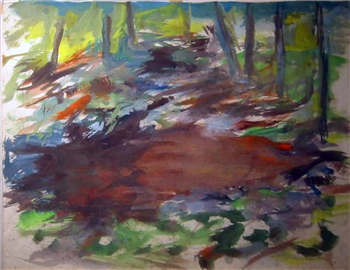 Elaine de Kooning continues to emerge from the shadow of her teacher and husband, Willem de Kooning, as an important artist in her own right. Thanks in part to major new scholarship by the National Portrait Gallery’s Chief Curator Brandon Fortune with their exhibition and book Elaine de Kooning: Portraits, as well as Cathy Curtis’s biography, A Generous Vision: The Creative Life of Elaine de Kooning, Oxford University Press 2017, and Mary Gabriel’s Ninth Street Women: Lee Krasner, Elaine de Kooning, Grace Hartigan, Joan Mitchell, and Helen Frankenthaler: Five Painters and the Movement That Changed Modern Art, that Elaine’s important artistic legacy has begun to receive the market recognition it deserves.
The 1950’s were an artistically prosperous time for Elaine. She secured several solo exhibitions at notable galleries such as the Stable Gallery and the Graham Gallery and also participated in numerous noteworthy shows including the Ninth Street Show, 1951, Young American Painters at the MOMA, 1956, and Artists of the NY School: 2nd Generation at the Jewish Museum, 1957. She was included in the Ten Best list in ARTnews Magazine in 1956 as well as the Great Expectations I article written by Thomas Hess that same year. At the root of great abstraction, there is usually great conflict. The “frenzied rush” embodied in her canvases of the 50’s and early 60’s is in fact part of a sustained level of engagement with an adversary…the adversary being herself.” *
Elaine would continue painting in an abstract manner for the rest of her life, informing her portraits, landscapes, Bull series, Sports series, Bacchus series and Cave series. Each of her series spanned a finite portion of her career, while portraiture always was threaded into her creative output spanning her entire 45 year career. Most notable is her commission to paint a series of portraits of President John F. Kennedy, including one for the Truman Library in 1963, just before Kennedy’s untimely death.
Her mastery in this genre is exemplified in her ability to effectively convey the moment, a feeling, a gesture, a sense of likeness about the person as opposed to their physicality. She wavered between precisely configured portraits and those of extreme abstraction, many times with faceless sitters in the early to mid 1950’s. But regardless of the approach, the character of Elaine’s subjects was always alive with a personality and gesture unique to sitter. The National Portrait Gallery’s Elaine de Kooning: Portraits exhibition in 2015-16 drew over 200,000 visitors. Levis Fine Art worked closely with the team at the National Portrait Gallery to gather additional scholarship and to assemble many of the paintings for loan to the museum.
In her series paintings, Elaine brought the same level of likeness as her portraits, with an added immediacy to the moment. Her brushstrokes dance around the figures, sweeping up and around, in and out, constantly shaping the multi-dimensional contours of their actions, creating a transcendence of energy throughout the entire painting; evidence of her extraordinary talent as an “Action” painter.
Source: Helen Harrison, Elaine de Kooning, the Early Years, This essay was included in the 1992 Memorial Exhibition catalog, Elaine de Kooning by Jane K. Bledsoe, with essays by Lawrence Campbell, Helen A. Harrison and Rose Slivka.
Submitted by: Jim Levis, 2019 Levis Fine Art, Inc.Biography from The Johnson Collection
ELAINE FRIED DE KOONING (1918–1989)
Elaine Fried de Kooning was an artist, writer, and wife during the heyday of Abstract Expressionism. Being a painter came first, yet her relationship to one of the dominant figures of the movement shaped her existence. She was a twenty-year old art student in 1938 when she first met Willem de Kooning, the Dutch painter sixteen years her senior. Elaine’s boyfriend at the time, Milton Resnick, claimed Bill de Kooning “seduced her by teaching her art.” She subsequently became de Kooning's model and the inspiration for his famous paintings of women. They were married in 1943.
As a child, Elaine Fried, a native of Brooklyn, New York, made regular visits to the Metropolitan Museum of Art. At Erasmus High School, she excelled in writing and math, but after a few weeks at Hunter College in Manhattan she dropped out to study at the Leonardo da Vinci Art School and the American Artists School.
In the spring of 1948, the de Koonings were struggling to make ends meet. When an invitation came from Josef Albers to teach at his experimental program near Asheville, North Carolina, they jumped at the chance. The couple thrived at Black Mountain College, especially Elaine who took classes with Albers, Buckminster Fuller, and Merce Cunningham. She was actively involved in the social life of the college, participated in theatrical performances, and painted bold organic abstractions on wrapping paper with enamel paint.
De Kooning became a writer for the influential magazine Art News in 1948. Over the next forty years as a contributor, she ran a series of articles in which she described artists at work—a novel approach in art criticism, as was her positive tone. As a fellow artist, she had access to individuals creating in a broad range of styles and shared a unique rapport with her subjects, who included Albers, Andrew Wyeth, Arshile Gorky, Franz Kline, Hans Hofmann, and Edwin Dickinson.
In her own work, de Kooning vacillated between complete abstraction and representational imagery. A respected portrait painter, she was at work on a commission of her most famous subject, President John F. Kennedy, at the time of his assassination in 1963. De Kooning worked almost obsessively in series that dealt with such subjects as faceless men, bullfighters, Bacchus, cave paintings, and Sumi drawings.
Vivacious and energetic, Elaine de Kooning was a full participant in the heady and collegial environment of New York’s art scene, which included weekly discussions, lectures, and parties. Although frequently overshadowed by her husband and their tumultuous relationship, she successfully gained recognition for herself. Her 1954 one-artist exhibition at the Stable Gallery was the first of over fifty solo and group exhibitions in the United States, many occurring during the halcyon days of the feminist movement and after she turned sixty. She held numerous teaching positions; from 1957 to 1962 she was at the University of New Mexico, and later taught at the University of Georgia (as the Lamar Dodd Visiting Professor of Art), Carnegie Mellon Institute, the University of Pennsylvania, and Yale University graduate school. Elaine de Kooning’s work is represented in the permanent collections of the Metropolitan Museum of Art, National Portrait Gallery, Guggenheim Museum, and the National Museum of Women in the Arts.
The Johnson Collection, Spartanburg, South Carolina
thejohnsoncollection.org