Page loaded successfully. Showing biography for Elizabeth Nourse.
Elizabeth Nourse BIOGRAPHY
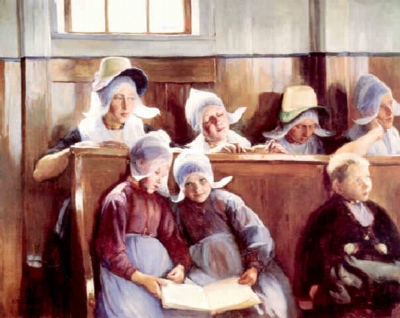
1859 Mount Healthy, Cincinnati, Ohio - 1938 Paris, France. Known for: Domestic interior, women with children-painting.
Elizabeth Nourse, born at Mt. Healthy (Cincinnati), Ohio on 26 October 1859, enrolled with her twin sister Adelaide at the McMicken School of Design in 1874 and took instruction from Thomas S. Noble... Read full biography
Elizabeth Nourse, born at Mt. Healthy (Cincinnati), Ohio on 26 October 1859, enrolled with her twin sister Adelaide at the McMicken School of Design in 1874 and took instruction from Thomas S. Noble (1835-1907). Adelaide would become a wood-carver. At that time there was still no possibility for a... Read full biography
Elizabeth Nourse, born at Mt. Healthy (Cincinnati), Ohio on 26 October 1859, enrolled with her twin sister Adelaide at the McMicken School of Design in 1874 and took instruction from Thomas S. Noble (1835-1907). Adelaide would become a wood-carver. At that time there was still no possibility for a woman to draw after the nude male figure, which was an important step in the traditional curriculum for art students. Some of Elizabeth's early works show the indirect influence of Frank Duveneck's... Read full biography
Elizabeth Nourse, born at Mt. Healthy (Cincinnati), Ohio on 26 October 1859, enrolled with her twin sister Adelaide at the McMicken School of Design in 1874 and took instruction from Thomas S. Noble (1835-1907). Adelaide would become a wood-carver. At that time there was still no possibility for a woman to draw after the nude male figure, which was an important step in the traditional curriculum for art students. Some of Elizabeth's early works show the indirect influence of Frank Duveneck's broad-brushed technique (e.g. Old Man and Child, 1887). Nourse studied briefly under William Sartain (1843-1924) in New York and met William Merritt Chase and J. Alden Weir. She traveled to Paris with Louise, another sister, in the summer of 1887 then... Read full biography
Elizabeth Nourse, born at Mt. Healthy (Cincinnati), Ohio on 26 October 1859, enrolled with her twin sister Adelaide at the McMicken School of Design in 1874 and took instruction from Thomas S. Noble (1835-1907). Adelaide would become a wood-carver. At that time there was still no possibility for a woman to draw after the nude male figure, which was an important step in the traditional curriculum for art students. Some of Elizabeth's early works show the indirect influence of Frank Duveneck's broad-brushed technique (e.g. Old Man and Child, 1887). Nourse studied briefly under William Sartain (1843-1924) in New York and met William Merritt Chase and J. Alden Weir. She traveled to Paris with Louise, another sister, in the summer of 1887 then enrolled in the Académie Julian's school for women. Already in the following year she was successful in showing La mère... Read full biography
Artist Biography
Biography page for Elizabeth Nourse ((1859 - 1938)), known for Domestic interior, women with children-painting. Showing 4 biographical entries and 0 sample artworks.
Elizabeth Nourse - Artist Info
About Elizabeth Nourse
Biography from the Archives of askART
 Elizabeth Nourse, born at Mt. Healthy (Cincinnati), Ohio on 26 October 1859, enrolled with her twin sister Adelaide at the McMicken School of Design in 1874 and took instruction from Thomas S. Noble (1835-1907). Adelaide would become a wood-carver. At that time there was still no possibility for a woman to draw after the nude male figure, which was an important step in the traditional curriculum for art students. Some of Elizabeth's early works show the indirect influence of Frank Duveneck's broad-brushed technique (e.g. Old Man and Child, 1887). Nourse studied briefly under William Sartain (1843-1924) in New York and met William Merritt Chase and J. Alden Weir. She traveled to Paris with Louise, another sister, in the summer of 1887 then enrolled in the Académie Julian's school for women. Already in the following year she was successful in showing La mère (now in a private collection) at the Salon — and it was hung "on the line," that is, at the most advantageous eye-level position. That summer she went to Barbizon and fell in love with rural France. Further travels took her to Russia via Warsaw and she also discovered Provence, sites in Italy, Germany and Austria, and the artists' colony in Picardy.
In 1890 the "new Salon" of the Société Nationale des Beaux-Arts invited her to exhibit, which turned out to be a smart career choice. The summer of 1892 was spent in Holland where Elizabeth did some plein air painting. She returned home the following year when some of her works were to be on display at the World's Columbian Exposition (in the Cincinnati Room of the Woman's Building, as well as in the Fine Arts Palace). That September Adelaide died and two months later Elizabeth's one-woman show at the Cincinnati Art Museum took place. Nourse returned to Paris in 1894 and went immediately to Brittany, then found a new studio on the rue d'Assas in Paris. A large oil, Les heures d'été (Newark Museum) resulted from another trip to Brittany in 1895. Here we see the origins of her freer brushwork, and the use of pure pigment and dappled sunlight effects on the dresses, somewhat reminiscent of Gari Melchers' works. In a typically American fashion, the facial features always receive a high degree of finish in Nourse's paintings.
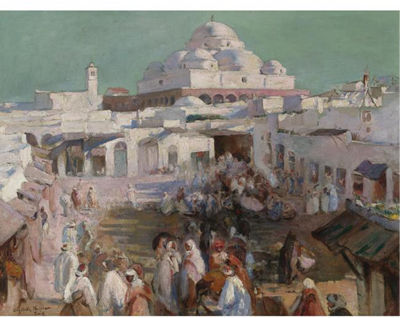
Another trip, this time to North Africa, changed Nourse's ideas of color and brightened her palette. She specialized more and more in peasant women and children even though some American dealers expressed their disapproval. Her uncompromising realism echoed more what was going on in European painting than in America, apart from painters like Thomas Eakins. Her painting La procession de Notre Dame de la Joie, Penmarc'h of 1903 (Xavier University, Cincinnati) shows further developments of dynamic brushwork and plein-air effects, including a violet sky, though the shadows are largely gray areas. Around that time, Nourse expressed to a reporter that "While I admire Monet, Raffaëlli, and the pronounced realistic paintings, I see more with the eyes of Cazin and of Dagnan[-Bouveret]." In other words, she felt closer to the French naturalists than to the Impressionists. According to Mary Alice Heekin Burke (in Burke and Fink, 1983, p. 66), Nourse probably regarded the impressionist technique as "too experimental for her subject matter."
Two of the most impressionistic works of Nourse are La rêverie, dated 1910 (Salon of 1911), and The Open Window, exhibited at the Anglo-American Exposition in 1914 (both in the University of Cincinnati). In the former, a woman stands before an open window, musing while staring at a goldfish bowl. This painting seems to reflect the contemporary developments of decorative intimism of Richard Miller and others in Giverny. Arguably, Nourse's art possesses a spiritual depth that is lacking in most French Impressionism and the subsequent American developments in Giverny. During the first world war, Nourse distinguished herself through acts of charity. Parts of her diary appeared in Art and Progress in 1914-15. Perhaps forgetting Mary Cassatt, in 1921 the New York Herald called Nourse "the dean of American woman painters in France and one of the most eminent contemporary artists of her sex." When Modernism made her type of Realism unpopular, Nourse stopped exhibiting (1924). She died in Paris, on October 8, 1938.
Sources:
Keyser, Frances. "Some American Artists in Paris." International Studio 4 (June 1889): 369-376; MacChesney, Clara T. "An American Artist in Paris: Elizabeth Nourse," American Illustrator 13 (August 1896): 3-11; Seton-Schmidt, Anna. "The Paintings of Elizabeth Nourse," International Studio 36 (December 1905): 247-254; Clark, Edna Maria. Ohio Art and Artists. Richmond, VA: Garrett and Massie, 1932, pp. 196-200; Quick, Michael. American Expatriate Painters of the Late Nineteenth Century. Dayton, OH: The Dayton Art Institute, 1976, pp. 120-121, 155; Cincinnati Art Museum. Cincinnati Painters of the Nineteenth Century Represented in the Cincinnati Art Museum: The Golden Age. Cincinnati: 1979, pp. 89-91, 170-171; Burke, Mary Alice Heekin and Lois Fink. Elizabeth Nourse, 1859-1938: A Salon Career. Washington, DC: Smithsonian Institution Press, 1983; Vitz, Robert C. The Queen and the Arts: Cultural Life in Nineteenth-Century Cincinnati. Kent, OH: Kent State University Press, 1989, pp. 175-177; The Cincinnati Wing: The Story of the Queen City. Ed. Julie Aronson. Athens, OH: Ohio State University Press, 2003, pp. 66-67, 78, 81, 85-87.
Submitted by Michael Preston Worley, Ph.D.Biography from the Archives of askART
 Elizabeth Nourse and her twin sister, Adelaide, were born in Mount Healthy, Ohio, a suburb of Cincinnati. In 1874 at the young age of fifteen, Elizabeth began art studies at the McMicken School of Design, which later became the Art Academy of the Cincinnati Art Museum. During her seven years at the school, she studied drawing, watercolor, oil painting, woodcarving, painting on china, and sculptor.
Although she did not study with Frank Duveneck, a student of the Munich School and Cincinnati's most famous teacher, Nourse became aware of Duveneck's influence and began to incorporate his rich painterly technique into her work. After the marriage of her twin sister and the death of her parents in 1822, Nourse went to New York and studied with William Sartain. She returned to Cincinnati and began to support herself by selling her artwork.
In 1887, Nourse and her sister Louise traveled to Paris, where Nourse studied for three months with Gustave Boulanger and Jules Lefebvre at the Academie Julian and received advice from Jean Jacques Henner and Carolus-Duran. Her painting La Mere 1888 (Private Collection), was accepted to the Paris Salon in the same year. Elizabeth Nourse became well established at the Salon as a painter of peasant woman and children. She also painted genre, portraits, Arabs, markets, canals and flowers.
After establishing herself in France, Nourse returned only once to the United States in 1893, to visit with her family and to see the World's Colombian Exposition in Chicago. During her life she traveled (often in the company of her sister Louise) to Russia, Italy, Austria, Holland, Spain, and North Africa, where she was known to paint the exotic sites and inhabitants of the land she visited. She usually spent her summers either in Brittany, Normandy, or Saint-Leger-en-Yvelines, near Paris. Nourse called North Africa "the land of sunshine and flowers and lovely Arabs."
Her style was bold and strong and demonstrated a rather painterly quality that she was praised for both during and after her life. Nourse employed bold confident brush strokes and a strong sense of color and light that was derived from her training in Cincinnati, where Munich trained Duveneck had introduced "a taste for both picturesque subject matter and rapid painterly style." She often set her subjects against a rich contrasting background to further highlight the central theme.
She maintained an active exhibition schedule wining numerous awards and sending paintings to major exhibitions in France and abroad including the Colombian Exposition, Chicago, 1893; third class medal, Institute de Carthage, Tunis, 1897; silver medal, Paris Exposition, 1900; silver medal, St. Louis Exposition, 1904; gold medal, Panama Pacific Exposition, San Francisco, 1915; Laetare medal, University of Notre Dame, South Bend, In, 1921 and others. She was also a member of the Societe Nationale des Beaux-Arts, 1901; Paris American Woman's Art Association; National Association of Woman Painters and Sculptors, (hon.) and others.
Her works can be found in numerous important public and private collections here and abroad.She retired in 1924 and lived with and supported her older sister Louise throughout her life, passing away only one year after her in 1938.
Sources include:
Peter Hastings Falk, Editor, Who Was Who in American Art
Blake Benton Fine ArtBiography from Caldwell Gallery Hudson
Elizabeth Nourse studied art extensively at several different schools including the Cincinnati School of Design (1874-81), Art Students League of New York ('82, '85-6) and Academie Julian in Paris ('87). By 1883 Nourse was able to support herself and her sister with the sale of her work and decorative commissions.
She was offered a position as a drawing instructor for Cincinnati School of Design in 1887 but decided to study in Paris instead.
Within a year of her study under Gustav Boulanger and more independent work, her painting was accepted to hang "on the line" (at eye level) in the Paris Salon.
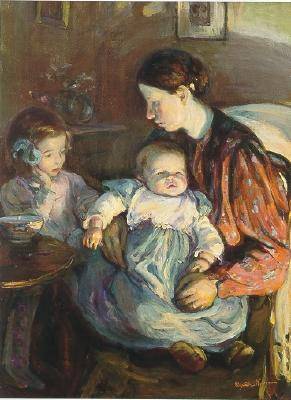
Her canvases portray intimate scenes of rural women in domestic work as well as women with children. Nourse was the first woman to have a painting purchased by the French government, which was placed in the Luxembourg Museum. She has been described as a forerunner of Social Realism.Biography from The Johnson Collection
ELIZABETH NOURSE (1859-1938)
In the final years of the nineteenth century, Elizabeth Nourse joined the legions of aspiring American artists who traveled to Paris for advanced studies. Like her contemporary Mary Cassatt, Nourse settled there permanently, writing on the eve of her initial voyage overseas in 1887: “There is so much to see and do before we come back—and then will we ever come back?” Unlike Cassatt, however, Nourse did not enjoy family financial backing and instead bore the responsibility of supporting herself and her sister with her art. In fulfilling that obligation, she earned an international reputation and was a frequent exhibitor at the prestigious Paris Salon and in juried exhibitions in the United States. In a May 1900 review of expatriate artists featured at the Salon, the author—a fellow American— opined that “no American woman stands so high in Paris today as Miss Nourse. Indeed, she is one woman painter of our country . . . who ranks in the world as a painter and not as a woman who paints.” One year later, Elizabeth Nourse was elected to the Société Nationale des Beaux Arts, becoming only the second female artist and first American woman to be elevated to that stature in the male-dominated Parisian art world.
One of ten children, Elizabeth was born in Mount Healthy, Ohio, fifteen miles north of Cincinnati. Her father, once a quite successful banker, suffered a staggering financial setback during the Civil War, going quickly from “very wealthy to very poor.” Having received excellent early instruction in art, at the age of fifteen Nourse began her studies at the McMicken School of Design (now the Art Academy of Cincinnati) and later was one of the first females to be admitted to Thomas Satterwhite Noble’s drawing class. After seven years as a student, she was offered a teaching position at the school, an invitation she rejected to pursue her own practice. For a brief period in late 1882 and early 1883, Nourse enrolled at the Art Students League in New York, but returned to Cincinnati where she decorated homes and painted portraits. She spent the summers of 1884 through 1886 executing watercolors in the Appalachian Mountains of Tennessee, probably in Blount County near Mount Nebo, as a sketchbook bears that name on its cover, or possibly further east in Pine Mountain.
In August of 1887, Nourse—together with her older sister Louise who served as her business manager and lifelong companion—arrived in Paris. She soon began studies at the Académie Julian with Gustave Boulanger and Jules Lefebvre, but remained for only three months, likely because she was already proficient as a draftsman, the mainstay of the academic tradition. She painted subjects that were popular at the time—ordinary rural laborers, women at work, and mothers with their children, as well as domestic interiors and landscapes. Instead of embracing Impressionism, which she considered “too experimental for her subject matter,” Nourse preferred a kind of naturalism reminiscent of the French Barbizon painters. She made frequent extended trips to Brittany, traveled throughout the continent, as well as to England and North Africa.
Nourse’s talents were recognized on both sides of the Atlantic. In 1893, during one of her few trips home, the Cincinnati Art Museum exhibited 102 works, of which eighteen were sold, followed by an exhibition in Washington, DC, in which twenty-one sold. Her paintings were regularly selected for annual juried exhibitions at the Pennsylvania Academy of the Fine Arts, the Cincinnati Art Museum, the Carnegie Art Institute, and the Art Institute of Chicago, and appeared at important international expositions in Chicago, Nashville, Saint Louis, and San Francisco. The French government purchased her canvas, Les volets clos (The Closed Shutters) which depicted Louise near a window, for its holdings of contemporary art at the Musée du Luxembourg. Nourse’s inclusion in this prestigious collection placed her among such celebrated American artists as Winslow Homer, John Singer Sargent, and James A. M. Whistler.
During World War I, Nourse did not leave Paris like many of her compatriots, but assisted refugees and sought donations from her American friends. Four years after undergoing surgery for breast cancer, she stopped exhibiting her work in 1924. Elizabeth Nourse died in the fall of 1938, twenty months after the death of her sister Louise. Devout Catholics, the two are buried alongside each other in a church cemetery in their adopted home city.
The Johnson Collection, Spartanburg, South Carolina
thejohnsoncollection.org