Page loaded successfully. Showing biography for Ellis Wilson.
Ellis Wilson BIOGRAPHY
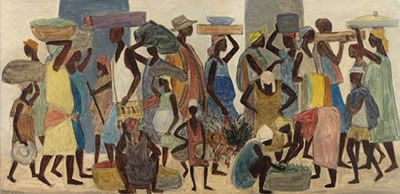
1899 Mayfield, Kentucky - 1977 New York, New York. Known for: Afro-naive to mod figure, animal, painting, illustration.
The following, submitted October 2005, is from Albert Sperath, curator of the March 2000 Wilson exhibition at Murray State University and biographer of the artist: The Art of Ellis Wilson, University... Read full biography
The following, submitted October 2005, is from Albert Sperath, curator of the March 2000 Wilson exhibition at Murray State University and biographer of the artist: The Art of Ellis Wilson, University Press of Kentucky. A once-acclaimed Kentucky-born artist who captured the black culture in the... Read full biography
The following, submitted October 2005, is from Albert Sperath, curator of the March 2000 Wilson exhibition at Murray State University and biographer of the artist: The Art of Ellis Wilson, University Press of Kentucky. A once-acclaimed Kentucky-born artist who captured the black culture in the Southeast and Haiti of his time, Ellis Wilson is little-known in his home state today. To remedy this neglect and to celebrate the centennial of his birth, he became the subject of a February through... Read full biography
The following, submitted October 2005, is from Albert Sperath, curator of the March 2000 Wilson exhibition at Murray State University and biographer of the artist: The Art of Ellis Wilson, University Press of Kentucky. A once-acclaimed Kentucky-born artist who captured the black culture in the Southeast and Haiti of his time, Ellis Wilson is little-known in his home state today. To remedy this neglect and to celebrate the centennial of his birth, he became the subject of a February through March 2000 exhibition premiered at Murray State University in the Clara M. Eagle Art Gallery, 25 miles southeast of Mayfield, birthplace of the artist. The exhibition, organized by Albert Sperath, Director of the Eagle Gallery, featured forty-five... Read full biography
The following, submitted October 2005, is from Albert Sperath, curator of the March 2000 Wilson exhibition at Murray State University and biographer of the artist: The Art of Ellis Wilson, University Press of Kentucky. A once-acclaimed Kentucky-born artist who captured the black culture in the Southeast and Haiti of his time, Ellis Wilson is little-known in his home state today. To remedy this neglect and to celebrate the centennial of his birth, he became the subject of a February through March 2000 exhibition premiered at Murray State University in the Clara M. Eagle Art Gallery, 25 miles southeast of Mayfield, birthplace of the artist. The exhibition, organized by Albert Sperath, Director of the Eagle Gallery, featured forty-five paintings that were borrowed from private collectors, art dealers, and museums. Of this exhibit,... Read full biography
Artist Biography
Biography page for Ellis Wilson ((1899 - 1977)), known for Afro-naive to mod figure, animal, painting, illustration. Showing 2 biographical entries and 0 sample artworks.
Ellis Wilson - Artist Info
About Ellis Wilson
Biography from the Archives of askART
 The following, submitted October 2005, is from Albert Sperath, curator of the March 2000 Wilson exhibition at Murray State University and biographer of the artist: The Art of Ellis Wilson, University Press of Kentucky.
A once-acclaimed Kentucky-born artist who captured the black culture in the Southeast and Haiti of his time, Ellis Wilson is little-known in his home state today. To remedy this neglect and to celebrate the centennial of his birth, he became the subject of a February through March 2000 exhibition premiered at Murray State University in the Clara M. Eagle Art Gallery, 25 miles southeast of Mayfield, birthplace of the artist. The exhibition, organized by Albert Sperath, Director of the Eagle Gallery, featured forty-five paintings that were borrowed from private collectors, art dealers, and museums.
Of this exhibit, art critic David Minton wrote that Ellis Wilson "painted a vivid but realistic portrait of black culture beginning in the 1920s. Wilson doesn't paint his subjects in mythical proportions. He simply shows them as they were: a fisherman with his catch slung over his back, his shoulders illuminated by the sunlight, his figure completely surrounded by a luminous sea. Or factory workers and farmhands, full of life and dignity. The same concept applies to his images of Harlem cabaret dancers, people engaged in ritual religious ceremonies and sitters for straight portraits. Wilson gained prominence in the art world during the 1930s and 40s. But that doesn't mean he was ever widely known or was even able to make a living at art."
Wilson was born in Mayfield, Kentucky and attended Kentucky State University in Frankfort for two years. However, because he could only study agriculture or education, he left at age 19 to study at the Art Institute of Chicago. He stayed in Chicago for five years trying to make it as a commercial artist, but in 1928 moved to New York.
As a new art school graduate, Wilson was active in the New Negro Art Movement of the 1920s and '30s in New York, where he lived until his death. He was employed by the Works Progress Administration from 1935 to 1940.
On the basis of paintings done from sketches of fellow workers at an airplane factory, he was awarded a Guggenheim Fellowship in 1944, which was renewed in 1945.
Wilson used his fellowship to travel across the South, where he painted black people at work. He was noted as a colorist with a deft touch for simplification.
In 1947 he had an exhibition in his hometown; it was reportedly the first art show ever held in Mayfield. A year later, Louisville's J.B. Speed Art Museum had a solo exhibition of Wilson's figural images, and in 1953 Murray also gave Wilson an exhibition.
In 1952 he won a $3,000 prize in a Miami show, which he used to make a trip to Haiti to paint. In the meantime, Wilson continued to work at manual labor jobs in New York and paint on the side until his death in 1977.
One of Wilson's paintings, Funeral Procession, was part of the set on Bill Cosby's TV series in the 1980s.Biography from The Johnson Collection
ELLIS DOUGLAS WILSON (1899-1977)
Ellis Wilson is best known for paintings that presented African American subjects with objectivity and dignity, devoid of idealization, caricature, or mythical attributes. A colorist with a preference for simplified modern compositions, Wilson wrote in a 1939 Guggenheim fellowship application that he was “most interested in painting the Negro. Unfortunately, this type of painting hasn’t a large following at present. I am desirous of both making a name for myself in the Art World and to create paintings which will be a credit to my Race and my time.”
Wilson attributed his artistic inclinations to his father, an amateur painter who worked in what Wilson described as a primitive style. Growing up in Mayfield, Kentucky, young Ellis held a variety of odd jobs and constantly looked for creative outlets in the midst of the mundane. While employed as the janitor for a local dress shop, for example, Wilson drew pictures on the store window using cleaning soap, an exercise that was subsequently encouraged by the shop owner as a promotional ploy. In 1916, Wilson enrolled at Frankfurt’s Kentucky Normal and Industrial Institute for Colored Persons (now Kentucky State University). Frustrated that his studies were limited to either agriculture or education, he left after two years, embarking on a decade-long residency in Chicago. There, Wilson earned a degree from the Art Institute of Chicago in 1923 and participated in the Chicago Art League. The typically shy and reserved youth blossomed during these years. It was a time of inspiration for Wilson, who was interacting with other creative African Americans.
After briefly working as a commercial artist in Chicago, Wilson moved to New York. There, he became involved with the Harmon Foundation, exhibiting his work in the 1933 and 1935 annuals. From 1935 to 1940, Wilson found steady employment, as did so many artists of the day, with the Works Progress Administration’s Federal Art Project. Once again, Wilson’s relationships with other African American artists, such as Joseph Delaney, proved fruitful. Undoubtedly inspired by the early work of Abstract Expressionist painters also working for the WPA, Wilson’s academic style gradually became more abstract. A series of works of airplane factory laborers created during these years won him a Guggenheim Fellowship in 1944 and, again, in 1945. Wilson used these funds to travel throughout the South and capture the “poise and simple dignity” of African Americans at work. He painted men making turpentine in Georgia, laborers hewing lumber in South Carolina, and field hands harvesting tobacco in Kentucky.
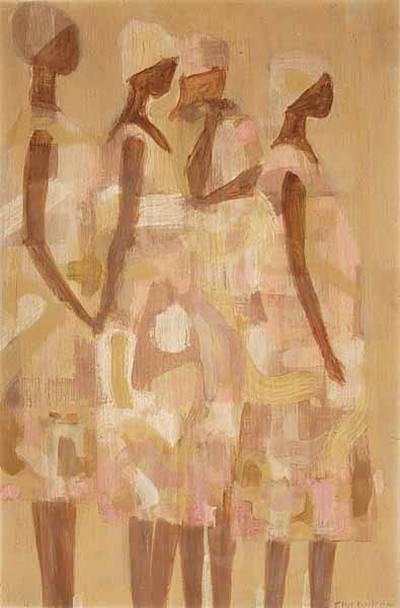
With prize monies from the 1952 National Terry Art Exhibition, Wilson took the first of several trips to Haiti. Invigorated by African-Caribbean culture, Wilson abandoned his representational style in favor of an almost fauvist abstraction executed in heightened color. His subjects appear as black silhouetted forms devoid of facial features and clothed in basic geometric shapes absent of folds and other details, as evidenced by African Princesses.
Although Wilson continued to paint until his death in 1977, his work fell into relative obscurity in the 1950s. Interest was renewed, however, in the 1980s when his painting Funeral Procession (circa 1950) was used on the set of the popular television series, The Cosby Show. His paintings have since been featured in numerous national exhibitions and, in 2000, Kentucky Educational Television produced a documentary titled Ellis Wilson: So Much to Paint. Today, Wilson’s work can be found in the collections of the Smithsonian American Art Museum, the North Carolina Museum of Art, and the Amistad Research Center at Tulane University, among others.
The Johnson Collection, Spartanburg, South Carolina
thejohnsoncollection.org