Page loaded successfully. Showing biography for Emil Armin.
Emil Armin BIOGRAPHY
1883 Radautz, Austria (Romania) - 1972. Known for: Mod naive cityscape, sculpture.
Born in Rumania on April 1, 1883, Emil Armin studied at the School of the Art Institute of Chicago's evening classes under Dudley Crafts Watson, Randall Davey and George Bellows, then he graduated in... Read full biography
Born in Rumania on April 1, 1883, Emil Armin studied at the School of the Art Institute of Chicago's evening classes under Dudley Crafts Watson, Randall Davey and George Bellows, then he graduated in 1920. Between 1922 and 1949 he exhibited his works at the Art Institute annuals and was involved in... Read full biography
Born in Rumania on April 1, 1883, Emil Armin studied at the School of the Art Institute of Chicago's evening classes under Dudley Crafts Watson, Randall Davey and George Bellows, then he graduated in 1920. Between 1922 and 1949 he exhibited his works at the Art Institute annuals and was involved in the No-Jury Society, organized in 1922. At that time he was immersed in Chicago's bohemian 57th Street Art Colony and he experimented with sculpture and decorative arts as a member of the Chicago... Read full biography
Born in Rumania on April 1, 1883, Emil Armin studied at the School of the Art Institute of Chicago's evening classes under Dudley Crafts Watson, Randall Davey and George Bellows, then he graduated in 1920. Between 1922 and 1949 he exhibited his works at the Art Institute annuals and was involved in the No-Jury Society, organized in 1922. At that time he was immersed in Chicago's bohemian 57th Street Art Colony and he experimented with sculpture and decorative arts as a member of the Chicago Society of Artists. He taught at Chicago's Hull House (1925-26) and did cartoons full of angular forms and a particular method of shading and "zigzag outlining" taken from German Expressionist masters, for the Chicago Literary Times, a journal created... Read full biography
Born in Rumania on April 1, 1883, Emil Armin studied at the School of the Art Institute of Chicago's evening classes under Dudley Crafts Watson, Randall Davey and George Bellows, then he graduated in 1920. Between 1922 and 1949 he exhibited his works at the Art Institute annuals and was involved in the No-Jury Society, organized in 1922. At that time he was immersed in Chicago's bohemian 57th Street Art Colony and he experimented with sculpture and decorative arts as a member of the Chicago Society of Artists. He taught at Chicago's Hull House (1925-26) and did cartoons full of angular forms and a particular method of shading and "zigzag outlining" taken from German Expressionist masters, for the Chicago Literary Times, a journal created by Maxwell Bodenheim and Ben Hecht. Samuel Putnam, a critic for the Chicago Evening Post (21 September 1926) regar... Read full biography
Artist Biography
Biography page for Emil Armin ((1883 - 1972)), known for Mod naive cityscape, sculpture. Showing 2 biographical entries and 0 sample artworks.
Emil Armin - Artist Info
About Emil Armin
Biography from the Archives of askART
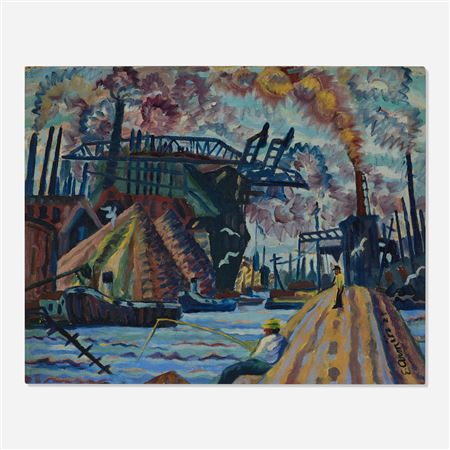 Born in Rumania on April 1, 1883, Emil Armin studied at the School of the Art Institute of Chicago's evening classes under Dudley Crafts Watson, Randall Davey and George Bellows, then he graduated in 1920. Between 1922 and 1949 he exhibited his works at the Art Institute annuals and was involved in the No-Jury Society, organized in 1922. At that time he was immersed in Chicago's bohemian 57th Street Art Colony and he experimented with sculpture and decorative arts as a member of the Chicago Society of Artists. He taught at Chicago's Hull House (1925-26) and did cartoons full of angular forms and a particular method of shading and "zigzag outlining" taken from German Expressionist masters, for the Chicago Literary Times, a journal created by Maxwell Bodenheim and Ben Hecht. Samuel Putnam, a critic for the Chicago Evening Post (21 September 1926) regarded Armin as "perhaps the most finely sensitized artist in Chicago . . . with the soul of a peasant and the mind of a philosopher."
In 1928 Armin traveled to New Mexico where he executed a naïve, child-like woodcut, Mountain Farm, Santa Fe (Art Institute). Chicago critic Bulliet's characterization of Armin as a "primitive" in impulses, "though sophisticated and intelligent" applies here: "His work resembles somewhat the peasant art of Middle Europe, with American motifs." (C.J. Bulliet, Apples and Madonnas: Emotional Expression in Modern Art. New York: Covici-Friede, 1930, p. 236). A year later came his oil on canvas, My Neighbors (National Museum of American Art), which recalls Joan Miró, Matisse and the German Expressionists. A famous work from 1930 is The Open Bridge (Illinois State Museum, Springfield, IL); that year the Art Institute gave him a one-man show. At that time he claimed, "My paintings are all architecture. Every part has to hold up every other part like the walls of a building." (Chicago Herald and Examiner, 23 February 1930). Another solo show followed at the Kansas City Art Institute a year later.
In 1931-32 Armin taught at the Jewish Peoples Institute. He wrote a statement in J.Z. Jacobson's Art of Today: Chicago 1933 (Chicago: L.M. Stein, 1932, p. 40): like many modern artists he sought to "unlearn" what he had been taught in art school, to convey a more genuine inner expression. Armin participated in the Public Works of Art Project (PWAP) during the Depression years, and in the "easel section" of the WPA. In the mid 30s he was still with the 57th Street Art Colony some of whose members painted at the Indiana Dunes. The Renaissance Society in Chicago honored Armin with another one-man show in 1949. In the 50s he discovered the charms of painting in Mexico. Armin died on July 2, 1971 at the age of eighty-eight. More recently, the Illinois State Museum organized a special exhibition in 1980 that included seventy-two of his works.
Submitted by Michael Preston Worley, Ph.D.Biography from the Archives of askART
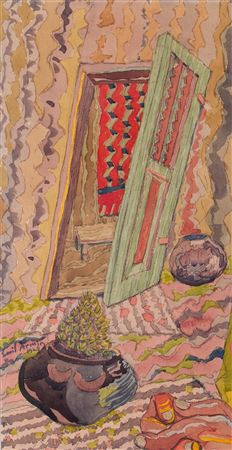 Born in Radautz, Austria, later Romania, Emil Armin settled in Chicago, Illinois in 1905 and became an oil painter, printmaker and sculptor in wood.
He studied at the Chicago Art Institute with J. Wellington Reynolds, George Bellows and Randall Davey and spent time painting and carving in New Mexico, Mexico, the Indiana Dunes, and Maine.
Stimulated by the encouragement of Bellows and Davey to paint that which inspired him and not that which pleased some academic, Armin developed a mature style that reflected his Romanian Jewish background with his craftsman father but focused on his native city of Chicago. He wrote: "I found the characteristics of the environment I live in expressed in my work, I found the steel ribs of the tall towers in the construction of my compositions, the earth being pushed up out of the lake for an outer drive in the texture of the paint and the whistlings, screeches, electric flashes, whirrings and fast motion mixed with sunlight contained in the light of the paint. . .Environment speaks; and I have come to know myself as a natural expressionist for I hear, see and vibrate, without any special effort"...(Kennedy 85)
Sources:
Louise Dunn Yochim, Role and Impact: The Chicago Society of Artists
Elizabeth Kennedy, Chicago Modern 1893-1945