Page loaded successfully. Showing biography for Emilio Grau-Sala.
Emilio Grau-Sala BIOGRAPHY
1911 Barcelona, Spain - 1975 Barcelona, Spain. Known for: Abstract florals-still life, figure and genre painting, stage design, illustration.
Son of the draughtsman Juan Grau Miró, Grau Sala combined his attendance at the Barcelona School of Fine Arts with an essentially self-taught training. In 1930 he held his first exhibition at the... Read full biography
Son of the draughtsman Juan Grau Miró, Grau Sala combined his attendance at the Barcelona School of Fine Arts with an essentially self-taught training. In 1930 he held his first exhibition at the Badriñas gallery in Barcelona. At the outbreak of the Civil War, in 1936, he moved to Paris, where he... Read full biography
Son of the draughtsman Juan Grau Miró, Grau Sala combined his attendance at the Barcelona School of Fine Arts with an essentially self-taught training. In 1930 he held his first exhibition at the Badriñas gallery in Barcelona. At the outbreak of the Civil War, in 1936, he moved to Paris, where he settled in the Montparnasse colony of Spanish artists. That same year he was awarded the first Carnegie Prize. During the twenty-five years he spent there he became closely acquainted with the... Read full biography
Son of the draughtsman Juan Grau Miró, Grau Sala combined his attendance at the Barcelona School of Fine Arts with an essentially self-taught training. In 1930 he held his first exhibition at the Badriñas gallery in Barcelona. At the outbreak of the Civil War, in 1936, he moved to Paris, where he settled in the Montparnasse colony of Spanish artists. That same year he was awarded the first Carnegie Prize. During the twenty-five years he spent there he became closely acquainted with the avant-garde, although he always favoured a colourist figuration derived from Impressionism and Fauvism. It was a path already taken by the commercial circuit, surpassed in terms of novelty by Cubism and Surrealism, but which was kept alive at a high level... Read full biography
Son of the draughtsman Juan Grau Miró, Grau Sala combined his attendance at the Barcelona School of Fine Arts with an essentially self-taught training. In 1930 he held his first exhibition at the Badriñas gallery in Barcelona. At the outbreak of the Civil War, in 1936, he moved to Paris, where he settled in the Montparnasse colony of Spanish artists. That same year he was awarded the first Carnegie Prize. During the twenty-five years he spent there he became closely acquainted with the avant-garde, although he always favoured a colourist figuration derived from Impressionism and Fauvism. It was a path already taken by the commercial circuit, surpassed in terms of novelty by Cubism and Surrealism, but which was kept alive at a high level thanks to masters such as Bonnard, Chagall and Dufy. In fact, he soon became known in Paris as the successor to the Impressionist spirit and... Read full biography
Artist Biography
Biography page for Emilio Grau-Sala ((1911 - 1975)), known for Abstract florals-still life, figure and genre painting, stage design, illustration. Showing 3 biographical entries and 0 sample artworks.
Emilio Grau-Sala - Artist Info
About Emilio Grau-Sala
Name variants
Emile Grausala, Emile Grau Sala, Emilio Grau Sala
Biography from Schiller & Bodo European Paintings
A School of Paris painter who never abandoned lyrical figurative and landscape subjects, Emilio Grau-Sala was born in Barcelona and studied at the School of Fine Arts in his native town. Beginning his public career in 1929, he moved to Paris in 1932 and exhibited at the Salon du Printemps.
His lively and graceful street scenes, circus rings and interiors accorded well with current sensibilities in the Parisian art center, and Grau-Sala quickly gained an international reputation. In 1937 he was awarded a Carnegie prize in Pittsburgh, and his regular exhibitions in the United States made him as sought-after overseas as he was in Europe.
In addition to his work as a painter, Grau-Sala was also recognized as an important illustrator, decorator, and pastel painter, illustrating numerous fine editions of volumes by authors such as Flaubert, Baudelaire, and Maupassant.
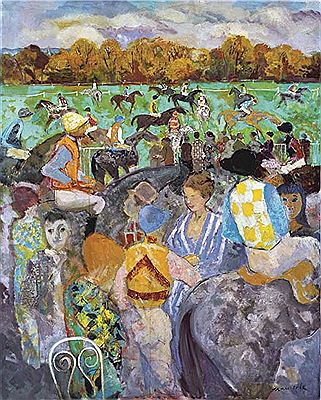
Leisure, entertainment, and elegant domesticity are Grau Sala's most frequently treated themes: people conversing at the racetrack or circus, splendid parties, or domestic scenes in well-appointed interiors. He depicted his pleasant scenes with an intense, broken color and sparkling, impastic surface heighten the joyous quality so typical of his work.Biography from Setdart
Son of the draughtsman Juan Grau Miró, Grau Sala combined his attendance at the Barcelona School of Fine Arts with an essentially self-taught training. In 1930 he held his first exhibition at the Badriñas gallery in Barcelona. At the outbreak of the Civil War, in 1936, he moved to Paris, where he settled in the Montparnasse colony of Spanish artists. That same year he was awarded the first Carnegie Prize.
During the twenty-five years he spent there he became closely acquainted with the avant-garde, although he always favoured a colourist figuration derived from Impressionism and Fauvism. It was a path already taken by the commercial circuit, surpassed in terms of novelty by Cubism and Surrealism, but which was kept alive at a high level thanks to masters such as Bonnard, Chagall and Dufy. In fact, he soon became known in Paris as the successor to the Impressionist spirit and values, directly related to Bonnard and Vuillard.
This stylistic choice of Grau Sala's conditioned that of his wife, Ángeles Santos, who abandoned her singular surrealism for a more conventional landscape, a decision that critics did not hesitate to regret. The success of his style led Grau Sala to devote himself also to graphic work (engravings, lithographs, illustrations for novels, posters...), as well as theatre sets. The grace and finesse of his characters, the liveliness of the colours and the elegant atmosphere of the environments he depicted brought him great success and recognition all over the world. He held several solo exhibitions, mainly in Barcelona and Paris, but also in cities such as New York, Toulouse, London and Los Angeles.
In 1963 he returned to Barcelona, when the stagnant figuration of Franco's Spain was beginning to be challenged by Oteiza, Chillida, Tàpies and the "El Paso" collective. However, he remained faithful to his style, and until his death in 1975 he worked in his own personal style, centred on his favourite themes, female figures, interiors and landscapes, in a vaguely classical, nostalgic 19th-century setting. After his death, and for more than a decade, Grau Sala was overshadowed by the many novelties that were emerging in democratic Spain, but from the 1990s onwards, the new boom in mid-level collecting revived Grau Sala, as he was seen as an interpreter of Impressionism in a Spanish key.
Works by Emilio Grau Sala are kept in the Museo Nacional de Arte de Cataluña, the Museo de Arte Contemporáneo Esteban Vicente and the Instituto Óscar Domínguez de Arte y Cultura Contemporánea.Biography from Auctionata
Emilio Grau Sala was born in Barcelona in 1911 as the son of a painter and attended the Escuela de Bellas Artes in his hometown. In 1930 he held his first exhibition.
During the Spanish Civil War, the artist emigrated to Paris. Here he was influenced by Impressionism and artists such as Pierre Bonnard, Marc Chagall or Raoul Dufy and exhibited in the Salon du Printemps. He also created illustrations for writings such as Flaubert's Madame Bovary, Les Fleurs du Mal by Baudelaire or Bel-Ami by Guy de Maupassant, as well as posters and lithographs.
In 1963 Grau Sala returned to Barcelona. The artist passed away in 1975. His multi-faceted and comprehensive oeuvre, which was only rediscovered in the 1990s, includes interiors, scenes on the racecourse as well as circus and summery motifs in the park or garden.