Page loaded successfully. Showing biography for Ernest Lothar.
Ernest Lothar BIOGRAPHY
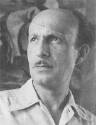
1906 Vienna, Austria - 1961 Arlington, Virginia. Known for: Abstract figure, cartoon, illustration.
The following is submitted by Melita Pepper, stepdaughter of the artist. Ernest Lothar was born in Vienna to a Jewish family in 1906, as Ernest Lothar Deutsch. His mother painted as a hobby, and... Read full biography
The following is submitted by Melita Pepper, stepdaughter of the artist. Ernest Lothar was born in Vienna to a Jewish family in 1906, as Ernest Lothar Deutsch. His mother painted as a hobby, and Ernest showed talent as soon as he could hold a pencil. As a youth he studied at the Academy of Fine and... Read full biography
The following is submitted by Melita Pepper, stepdaughter of the artist. Ernest Lothar was born in Vienna to a Jewish family in 1906, as Ernest Lothar Deutsch. His mother painted as a hobby, and Ernest showed talent as soon as he could hold a pencil. As a youth he studied at the Academy of Fine and Applied Arts from 1922-1926, under Professor Adolf Boehm. After leaving the Academy he concentrated on copying old masters of the Italian School in the Kunsthistorichen Museum. While making his... Read full biography
The following is submitted by Melita Pepper, stepdaughter of the artist. Ernest Lothar was born in Vienna to a Jewish family in 1906, as Ernest Lothar Deutsch. His mother painted as a hobby, and Ernest showed talent as soon as he could hold a pencil. As a youth he studied at the Academy of Fine and Applied Arts from 1922-1926, under Professor Adolf Boehm. After leaving the Academy he concentrated on copying old masters of the Italian School in the Kunsthistorichen Museum. While making his living working in a factory in the late twenties, he became a full time freelance artist and illustrator for publishing houses in Austria, Poland, Italy and Switzerland. When Hitler invaded Austria in 1938, Lothar went to Zurich, Switzerland as a refugee.... Read full biography
The following is submitted by Melita Pepper, stepdaughter of the artist. Ernest Lothar was born in Vienna to a Jewish family in 1906, as Ernest Lothar Deutsch. His mother painted as a hobby, and Ernest showed talent as soon as he could hold a pencil. As a youth he studied at the Academy of Fine and Applied Arts from 1922-1926, under Professor Adolf Boehm. After leaving the Academy he concentrated on copying old masters of the Italian School in the Kunsthistorichen Museum. While making his living working in a factory in the late twenties, he became a full time freelance artist and illustrator for publishing houses in Austria, Poland, Italy and Switzerland. When Hitler invaded Austria in 1938, Lothar went to Zurich, Switzerland as a refugee. There he was able to study for a time at Kunstgewebeschule, and with sculptor Hans Aeschbacher, whose studio he worked in. He also gave... Read full biography
Artist Biography
Biography page for Ernest Lothar ((1906 - 1961)), known for Abstract figure, cartoon, illustration. Showing 1 biographical entries and 0 sample artworks.
Ernest Lothar - Artist Info
About Ernest Lothar
Name variants
Ernesto Lothar
Biography from the Archives of askART
The following is submitted by Melita Pepper, stepdaughter of the artist.
Ernest Lothar was born in Vienna to a Jewish family in 1906, as Ernest Lothar Deutsch. His mother painted as a hobby, and Ernest showed talent as soon as he could hold a pencil. As a youth he studied at the Academy of Fine and Applied Arts from 1922-1926, under Professor Adolf Boehm. After leaving the Academy he concentrated on copying old masters of the Italian School in the Kunsthistorichen Museum. While making his living working in a factory in the late twenties, he became a full time freelance artist and illustrator for publishing houses in Austria, Poland, Italy and Switzerland.
When Hitler invaded Austria in 1938, Lothar went to Zurich, Switzerland as a refugee. There he was able to study for a time at Kunstgewebeschule, and with sculptor Hans Aeschbacher, whose studio he worked in. He also gave art classes in refugee camps until a year later when he was taken into the Swiss Military Service, where he worked 10-hour days as a stonebreaker. During the year he worked in the Road Service, he had a single 24-hour break. Reporting too sick to work, he was told that since he was an artist, he could spend the time painting a portrait of the commanding general.
Although he desired to immigrate to America, Austrians were not allowed to enter the United States at that time. With the threat of Hitler imminent, Lothar took the opportunity to enter the Dominican Republic, although told it would be on the condition that he remain there for the rest of his life as a farmer. In January 1941 he arrived in the newly founded agricultural settlement of Sosua with his Swiss wife. There he worked for 35 cents a day on a tobacco plantation. Despite the labor, intense heat, and constant din of insects, the primitive beauty of the tropics inspired outpourings of work in a new unique style. His work drew enough attention for the Pan-American Union to organize a one-man show in 1942. More successful shows followed in Washington DC, New York, and Los Angeles, resulting in his appointment to Professor of Painting at the School of Fine Arts in Ciudad Trujillo by the President of the Dominican Republic in 1945.
Assisted by his friends Leo Katz and Viktor Lowenfeld, he accepted a teaching position at Hampton Institute in Virginia. Through this job he was allowed to leave the Dominican Republic in 1947. After 3 years at Hampton, and needing more time to devote to his craft and evolving style, Lothar moved to Washington DC, teaching at Washington Center for the Arts, the National Art School, and Dept of Recreation in Arlington, VA.
Stricken with Multiple Sclerosis sometime after 1942, the disease began to assert itself more aggressively and so he moved to Baltimore in 1952, living close by his parents who had immigrated a few years previous. In 1953 he married his second wife, Helen Pepper. Inspired by love, he worked feverishly that year, creating some of his most beautiful work. As the disease progressed, he adapted his style to his physical abilities, until he could no longer hold a brush. With Helen's daughter, the couple moved to Arlington, VA in 1956. After his death in1961, Helen placed most of his work in storage where it remained for almost 30 years.
Ernest Lothar's unique style melds influences of Art Deco, pre-Columbian, Expressionism, and oriental art. Summed up by his friend Leo Katz, his work has "an almost rhythmically musical kind of organization of lines, tone, and colors in space".
The following is a quote from a letter Lothar wrote to a friend in 1955.
"When I came to the United States, I taught three years with Dr. Leo Katz who is now director of Atelier 17 in New York City. All my teaching experiences had to be discarded and I had to start new research into the modern approaches which have been discovered during the last twenty years. I worked very hard and found myself involved in new ways of esthetic expressions which I had never dreamed of before. It changed completely my way of teaching and of creating. It is impossible to explain in a letter findings which took sometimes the whole life of great artists to make. In general my composition deals with completely heretofore unknown ways with line, form, color and space. This explains certain unfamiliar aspects of my work. I am not surprised that it does not appeal in an instant."
Periodicals (magazines and newspapers) wherereferenced:
Art Digest November 1945, March 15, 1946 Jo Gimes, March 15, 1951
Art News March 1946, March 1951
La Nacion Ciudad Trijillo, Dominican Republic November 1943
March 1944
November 1945
March 1946
August 1946
February 1947
Newspaper Articles
La Prensa New York March 15, 1946
Brooklyn Eagle March 10, 1946
Los Angeles Examiner January 4, 1948 Kay English
World Telegraph 1946
Bangor Commercial Maine November 3, 1947, December 1, 1947, January 4, 1949
Washington Post November 4, 1945, March 13, 1949
Sunday May 14, 1950 Sonia Stein
Sunday April 13, 1952 Leslie Judd Portner
Sunday October 10, 1954 Leslie Judd Portner
The Sunday Star, Washington, D.C. March 20, 1949
April 6, 1952
Dec. 12, 1954 Florence S. Berryman
April 14, 1957
The Evening Sun, Baltimore November 12, 1952, December 3, 1952
The Sun, Baltimore, November 9, 1952
Sunday May 6, 1956 Kenneth B. Sawyer
Daily Press Newport News Sunday May 1, 1949 Matt Fulgham
EXHIBITIONS:
One Man Shows
1942 Museum of the Pan American Union
1942 Atheneum of San Juan, Puerto Rico
1943 National Gallery, Ciudad Trujillo, Dominican Republic
1945 The Whyte gallery, Washington, D.C.
1946 George Binet Gallery, New York, New York
1947 National Gallery, Ciudad Trujillo, Dominican Republic
1947 University of Maine, Orono, Maine
1947 Public Library, Bangor, Maine
1948 Francis Taylor galleries, Los Angeles, CA
1948 Catholic University, Washington, D.C.
1948 University of Maine, Orono, Maine
1949 United Nations Club, Washington, D.C.
1951 Bodley Gallery, New York, New York
1951 Erskine College, Due West, South Carolina
1952 Maryland University, College Park, Maryland
1952 Johns Hopkins University, Baltimore, Maryland
1953 American University, Washington, D.C.
1953 Hilltop Theatre School of Art, Baltimore, Maryland
1954 Dupont Theatre, Washington, D.C.
1955 Circle Theater Gallery, New Orleans, Louisiana
1955 University of Maine, Orono, Maine
GROUP EXHIBITIONS
The 55th Chicago Annual, Chicago Art Institute
Washington Watercolor Club, Washington, D.C., 1951, 1952
George Binet Gallery, New York, New York
Hudson River Museum, Yonkers, New York
Dupont Theatre Art Gallery, Washington. D.C.
Norfolk Museum, Norfolk, Virginia
The Whyte Gallery, Washington, D.C.
American University spring Show, 1951, Washington, D.C.
Corcoran Annual Exhibitions, 1951, 1952, Washington, D.C.
Phillips Gallery, March 1952, Washington, D.C.
Artists' Equity Show, Baltimore Museum, Baltimore, Maryland 1952, 1955
Artists' Union Show, Baltimore Museum, Baltimore, Maryland 1952, 1954, 1955
Society of Arts and Letters Show, Corcoran Gallery, Washington, D.C. 1953
Artists' Guild Show, Washington, D.C. 1954, 1955