Page loaded successfully. Showing biography for Fernando Botero.
Fernando Botero BIOGRAPHY
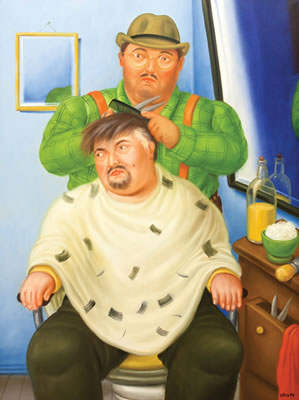
1932 Medellin, Columbia - 2023 Monaco. Known for: Round female figure painting, sculpture.
Fernando Botero, the youngest of three brothers, was born in Medellin, the industrial and commercial center of Columbia; a small provincial city high in the Andes mountains. His father, who died when... Read full biography
Fernando Botero, the youngest of three brothers, was born in Medellin, the industrial and commercial center of Columbia; a small provincial city high in the Andes mountains. His father, who died when Fernando was four, was a salesman who traveled on horseback into the mountains to work. Botero had... Read full biography
Fernando Botero, the youngest of three brothers, was born in Medellin, the industrial and commercial center of Columbia; a small provincial city high in the Andes mountains. His father, who died when Fernando was four, was a salesman who traveled on horseback into the mountains to work. Botero had an uncle who sent him to a school for matadors. Botero's first painting was a watercolor of a matador. As an adolescent he discovered "Esquire Magazine" and the Vargas girls and decided that he was... Read full biography
Fernando Botero, the youngest of three brothers, was born in Medellin, the industrial and commercial center of Columbia; a small provincial city high in the Andes mountains. His father, who died when Fernando was four, was a salesman who traveled on horseback into the mountains to work. Botero had an uncle who sent him to a school for matadors. Botero's first painting was a watercolor of a matador. As an adolescent he discovered "Esquire Magazine" and the Vargas girls and decided that he was going to be an artist, even though that meant that he would always be poor. He was expelled from his Jesuit high school for his "irreligious" ideas after he wrote an article on Picasso and Cubist fragmentation. He was sent to a government school in... Read full biography
Fernando Botero, the youngest of three brothers, was born in Medellin, the industrial and commercial center of Columbia; a small provincial city high in the Andes mountains. His father, who died when Fernando was four, was a salesman who traveled on horseback into the mountains to work. Botero had an uncle who sent him to a school for matadors. Botero's first painting was a watercolor of a matador. As an adolescent he discovered "Esquire Magazine" and the Vargas girls and decided that he was going to be an artist, even though that meant that he would always be poor. He was expelled from his Jesuit high school for his "irreligious" ideas after he wrote an article on Picasso and Cubist fragmentation. He was sent to a government school in Marinilla, a small nearby town, to finish his schooling. After finishing high school in 1951, Botero moved to Bogota. He settled in... Read full biography
Artist Biography
Biography page for Fernando Botero ((1932 - 2023)), known for Round female figure painting, sculpture. Showing 6 biographical entries and 0 sample artworks.
Fernando Botero - Artist Info
About Fernando Botero
Biography from the Archives of askART
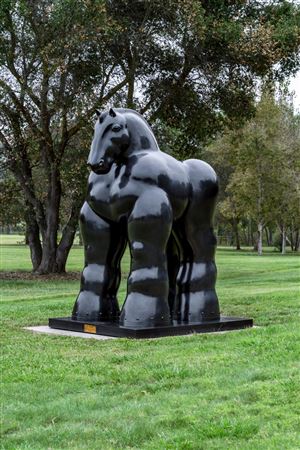 Fernando Botero, the youngest of three brothers, was born in Medellin, the industrial and commercial center of Columbia; a small provincial city high in the Andes mountains. His father, who died when Fernando was four, was a salesman who traveled on horseback into the mountains to work. Botero had an uncle who sent him to a school for matadors.
Botero's first painting was a watercolor of a matador. As an adolescent he discovered "Esquire Magazine" and the Vargas girls and decided that he was going to be an artist, even though that meant that he would always be poor.
He was expelled from his Jesuit high school for his "irreligious" ideas after he wrote an article on Picasso and Cubist fragmentation. He was sent to a government school in Marinilla, a small nearby town, to finish his schooling.
After finishing high school in 1951, Botero moved to Bogota. He settled in Madrid for a year, spent a year in Paris, then two years in Florence. During his twenties, Botero continued to move frequently, returning to Columbia in 1955 when he married. He moved to Mexico City in 1956. He visited the United States for the first time a year later and in 1960 he moved to New York and has not lived full time in Latin America since. In 1972 Botero bought a house near Bogota, where he now spends several months each year. He is a celebrity there, a national hero, mobbed at the airport by fans wanting autographs.
Botero had three children from his first marriage and only one from his second marriage. Unfortunately this little boy died in 1974 in an automobile accident in which Botero himself was badly injured, especially his hands. Sophie Vari is a sculptor with whom he has lived for many years. They live in Pietrasante where both have studios in different parts of their house. Botero's turning to sculpture in the late 1970s surprised few who knew him well.
Botero is an avid collector of the work of the world's most foremost artists. His homes are all full of these works and they have all been a very strong influence on his painting and on his sculpture. There are many who consider his treatments of many of these themes to be satirical. His comment: "I create my subjects somehow visualizing them in my style. I start as a poet, put the colors down on canvas as a painter, but finish my work as a sculptor, taking delight in caressing the forms."
No, Botero is not fat.
Compiled and submitted August 2004 by Jean Ershler Schatz, artist and researcher from Laguna Woods, California.
Sources include:
"A Gift for Being Different" by Margaret Moorman in 'ARTnews', February 1986
"World Artists", 1950-80, by Claude MarksBiography from RoGallery
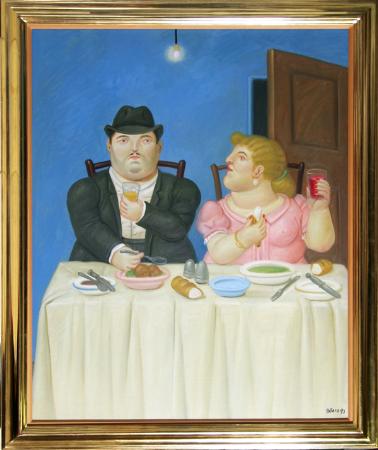 Fernando Botero's distinctive style of smooth inflated shapes with unexpected shifts in scale is today instantly recognizable. It reflects the artist's constant search to give volume presence and reality. The parameters of proportion in his world seem innovative and almost always surprising. Appropriating themes from all of art history-- from the Middle Ages, the Italian quattrocento, and Latin American colonial art to the modern trends of the 20th century--Botero transforms them to his own particular style.
Born in 1932 in Medellin, Colombia, Botero became interested in painting at an early age. His artistic precocity was evident in an illustrated article he contributed to the Medellin newspaper El Colombiano when he was seventeen. Titled Picasso and the Nonconformity of Art, it revealed his avant-garde thinking about modern art.
Botero moved to Bogotá in 1951 and held his first one-man exhibition there at the Leo Matiz Gallery. The following year, at the age of twenty, he was awarded a Second Prize at the National Salon in Bogota. With the money he earned from the Salon award and his exhibitions, Botero traveled to Spain, France and Italy to study the work of the Old Masters. In Madrid, he visited El Prado Museum daily while studying at the San Fernando Academy. In Florence, he studied at the Academy of San Marcos and was profoundly influenced by the works of Giotto, Piero della Francesca, Paolo Uccello and Andrea del Castagno.
It was during a brief stay in Mexico that Botero produced Still Life with Mandolin (1956), the first work in which "puffed-up" form makes a definite appearance. Two years later he was awarded a First Prize at the National Salon in Bogota for his Bridal Chamber: Homage to Mantegna, a work inspired in Mantegna's 1474 frescoes for the Ducal Palace in Mantua.
Botero later did a second version on this theme, which is now in the collection of the Hirshhorn Museum. Botero moved to New York in 1960 and the following year the Museum of Modern Art of New York acquired his painting Mona Lisa, Age Twelve for its collection. During this period he experimented briefly with a gestural brushstroke, which Botero called his flirtation with the School of New York. Over the next years Botero continued to explore the manipulation of form for aesthetic effect, gradually eliminating all traces of brushwork and texture, opting instead for smooth inflated shapes.
His continuing attraction to the Colombia of his youth is reflected in paintings rooted in small town Colombian life--middle-class family groups, heads of state, prelates, madonnas, military men, prostitutes and opulent still lifes with exotic fruit. In 1973 Botero left New York for Paris and began to produce sculpture, although without giving up painting. His work in a three-dimensional art was a natural progression for an artist singularly dedicated to expressing volume and mass.
It is not the semblance of volume, however, but volume itself, a tangible volume, that the medium of sculpture offers. His vision involves the conviction that monumentality is not so much a question of size as it is of proportion. It is a search for the heroic in art, an attribute that Botero first discovered as a student in Florence. Today Fernando Botero divides his time between Paris, New York and Tuscany. His paintings, sculptures, and drawings are exhibited and represented in museum collections throughout the world.
Source: Artist ShowroomBiography from DB Fine Art
 Fernando Botero was born in 1932 in Medellín, Colombia. His upbringing was marked by isolation from the traditional art venues; Colombian heritage thus informs his art. The self-titled "most Colombian of Colombian artists", establishes and nourishes a link to his mother country despite his being based in New York since 1960.
He graduated from the Medellín University in 1950, before going to study at the San Fernando Academy, Madrid, in 1952. He continued his European education from 1953 to 1955 in Florence, studying particularly fresco techniques and Art History. Botero became interested in painting at a young age and his first one-man exhibition took place place in Bogotá at the Leo Matiz Gallery in 1951, when he was just nineteen years old.
Appropriating themes from all of art history, he transforms them to his own particular vocabulary. His distinctive style of smooth inflated shapes with unexpected shifts in scale is today instantly recognizable. The 'fat people', often thought by critics to satirize the subjects and situations that Botero chooses to paint, first stand for themselves, as aesthetic shapes, plain expressions of the living model.
Botero is an abstract artist in the most fundamental sense of the word, choosing what colors, shapes, and proportions to use based on intuitive aesthetic thinking and on the artist's own apprehension of the surrounding world. His paintings, sculptures and drawings are exhibited and represented in museum collections throughout the world and most major art infrastructures have included one man exhibitions of his work in the past forty years showing global and constant interest for his work.Biography from Vered Gallery - International artists
"I try to create sensuousness thru form"
-Fernando Botero
Botero's monumental sculptures have lined Park Avenue, graced Berlin's Lustgarten, been exhibited in San Antonio, paraded on the Champs Elysses, graced the streets of Sevilla and delight vacationers at the Grand Wailea resort in Hawaii - Botero is magnifique! Both as sculptor and painter, Botero's brilliant colors and massive forms make you stand up and take notice immediately.
From an improbable beginning one of the world's most arresting and talked about artists rose to great prominence. Fernando Botero was born in Medellin, the industrial and commercial center of Columbia; a small provincial city high in the Andes mountains. His father, who died when Fernando was four, was a salesman who traveled on horseback into the mountains to work. Botero had an uncle who sent him to a school for matadors. As an adolescent he discovered Esquire Magazine and the Vargas girls and decided that he was going to be an artist, even though that meant that he would always be poor - or so it seemed then. He was expelled from his Jesuit high school for his "irreligious" ideas after he wrote an article on Picasso and Cubist fragmentation. He was sent to a government school in Marinilla, a small nearby town, to finish his schooling. After finishing high school in 1951, Botero moved to Bogota. Only then was Botero allowed to travel beyond Columbia's borders.
Botero then traveled to the great art 'capitals' in Europe; Madrid for a year, then a year in Paris, then two years in Florence. During his twenties, Botero continued to move frequently, returning to Columbia in 1955. Today, Botero has several homes; Pietrasanta, Mexico City, New York… Bogata. In Bogota he has taken on celebrity status. He is a national hero, mobbed at the airport by fans wanting autographs.
Among Botero's earliest works were still life paintings. It was with still life painting that Botero launched his own particular style of inflated volumes, and it is precisely in this genre, that the underlying principle of distortion is most readily seen. It is a slight detail—such as the tiny bite mark on a pear, or the minuscule sound hole at an instrument's center—that acts as a catalyst in the process of proportional modification, and the ensuing alteration of the composition's very meaning. Botero says, "An artist is attracted to certain kinds of form without knowing why. You adopt a position intuitively; only later do you attempt to rationalize or even justify it." He is an abstract artist in the most fundamental sense of the word, choosing what colors, shapes, and proportions to use based on intuitive fundamental aesthetic thinking." This being said, his works are informed by a Colombian upbringing void of traditional art venues. Social commentary is woven all throughout his work.
The turning point in Botero's career came in 1961 when Dorothy Miller, then curator of museum collections at The Museum of Modern Art in New York bought his Mona Lisa, Age Tvelve. The wide-ranging retrospective of his work, held at the Hirshhorn Museum and Sculpture Garden in Washington, D.C., in 1979, was the first in a series of similar shows. Subsequent exhibitions were held in Chicago, New York, and Madrid. Neither the fame nor the high prices fetched by his works has changed Botero's nomadic habits. To this day, the artist continues to divide his time between Colombia, New York, Paris, and Pietrasanta.
For the most part, Botero's forays into portraiture have taken the form of self-portraits, in which he subjects his own figure to the same deforming logic that he applies to all others. He does so with a good amount of humor, especially when echoing such illustrious antecedents as Rembrandt or de Chirico. He portrays himself disguised as some of the most diverse characters—projections, perhaps, of his unfulfilled desires—ranging from Spanish conquistador to gallant bullfighter. In some instances, the Colombian artist portrays himself as a tiny figure, somewhere between the medieval representation of the donor, and the self-portraits of Velazquez depicted alongside his eminent models. In other instances, however, Botero's presence is rendered almost imperceptible, as his distinctive visage timidly emerges from some minuscule cameo.
More important than his subject matter, is the means he uses to depict the subject which you see clearly in his paintings. Expressionism interested him, he sought his primary inspiration from the Italian creating volume in his paintings by expanding the figures and compressing the space around them, a quality which he continues to explore whether painting imaginary group portraits or parodies on the work of famous masters.
One of the most distinctive chapters in Botero's career is the one comprising his renderings of celebrated paintings from the history of art. Like a legion of painters before him, and certainly Picasso Bacon, Lichtenstein and Johns, the Colombian painter borrows motifs from a shared cultural heritage. Botero's intention, however, is not to copy Leonardo, Caravaggio, or Mantegna, since his pictures are free interpretations retaining only the subject matter of the originals. By stripping the motifs of all their stylistic traits he converts them into genuine Boteros. Although a certain touch of irony infiltrates these works, whether paintings by Velazquez at the Prado, or fresco masters in Florence, the artist's goal is not to create caricatures. Rather, they are his attempts to distill the true essences of paintings while conforming to the formal aspects of his particular style.
First a painter, Botero began to produce sculpture in the 70's. His work in a three dimensional art was a natural progression for an artist singularly dedicated to expressing volume and mass. Columbian artist Fernando Botero's unique style is recognized and renowned world-wide for the voluminous forms and sensuous figures found within his paintings, sculpture and works on paper. The monumentality of his images has made his work instantly recognizable. "I studied the art of Giotto and all other Italian Masters, I was fascinated by their sense of volume and monumentality, of course in modern art everything is exaggerated - so my voluminous figures also became exaggerated."
Most recently (2007-2011) the major Botero exhibition "The Baroque Works of Ferdando Botero" has been traveling to museums world wide. 100 of his paintings, sculptures, and drawings, the first retrospective exhibition in the United States of Botero's work since 1978, and selected by Dr. John Sillevis, Curator of the Gemeentemuseum, The Hague. Presented will be the best works from the several stages in his development as an artist. The exhibition follows Botero in his extensive studies of the history of European art, which he pursued in art museums across the continent. Another important theme illustrated in the exhibition is the glory and misery of contemporary life in Latin America. The show opened at Musée National des Beaux-Arts du Québec (Canada) .
Botero's work is represented in National and International museum collections throughout the world including: Arkansas Art Center, Museum of Modern Art NY, Delaware Art Museum, Hirshhorn Museum and Sculpture Garden ; Hiroshima City Museum of Contemporary Art, Japan; Ho-am Museum, Seoul, Süd Korea; Hood Museum of Art, Dartmouth College; Israel Museum, Jerusalem; Kunsthalle Nürnberg, Deutschland; Lowe Art Museum, University of Miami; University, University of Rochester Art Museum, Michigan; Metropolitan Museum of Art , New York; Milwaukee Art Museum; Miyagi Museum of Art, Japan; Museo d´Arte Moderna del Vaticano; Museo de Antioquia, Medellín, Kolumbien; Museo de Bellas Artes, Caracas, Venezuela; Museo Nacional, Bogotá, Kolumbien; Museo Nacional de Bellas Artes, Santiago, Chile; A Museum Moderne Kunst, Vienna, Österreich; The Museum of Modern Art, New York; The Museum of Modern Art, New York; The Museum of Modern Art, Saitama, Japan; Neue Pinakothek, München, Deutschland; Ponce Museum of Art, Ponce, Puerto Rico; Pushkin Museum, Moscow, Russland; The Solomon R. Guggenheim Museum, New York; Staatsgalerie Moderne Kunst, München, Deutschland; The State Hermitage Museum, St. Petersburg, Russland; Tokushima Modern Art Museum, Japan; Wallraf-Richartz-Museum, Köln, Deutschland and Yamanashi Prefectural Museum of Art, Japan.
Selected Exhibitions:
2009 Gary Nader Fine Art, Coral Gables, FL, USA
Fernando Botero: The Circus. James Goodman Gallery, New York, NY, USA
El Dolor de Colombia, Pinacoteca Diego Rivero, Xalapa, Veracruz, Mexico
2008 The Baroque World of Fernando Botero, Brooks Museum of Art, Memphis, TN; New Orleans Museum of Art, New Orleans, LA; Delaware Art Museum, Wilmington, DE
2007 - 2008 Botero: Oeuvres récentes, Marlborough Monaco, Monte Carlo, Monaco, November 22, 2007 - January 25, 2008 (solo)
2007 Fernando Botero: Abu Ghraib, University of California, Berkeley, California, January 29 - March 23, 2007 (solo)
2007 The Baroque World of Fernando Botero, Musée National des Beaux-Arts du Québec, Canada, January-April 2007 (solo)
2007 Delaware Art Museum, Wilmington, Delaware, March - June, 2008 (solo)
2007 New Orleans Museum of Art (New Orleans, LA) - June-September 2008 (solo)
2007 Summer Exhibition, Marlborough Gallery, New York, NY, June 6 - September
2007 Latin Masters, Nassau County Museum of Art, Roslyn Harbor, New York, August 26 - November 4
2007 Fernando Botero, Samuelis Baumgarte Galerie, Bielefeld, Germany (solo)
2006 Sculpture, Marlborough Gallery, New York, NY, January 5 - 28, 2006
2006 Summer Group Show, Marlborough Gallery, New York, NY, June 22 - September 5
2006 Fernando Botero, Athens Concert Hall, Greece, May 24 - September 10 (solo)
2006 Fernando Botero: Abu Ghraib, Marlborough Gallery, New York, New York, October 18-November 18 (solo)
2005 Landscape, Cityscape, Marlborough Gallery, New York
2005 Palazzo Venezia, Rome
2004 The Art Museum, Singapore
2003 The Doge's Palace and other locations, Venice
2003 The Gemeente Museum, Aja
2003 The Maillol Museum, Paris
2002 Museum of Modern Art, Copenhagen
2001 Moderna Musset, Stockholm
2000 The Museum of Antioquìa, Medellìn
2000 City di Pietrasanta
1998 - 1999 San Paolo Museum of Art, San Paolo
1998 - 1999 The National Museum of Fine Arts, Rio de Janeiro
1998 - 1999 The Monterey Museum of Contemporary Art
1998 - 1999 The Art Museum, Tel Aviv
1997 The Modern Art Museum of Lugano
1997 The National Musuum of Fine Arts, Santiago
1996 The Israel Museum, Jerusalem
1996 The Art Museum of the Americas, Washington D.C.
1996 Niigata Prefectoral Modern Art Museum, Niigata
1996 Sonje Museum of Contemporary Art, Kyongju
1996 The Sofia Imber Museum of Contemporary Art, Caracas
1994 - 1995 Museo of Art, Takamatsu City
1994 - 1995 Shinjuku Mitsukoshi Museum of Art, Mitsukoshi
1994 - 1995 Iwaki City Art Museum, Iwaki
1994 Helsinki City Art Museum
1994 The National Museum of Fine Arts, Buenos, Aires
1994 Paseo de Recolet, Madrid
1994 Museo Nacional de Bellas Artes, Buenos Aires
1994 Paseo de Recoletes, Madrid
1994 Museum of Art, Fort Lauderdale
1992 - 1993 Montecarlo Kunsthaus, Vienna
1992 - 1993 Champs-Elysées, Paris
1992 - 1993 The Hermitage Museum, Saint Petersburg
1991 Exhibition Palace, Rome
1989 The Coro Museum of the Arts
1989 The Contemporary Museum of Art, Caracas
1989 The Rufino Tamayo Museum
1987 The Queen Sofia Center for the Arts, Madrid
1986 The Contemporary Art Museum, Caracas
1986 Municipal Art Museum, Niigata
1986 Museum of Art, Alòbany
1985 The National Museum, Bogota
1985 The Ponce Museum, Puerto Rico
1984 The Munson-Williams-Proctor Museum of Art, Ithaca, New York
1984 The Everhard Museum, Scranton
1984 The Herbert F. Johnson Museum, Cornell University, Ithaca, New York
1983 The Veranneman Foundation, Belgium
1981 The Civic Museum of Art, Osaka
1981 The Seibu Museum of Art, Tokyo
1979 The d'Ixelles Museum, Brussels
1979 The Hirschorn Museum and Sculpture Garden, Washington, D.C.
1979 The South Texas Museum of Art
1978 Sculpture Museum of the city of MarlMarl
1977 The Medellìn Museum of Art, Medellìn
1976 The Museum of Comtemporary Art, Caracas
1975 The Boymans van Beuningen Museum, Rotterdam
1972 Marlborough Gallery, New York
1972 Buchholz, Munich
1972 Claude Bernard, Paris
1970 Staatliche Kunsthalle. Fernando Botero: Bilder 1962-1969. Baden-Baden, Germany. Traveled to Berlin, Haus am Waldsee; Dusseldorf, Stadtische Kunsthalle; Hamburg, Kunstverein; and Bielefeld, Kunsthalle.
Galerie Buchholz. Botero. Munich, Germany.
Hanover Gallery. Fernando Botero, London, England.
1969 Center for Inter-American Relations. Fernando Botero. Catalogue, foreword by Stanton L. Catlin, essay by Klaus Gallwitz. New York, U.S.A.
Galerie Claude Bernard. Botero: Peintures, pastels, fusains. Paris, France.
1969 Inflated Images, Museum of Modern Art, New York
1968 Galería Juana Mordó. Botero. Madrid, Spain.
Galerie Buchholz. Botero. Munich, Germany.
1966 Staatliche Kunsthalle. Fernando Botero. Catalogue, text by Daniel Robbins. Baden-Baden,Germany.
Traveled to Munich, Galerie Buchholz. Hanover, Galerie Brusberg. Fernando Botero: Olbilder und Zeichnungen.
Milwaukee Art Center. Fernando Botero: Recent Works. Catalogue, foreword by Tracy Atkinson. Milwaukee, Wisconsin, U.S.A.
1965 Zora Gallery. Botero: Recent Works. Los Angeles, California, U.S.A.
1964 Cordoba Bienale, Argentina
Galería Arte Moderno. Fernando Botero: Bosquejos realidades. Bogotá, Colombia
Museo de Arte Moderno. Fernando Botero: Obras recientes. Bogotá, Colombia.
1962 7 Contemporary Painters, Museum of Modern Art, Bogota
Gres Gallery. Botero. Chicago, U.S.A.
The Contemporaries. Botero. New York, U.S.A.
1961 Galería de Arte El Callejón. Botero. Bogotá, Colombia.
1960 Gres Gallery. Botero. Washington D.C., U.S.A.
1959 Biblioteca Nacional de Colombia, Sala Gregorio Vásquez. Botero: Obras recientes. Bogotá, Colombia.
1958 Galería Antonio Souza. Fernando Botero: Oleos. Mexico D.F., Mexico.
Gres Gallery. Fernando Botero: Recent Oils, Watercolors, Drawings.
Washington D.C., U.S.A.
1957 Pan American Union, Washington, D.C.
1955 Biblioteca Nacional, Bogota
1951 Leo Matiz Gallery, Bogota
Literature:
2008 Castro Flórez, Fernando. Fernando Botero: Abu Ghraib, El circo. Valencia : Institut Valencià d'Art Modern, 2008
2007 Buysschaert, M., Chiappini, R., Malerba, F., Ruzzante, A., (eds.) Botero: works 1994-2007. Milan; NY: Distributed in North America by Rizzoli International Publications, 2007
2006 Ebony, D. Botero : Abu Ghraib. Munich ; New York : Prestel, c2006.
Sillevis, J., Elliott, E., Sullivan, E.J. The Baroque world of Fernando Botero. Alexandria, Va. : Art Services International ; New Haven : In association with Yale University Press, 2006
2005 Strinati, C., Veltroni, W., Botero : the last 15 years. Roma : De Luca Editori d'Arte, c2005 (catalogue)
2003 Gribaudo, P., Fuentes, C., Botero: women. New York : Rizzoli : Distributed to the U.S. trade by St. Martin's Press, 2003
2001 Botero: monumental sculpture. New York : Marlborough Gallery, 2001 (catalogue)
2000 Sullivan, E. J., Tasset, J. M. Fernando Botero: monograph & catalogue raisonné : paintings 1975-1990. Lausanne : Acatos, 2000 (catalogue raisonné)
1999 Villegas, B., Fumaroli, M., Botero drawings. Bogota : Villegas Editores, 1999
1998 Lambert, J. C., Villegas, B., Botero sculptures. Bogotá : Villegas Editores, 1998
Fernando Botero: drawings and watercolors on canvas. New York : Marlborough, 1998 (catalogue)
1997 Escallón, A. M., Botero: new works on canvas. New York : Rizzoli International Publications, 1997
Aguirre, E. (et al.), Botero : la corrida. adrid : Ministerio de Educación y Cultura : Fundación Central Hispano : Communidad de Madrid, 1997 (catalogue)
1993 Sullivan, E.J., Fernando Botero: drawings and watercolors. New York : Rizzoli, 1993
Gribaudo, P. Botero Affreschi - Chiesa della Misericordia, Pietrasanta. Torino: Stamperia Artistica Nazionale, 1993 (catalogue)
Fernando Botero: drawings on canvas. New York, NY : Marlborough Gallery, 1993 (catalogue)
1992 Cau, J. Botero aux Champs-Elysées "La Corrida aux Grand Palais". Paris: Mairie de Paris and Didier Imbert Fine Art. Edition of 3, Sculptures et Œuvres sur Papier," by Pierre Daix, "Sculptures Monumentales," by Charles Virmaître, 1992 (catalogue)
Sullivan, E.J. Botero: Aquarelles et Dessins. Madrid: Lerner & Lerner, 1992(catalogue)
Vargas Llosa, Mario. Botero: Dessins et Aquarelles. Paris: Editions de la Difference, (nd), 1992 (catalogue)
1991 Pacifico, M., Silvestro S., and Giorgio Van Straten. Botero al Forte Belvedere di Firenze. Florence: Tipolito Press, 1991 (catalogue)
1990 Caballero Bonald, J. M. Botero: the bullfight. New York, N.Y. : Rizzoli, 1990
Gribaudo, P. Botero. Milan: Gruppo Editoriale Fabbri, 1990
Soavi, Giorgio. Fernando Botero - Œuvres 1959-1989. Paris: Celiv, 1990 (catalogue)
1986 Sullivan, E. J. Botero, sculpture. New York : Abbeville Press, 1986
1980 Ratcliff, C. Fernando Botero: recent work. November 7 -December 2, 1980. Marlborough Gallery, New York: the Gallery, 1980 (catalogue)
1979 Jaffee McCabe, C. Fernando Botero: Hirshhorn Museum and Sculpture Garden. Washington : Smithsonian Institution Press, 1979 (catalogue)
1975 Fernando Botero. New York, Marlborough Gallery, 1975 (catalogue)
1973 Fernando Botero.April-maggio. Roma : Marlborough galleria d'arte, 1973 (catalogue)Biography from Boca Raton Museum of Art
Fernando Botero is Latin America's most famous living artist. His distinctive style of smooth inflated shapes with unexpected shifts in scale is today instantly recognizable and reflects the artist's constant search to give volume presence and reality. The parameters of proportion in his world are free, imaginative, innovative and almost always surprising. Appropriating themes from all of art history-- from the Middle Ages, the Italian quattrocento, and Latin American colonial art to the modern trends of the 20th century--Botero transforms them to his own particular style.
Born in 1932 in Medellin, capital of the Antioquia Department of Colombia, Botero became interested in painting at an early age. His artistic precociousness was evident in an illustrated article he contributed to the Medellin newspaper El Colombiano when he was seventeen. Titled "Picasso and the Nonconformity of Art," it revealed his avant-garde thinking about modern art.
Botero moved to Bogotá in 1951 and held his first one-man exhibition there at the Leo Matiz Gallery. The following year, at the age of twenty, he was awarded a Second Prize at the National Salon in Bogotá. With the money he earned from the Salon award and his exhibitions, Botero fulfilled his longtime desire to travel to Spain, France and Italy to study the work of the old masters. In Madrid, he visited El Prado Museum daily while studying at the San Fernando Academy. In Florence, he studied at the Academy of San Marcos and was profoundly influenced by the works of Giotto, Piero della Francesca, Paolo Uccello and Andrea del Castagno.
It was during a brief stay in Mexico that Botero produced Still Life with Mandolin (1956), the first work in which "puffed-up" form makes a definite
appearance. Two years later he was awarded a First Prize at the National Salon in Bogotá for his Bridal Chamber: Homage to Mantegna, a work inspired in Mantegna's 1474 frescoes for the Ducal Palace in Mantua.
Botero later did a second version on this theme, which is now in the collection of the Hirshhorn Museum.
Botero moved to New York in 1960 and the following year the Museum of
Modern Art of New York acquired his painting Mona Lisa, Age Twelve for its
collection. During this period he experimented briefly with a gestural brushstroke, which Botero called his flirtation with the School of New York. Over the next years Botero continued to explore the manipulation of form for aesthetic effect, gradually eliminating all traces of brushwork and texture, opting instead for smooth inflated shapes. His continuing attraction to the Colombia of his youth is reflected in paintings rooted in small town Colombian life--middle-class family groups, heads of state, prelates, madonnas, military men, prostitutes and opulent still lives with exotic fruit. By the end of the 1970s, Botero's fame was world-wide.
In 1973 Botero left New York for Paris and began to produce sculpture, although without giving up painting. His work in a three-dimensional art was a natural progression for an artist singularly dedicated to expressing volume and mass. It is not the semblance of volume, however, but volume itself, a tangible volume, that the medium of sculpture offers. His vision involves the conviction that monumentality is not so much a question of size as it is of proportion. It is a search for the heroic in art, an attribute that Botero first discovered as a student in Florence.
Today Fernando Botero divides his time between Paris, New York and Tuscany. His paintings, sculptures, and drawings are exhibited and represented in museum collections throughout the world. He is an artist who at a very early age developed a style of his own which established him firmly both on the local art scene and abroad, and as one of the masters of twentieth-century art.
Botero Exhibition-Artist Botero in Washington D.C.
An exhibition presented by The Art Museum of the AmericasBiography from Pierre Berge
Fernando Botero Angulo, born April 19, 1932 in Medellín, is a Colombian painter and sculptor known for his round and voluptuous figures. Having ironically nicknamed himself "the most Colombian of Colombian artists", he is one of the few painters to enjoy success and glory during his lifetime. Fernando Botero's career really began in 1958, when he won the first prize at the Salón de Artistas Colombiens: Salón de Artistas Colombianos. During his numerous trips to the United States and Europe, Fernando Botero developed his own style, of which his Still Life with Mandolin, dating from 1957, is the first manifestation. This style, which can be seen in his paintings or drawings as well as in his sculptures, allows him not to be associated with any movement or current, past or present. Moreover, his work is essentially inspired by pre-Columbian and popular art. Fernando Botero now lives and works in Paris, France, but also in New York in the United States and in Pietrasanta near Lucca in Tuscany.