Page loaded successfully. Showing biography for Filippo Lauri.
Filippo Lauri BIOGRAPHY
1623 - 1694. Known for: Mythological paintings.
Filippo Lauri, son of a painter from Flanders who had emigrated to Rome, was one the leading Roman artists of the second half of the 17th century. He was twice Principe of the Accademia di San Luca,... Read full biography
Filippo Lauri, son of a painter from Flanders who had emigrated to Rome, was one the leading Roman artists of the second half of the 17th century. He was twice Principe of the Accademia di San Luca, in 1684 and 1685. Filippo Lauri was described by his biographer Francesco Baldinucci as a capable... Read full biography
Filippo Lauri, son of a painter from Flanders who had emigrated to Rome, was one the leading Roman artists of the second half of the 17th century. He was twice Principe of the Accademia di San Luca, in 1684 and 1685. Filippo Lauri was described by his biographer Francesco Baldinucci as a capable painter, able to continuously vary his style and choice of subject. The present work demonstrates his ability not only to paint frescoes and monumental canvases, but also his talent at painting small... Read full biography
Filippo Lauri, son of a painter from Flanders who had emigrated to Rome, was one the leading Roman artists of the second half of the 17th century. He was twice Principe of the Accademia di San Luca, in 1684 and 1685. Filippo Lauri was described by his biographer Francesco Baldinucci as a capable painter, able to continuously vary his style and choice of subject. The present work demonstrates his ability not only to paint frescoes and monumental canvases, but also his talent at painting small cabinet pictures for private commissions and collectors. Lauri received his initial training from his father, the Flemish landscape painter Balthazar Lauwers. He later trained with his brother-in-law. Angelo Caroselli introduced him to the classicist... Read full biography
Filippo Lauri, son of a painter from Flanders who had emigrated to Rome, was one the leading Roman artists of the second half of the 17th century. He was twice Principe of the Accademia di San Luca, in 1684 and 1685. Filippo Lauri was described by his biographer Francesco Baldinucci as a capable painter, able to continuously vary his style and choice of subject. The present work demonstrates his ability not only to paint frescoes and monumental canvases, but also his talent at painting small cabinet pictures for private commissions and collectors. Lauri received his initial training from his father, the Flemish landscape painter Balthazar Lauwers. He later trained with his brother-in-law. Angelo Caroselli introduced him to the classicist tradition of the Bolognese school, and particularly the art of Domenichino and... Read full biography
Artist Biography
Biography page for Filippo Lauri ((1623 - 1694)), known for Mythological paintings. Showing 1 biographical entries and 0 sample artworks.
Filippo Lauri - Artist Info
About Filippo Lauri
Biography from Dorotheum, Vienna
Filippo Lauri, son of a painter from Flanders who had emigrated to Rome, was one the leading Roman artists of the second half of the 17th century. He was twice Principe of the Accademia di San Luca, in 1684 and 1685.
Filippo Lauri was described by his biographer Francesco Baldinucci as a capable painter, able to continuously vary his style and choice of subject. The present work demonstrates his ability not only to paint frescoes and monumental canvases, but also his talent at painting small cabinet pictures for private commissions and collectors.
Lauri received his initial training from his father, the Flemish landscape painter Balthazar Lauwers. He later trained with his brother-in-law. Angelo Caroselli introduced him to the classicist tradition of the Bolognese school, and particularly the art of Domenichino and Francesco Albani. The latter was to have a great influence on Lauri's work. He became the protégé of Roman aristocrats including the Colonna and Borghese Princes who paved his way to success. In 1684 Lauri was made Principe of the Accademia di San Luca.
William Beckford, who probably bought the painting in Rome during his Grand Tour, was one of the most important English art collectors of his time. The painting hung in Beckford's country house Fonthill Abbey, which was the first example of neo-Gothic architecture in England (built by Thomas Wyatt between 1796 and 1822). With the collapse of the West Indian sugar market, the source of Beckford's income, he was forced to sell Fonthill Abbey and his collection in 1822. The hugely successful auction ran for several days.
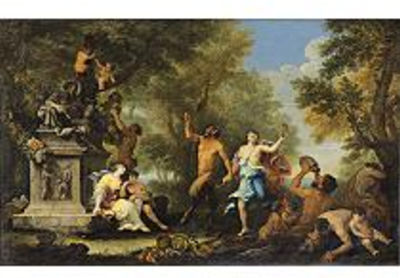
Filippo Lauri was celebrated for his compositions "in piccolo". In the course of his career, however, he was also a painter of monumental decorations, such as in the cantiere pittorico in the Gallery of Pope Alexander VII on the Quirinal Hill or in the mezzanines of the Palazzo Borghese. Apart from the quality of the present painting's drawing and brushwork, the work's authorship is also attested to by a monogram on the base of the statue of Bacchus. The composition entirely complies with the artist's own description of a work in an oeuvre catalogue attached to his biography by Francesco Saverio Baldinucci: "A bacchanal featuring satyrs and bacchantes dancing around the deity's statue, with putti decorating the latter with flowers and fruit, as well as a village" (F. S. Baldinucci, Vite di artisti dei secoli XVII - XVIII, ed. by A. Matteoli, 1975, p. 175).
Lauri painted this picture in 1680 for Abbot Francesco Marucelli, although the inventory of the learned scholar's possessions compiled by him in 1704 does not list any works by the painter. As far as the present painting's dimensions are concerned, none of the versions of the composition known to us - neither the present painting nor two other, larger variants with rich figural staffage - corresponds to the artist's own description of the composition mentioned above: "de mesura più grande che da mezza testa" (larger by half a head); nevertheless, this precious document is proof that there existed a prototype that met with sufficient approval to justify several autograph replicas for high-ranking patrons. A gouache (19 x 25 cm) showing an identical composition, if slightly shortened on the right-hand side, that was exhibited in the Trafalgar Galleries at the Royal Academy III in 1983 (cat. no. 29).