Page loaded successfully. Showing biography for Franz Bergmann.
Franz Bergmann BIOGRAPHY
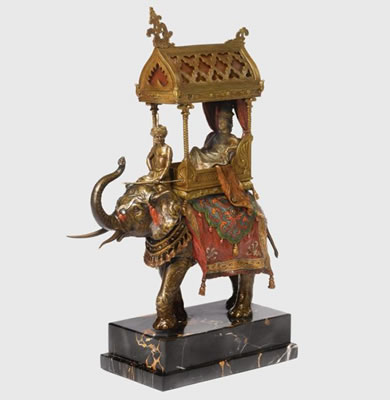
1861 Vienna, Austria - 1936 Vienna, Austria. Known for: Foundry owner of art nouveau sculpture.
Franz Xaver Bergman (or Franz Xaver Bergmann) (1861-1936) was the owner of a Viennese foundry who produced numerous patinated and cold-painted bronze Oriental, erotic and animal figures, the latter... Read full biography
Franz Xaver Bergman (or Franz Xaver Bergmann) (1861-1936) was the owner of a Viennese foundry who produced numerous patinated and cold-painted bronze Oriental, erotic and animal figures, the latter often humanized or whimsical, humorous objects d'art. Noted for his detailed and colorful work, and... Read full biography
Franz Xaver Bergman (or Franz Xaver Bergmann) (1861-1936) was the owner of a Viennese foundry who produced numerous patinated and cold-painted bronze Oriental, erotic and animal figures, the latter often humanized or whimsical, humorous objects d'art. Noted for his detailed and colorful work, and signed either with a 'B' in an urn-shaped cartouche or 'Nam Greb' or 'Namgreb' - 'Bergman' in reverse, he used these marks to disguise his identity on erotic works. His father Franz Bergmann was a... Read full biography
Franz Xaver Bergman (or Franz Xaver Bergmann) (1861-1936) was the owner of a Viennese foundry who produced numerous patinated and cold-painted bronze Oriental, erotic and animal figures, the latter often humanized or whimsical, humorous objects d'art. Noted for his detailed and colorful work, and signed either with a 'B' in an urn-shaped cartouche or 'Nam Greb' or 'Namgreb' - 'Bergman' in reverse, he used these marks to disguise his identity on erotic works. His father Franz Bergmann was a professional chaser* from Gablonz/Bohemia who came to Vienna and founded a small bronze factory in 1860. His son Franz Xaver Bergmann (1861 - 1936) inherited the company and opened a new foundry in 1900. Many of the bronzes from the 1900s were still... Read full biography
Franz Xaver Bergman (or Franz Xaver Bergmann) (1861-1936) was the owner of a Viennese foundry who produced numerous patinated and cold-painted bronze Oriental, erotic and animal figures, the latter often humanized or whimsical, humorous objects d'art. Noted for his detailed and colorful work, and signed either with a 'B' in an urn-shaped cartouche or 'Nam Greb' or 'Namgreb' - 'Bergman' in reverse, he used these marks to disguise his identity on erotic works. His father Franz Bergmann was a professional chaser* from Gablonz/Bohemia who came to Vienna and founded a small bronze factory in 1860. His son Franz Xaver Bergmann (1861 - 1936) inherited the company and opened a new foundry in 1900. Many of the bronzes from the 1900s were still based on designs from his fathers workshop. He was not a sculptor himself as often described wrongfully. There were many anonymous sculp... Read full biography
Artist Biography
Biography page for Franz Bergmann ((1861 - 1936)), known for Foundry owner of art nouveau sculpture. Showing 2 biographical entries and 0 sample artworks.
Franz Bergmann - Artist Info
About Franz Bergmann
Name variants
Franz Bergman, Namgreb
Biography from the Archives of askART
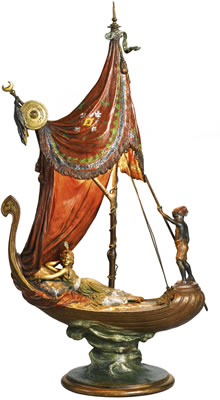 Franz Xaver Bergman (or Franz Xaver Bergmann) (1861-1936) was the owner of a Viennese foundry who produced numerous patinated and cold-painted bronze Oriental, erotic and animal figures, the latter often humanized or whimsical, humorous objects d'art. Noted for his detailed and colorful work, and signed either with a 'B' in an urn-shaped cartouche or 'Nam Greb' or 'Namgreb' - 'Bergman' in reverse, he used these marks to disguise his identity on erotic works.
His father Franz Bergmann was a professional chaser* from Gablonz/Bohemia who came to Vienna and founded a small bronze factory in 1860. His son Franz Xaver Bergmann (1861 - 1936) inherited the company and opened a new foundry in 1900. Many of the bronzes from the 1900s were still based on designs from his fathers workshop.
He was not a sculptor himself as often described wrongfully. There were many anonymous sculptors, hired temporarily by the workshops. At the turn of the 19th/20th Century, there were about fifty workshops producing Vienna Bronzes.
'Cold painted bronze' refers to pieces cast in Vienna and then decorated in several layers with so called dust paint; the know-how for the mix of this kind of paint has been lost. The color was not fired hence "cold painted". The painting was carried out mainly by women working at home, a typical cottage industry.
Sensuous poses of young women in the Art Nouveau* style were disguised by a covering that revealed all when a button was pushed or a lever moved. Often carefully sculpted animals, such as bears, could be opened to reveal an erotic figure inside.
Sources:
"Franz Xaver Bergman", Wikipedia, http://en.wikipedia.org/wiki/Franz_Xavier_Bergman (Accessed 12/14/2013)
Mike Parker, Collector of Art Deco, Art Nouveau or Animalier bronzes
* For more in-depth information about these terms and others, see AskART.com Glossary http://www.askart.com/AskART/lists/Art_Definition.aspxBiography from Carlo Bonte Auctions
Height 10-12.5 cm