Page loaded successfully. Showing biography for Franz Marc.
Franz Marc BIOGRAPHY
1880 Munich, Germany - 1916 Verdun, Austria. Known for: Abstract painting-landscape, animals.
Franz Marc was born in Munich, Germany in 1880. His father was a successful Munich landscape and genre artist who influenced him strongly. Marc studied at the Munich Academy. He left there for Paris,... Read full biography
Franz Marc was born in Munich, Germany in 1880. His father was a successful Munich landscape and genre artist who influenced him strongly. Marc studied at the Munich Academy. He left there for Paris, then went home full of the doings of the Fauves and Cubists. In 1911 he joined with Klee and... Read full biography
Franz Marc was born in Munich, Germany in 1880. His father was a successful Munich landscape and genre artist who influenced him strongly. Marc studied at the Munich Academy. He left there for Paris, then went home full of the doings of the Fauves and Cubists. In 1911 he joined with Klee and Kandinsky to found a group called the Blue Rider (Blaue Reiter). Their members aspired to nothing less than painting the essence of things. They put feeling first, faithfulness to nature or to formal... Read full biography
Franz Marc was born in Munich, Germany in 1880. His father was a successful Munich landscape and genre artist who influenced him strongly. Marc studied at the Munich Academy. He left there for Paris, then went home full of the doings of the Fauves and Cubists. In 1911 he joined with Klee and Kandinsky to found a group called the Blue Rider (Blaue Reiter). Their members aspired to nothing less than painting the essence of things. They put feeling first, faithfulness to nature or to formal conventions last. They were the clear sweet dawn of German expressionism. a school that later languished from too much heaviness, bitterness and swagger. For Marc, as for his friend and mentor, Kandinsky, implementation of new art forms was indeed a... Read full biography
Franz Marc was born in Munich, Germany in 1880. His father was a successful Munich landscape and genre artist who influenced him strongly. Marc studied at the Munich Academy. He left there for Paris, then went home full of the doings of the Fauves and Cubists. In 1911 he joined with Klee and Kandinsky to found a group called the Blue Rider (Blaue Reiter). Their members aspired to nothing less than painting the essence of things. They put feeling first, faithfulness to nature or to formal conventions last. They were the clear sweet dawn of German expressionism. a school that later languished from too much heaviness, bitterness and swagger. For Marc, as for his friend and mentor, Kandinsky, implementation of new art forms was indeed a religious crusade. He saw pure abstract art as truth and worked toward it with the same fervor he had once directed toward the study of theology. Marc... Read full biography
Artist Biography
Biography page for Franz Marc ((1880 - 1916)), known for Abstract painting-landscape, animals. Showing 2 biographical entries and 0 sample artworks.
Franz Marc - Artist Info
About Franz Marc
Biography from the Archives of askART
 Franz Marc was born in Munich, Germany in 1880. His father was a successful Munich landscape and genre artist who influenced him strongly. Marc studied at the Munich Academy. He left there for Paris, then went home full of the doings of the Fauves and Cubists. In 1911 he joined with Klee and Kandinsky to found a group called the Blue Rider (Blaue Reiter). Their members aspired to nothing less than painting the essence of things. They put feeling first, faithfulness to nature or to formal conventions last. They were the clear sweet dawn of German expressionism. a school that later languished from too much heaviness, bitterness and swagger.
For Marc, as for his friend and mentor, Kandinsky, implementation of new art forms was indeed a religious crusade. He saw pure abstract art as truth and worked toward it with the same fervor he had once directed toward the study of theology. Marc loathed conflict of any kind. Man therefore revolted him, and animals he painted with strong, elaborately rhythmical compositions. He transformed their animality with flashing colors; a horse might be sky blue or fire red.
Marc's career ended abruptly with his conscription in 1914. He died in 1916 in Verdun.
Written and submitted by Jean Ershler Schatz, artist and researcher from Laguna Woods, California.
Sources include:
Time Magazine, January 2, 1956
John Dornberg in ARTnews, December 1987
Master Paintings from the Phillips Collection.Biography from Ketterer Kunst, Munich
In 1910 Franz Marc pursued an entirely new concept of form and color that enabled him to create his iconic expressionistic masterpieces. The starting point of this development lies in Franz Marc's singular understanding of nature, in particularly in his view of animals. He was on the quest to grasp the animals' perception of nature: "Our convention of placing animals in landscapes just due to our perceptional habits ask for it is poor and soulless. Why don't we try to get into their soul in order feel their pictorial value?" Franz Marc chose horses as central motif for the implementation of these ideas. The work titled 'Zwei Pferde' shows this newly acquired rhythmical realization of the animal figures which found its climax in the painting 'Turm der Blauen Pferde' (The Tower of the Blue Horses') from 1913. Zwei Pferde already reflects the compositional idea that Franz Marc phrased in a letter to Reinhard Piper: "..The blood that circulates through the two horse bodies is expressed through manifold parallelisms and the vibrating lines. The observer should not even consider asking what kind of breed they are, instead I want him to sense the animal's trembling inner life." What makes this large-size drawing so special is the fact that it is the only preserved preliminary drawing of the destroyed painting 'Streitende Pferde' from 1910 (Hoberg/Jansen vol. I 132; illust. 2). Schardt (cataloug raisonné no. 1910-14) mentions this work with the title 'Weidende Pferde III'. In this painting, which then belonged to Carl Georg Heise, Director of the Hamburger Kunsthalle, Franz Marc achieved his radically new coloring: "Horses in light red-brown, white-heightened, green mane and tails, the wavy landscape in background in light shades of yellow. Three quarters of the ground greenish, turning into a light crimson in the upper part all the way to the horizon."
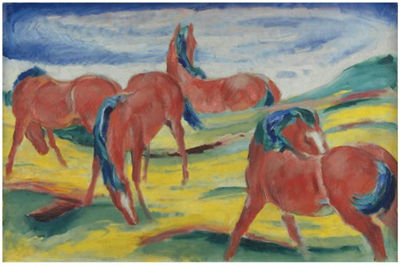
The four paintings from the same year titled 'Weidende Pferde' (today at the Lenbachhaus in Munich, the Staatsgalerie Stuttgart, Busch-Reisinger Museum, USA and in a private collection share the horse motif as their central theme. Though, our preliminary drawing might only be connected to of them. This large-scale drawing is simply extraordinary, both for the subject that Franz Marc treasured so much as well as for the fact that it is characterized by the exceptional concept of form that directly led to the unrivaled icon of Expressionism the 'Turm der blauen Pferde' (The Tower of Blue Horses).