Page loaded successfully. Showing biography for Friedrich Traffelet.
Friedrich Traffelet BIOGRAPHY
1897 - 1954. Known for: Painting.
Friedrich Traffelet was born in 1897 into a Bernese artisan family. Parallel to his apprenticeship as a decorative painter in his father's business, he attended the Bern Arts and Crafts School from... Read full biography
Friedrich Traffelet was born in 1897 into a Bernese artisan family. Parallel to his apprenticeship as a decorative painter in his father's business, he attended the Bern Arts and Crafts School from 1914-1916. In 1917, he moved to the School of Applied Arts in Zurich and became friends with Martin... Read full biography
Friedrich Traffelet was born in 1897 into a Bernese artisan family. Parallel to his apprenticeship as a decorative painter in his father's business, he attended the Bern Arts and Crafts School from 1914-1916. In 1917, he moved to the School of Applied Arts in Zurich and became friends with Martin Lauterburg and Walter Plattner. In 1919/20 he stayed in Paris and took drawing and painting classes at the Académie de la Grande Chaumière and at the Académie Julian. At the same time, he explored the... Read full biography
Friedrich Traffelet was born in 1897 into a Bernese artisan family. Parallel to his apprenticeship as a decorative painter in his father's business, he attended the Bern Arts and Crafts School from 1914-1916. In 1917, he moved to the School of Applied Arts in Zurich and became friends with Martin Lauterburg and Walter Plattner. In 1919/20 he stayed in Paris and took drawing and painting classes at the Académie de la Grande Chaumière and at the Académie Julian. At the same time, he explored the works of Paul Cézanne and Henri de Toulouse-Lautrec in the Louvre and met the Winterthur painter Hans Schoellhorn. Back in Bern, he married Ticinese Alice Rondi in 1922 and took over the studio of the late Wilhelm Balmer. In the wake of numerous... Read full biography
Friedrich Traffelet was born in 1897 into a Bernese artisan family. Parallel to his apprenticeship as a decorative painter in his father's business, he attended the Bern Arts and Crafts School from 1914-1916. In 1917, he moved to the School of Applied Arts in Zurich and became friends with Martin Lauterburg and Walter Plattner. In 1919/20 he stayed in Paris and took drawing and painting classes at the Académie de la Grande Chaumière and at the Académie Julian. At the same time, he explored the works of Paul Cézanne and Henri de Toulouse-Lautrec in the Louvre and met the Winterthur painter Hans Schoellhorn. Back in Bern, he married Ticinese Alice Rondi in 1922 and took over the studio of the late Wilhelm Balmer. In the wake of numerous study trips through England, France, Italy, Holland and Belgium, an extensive, naturalistic and... Read full biography
Artist Biography
Biography page for Friedrich Traffelet ((1897 - 1954)), known for Painting. Showing 1 biographical entries and 0 sample artworks.
Friedrich Traffelet - Artist Info
About Friedrich Traffelet
Biography from Dobiaschofsky Auktionen
Friedrich Traffelet was born in 1897 into a Bernese artisan family. Parallel to his apprenticeship as a decorative painter in his father's business, he attended the Bern Arts and Crafts School from 1914-1916. In 1917, he moved to the School of Applied Arts in Zurich and became friends with Martin Lauterburg and Walter Plattner. In 1919/20 he stayed in Paris and took drawing and painting classes at the Académie de la Grande Chaumière and at the Académie Julian.
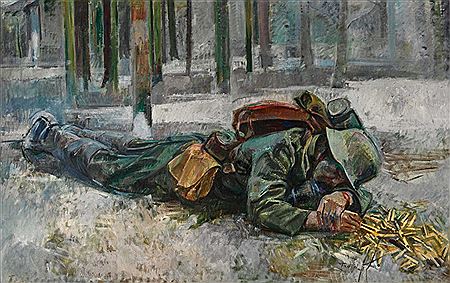
At the same time, he explored the works of Paul Cézanne and Henri de Toulouse-Lautrec in the Louvre and met the Winterthur painter Hans Schoellhorn. Back in Bern, he married Ticinese Alice Rondi in 1922 and took over the studio of the late Wilhelm Balmer. In the wake of numerous study trips through England, France, Italy, Holland and Belgium, an extensive, naturalistic and earthy shades of color influenced early work with portraits, still lifes, landscapes, acts and genre pictures. In 1933, Traffelet accompanied the Mountain Infantry Battalion 23 as a "peintre militaire".
In this context, he created numerous "soldier paintings", which quickly gained popularity due to their lively realism and their description of the army all-day and brought the Bernese a wealth of contracts. In 1935 he also published his essay "I am a soldier and I remain a soldier". During his active service Traffelet was dismissed as an intern painter, whereupon he 1940-1945 soldiers images of French, Poland and Spahis made, which are now among his best works. Traffelet's late work, which is characterized by a freer brushstroke and a brighter color palette, comprises a large number of historical images, portraits and landscapes with reference to Bern's military history.
In this context, in 1953, his contribution to the 800th anniversary of Bern, which consisted of 30 peacetime images. Traffelet's consistently patriotic oeuvre testifies to the artist's fascination and fondness for the army and his homeland in the context of intellectual defense. Traffelet died in 1954.