Page loaded successfully. Showing biography for Ganesh Pyne.
Ganesh Pyne BIOGRAPHY

1937 Kolkata, India - 2013 Kolkata, India. Known for: Dream-like atmosphere, creating hallucinatory figures which speak of death, decay, and the cycle of life..
Ganesh Pyne was initially influenced by Abindranath and Gagendranath Tagore, of the Bengal school, and is well regarded for his meticulous draughtsmanship and delicate handling of pigment. His early... Read full biography
Ganesh Pyne was initially influenced by Abindranath and Gagendranath Tagore, of the Bengal school, and is well regarded for his meticulous draughtsmanship and delicate handling of pigment. His early career was characterized by aesthetically pleasing watercolors; over time, however, his style... Read full biography
Ganesh Pyne was initially influenced by Abindranath and Gagendranath Tagore, of the Bengal school, and is well regarded for his meticulous draughtsmanship and delicate handling of pigment. His early career was characterized by aesthetically pleasing watercolors; over time, however, his style evolved away from that towards a more modernist approach. It also got several shades darker. Like a lot of modernist painters, his work often probed the deeper reaches of human experience. There is a... Read full biography
Ganesh Pyne was initially influenced by Abindranath and Gagendranath Tagore, of the Bengal school, and is well regarded for his meticulous draughtsmanship and delicate handling of pigment. His early career was characterized by aesthetically pleasing watercolors; over time, however, his style evolved away from that towards a more modernist approach. It also got several shades darker. Like a lot of modernist painters, his work often probed the deeper reaches of human experience. There is a distinct sadness to much of it. His brooding dreamscapes, populated with skeletal figures and recurring images of boats and groundless, floating bodies are intimations of decay and impermanence. They are also beautiful—reflecting a personal mythology... Read full biography
Ganesh Pyne was initially influenced by Abindranath and Gagendranath Tagore, of the Bengal school, and is well regarded for his meticulous draughtsmanship and delicate handling of pigment. His early career was characterized by aesthetically pleasing watercolors; over time, however, his style evolved away from that towards a more modernist approach. It also got several shades darker. Like a lot of modernist painters, his work often probed the deeper reaches of human experience. There is a distinct sadness to much of it. His brooding dreamscapes, populated with skeletal figures and recurring images of boats and groundless, floating bodies are intimations of decay and impermanence. They are also beautiful—reflecting a personal mythology steeped in existentialism and wonder. As he once said, "True darkness gives one a feeling of insecurity bordering on fear but it also has Christie's, Mumbai... Read full biography
Artist Biography
Biography page for Ganesh Pyne ((1937 - 2013)), known for Dream-like atmosphere, creating hallucinatory figures which speak of death, decay, and the cycle of life.. Showing 2 biographical entries and 0 sample artworks.
Ganesh Pyne - Artist Info
About Ganesh Pyne
Biography from the Archives of askART
 Ganesh Pyne was initially influenced by Abindranath and Gagendranath Tagore, of the Bengal school, and is well regarded for his meticulous draughtsmanship and delicate handling of pigment. His early career was characterized by aesthetically pleasing watercolors; over time, however, his style evolved away from that towards a more modernist approach. It also got several shades darker.
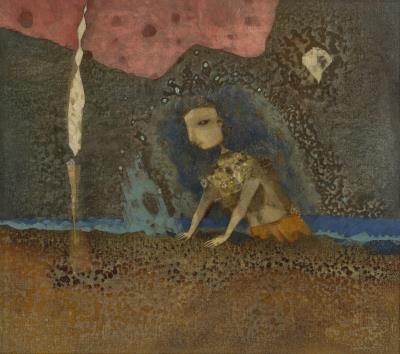
Like a lot of modernist painters, his work often probed the deeper reaches of human experience. There is a distinct sadness to much of it. His brooding dreamscapes, populated with skeletal figures and recurring images of boats and groundless, floating bodies are intimations of decay and impermanence. They are also beautiful—reflecting a personal mythology steeped in existentialism and wonder.
As he once said, "True darkness gives one a feeling of insecurity bordering on fear but it also has its own charms, mystery, profundity, a fairyland atmosphere." Pyne was born in Kolkata, where he stayed to study at the Government College of Arts and Crafts. His first solo exhibition wasn't held until 1990, in New Delhi, but he exhibited throughout his life in numerous group shows around the world, in cities from Kolkata to London. He has represented India at the Paris Biennale and at the Festival Internationale de la peinture, Cagnes-sur-Mer, France.
Pyne lived and worked in Kolkata until he passed away in 2013.Biography from Saffronart
Ganesh Pyne is obsessed with death. He can't forget his first brush with death, in the summer of 1946, when communal riots had rocked Kolkata. His family was forced out of their crumbling mansion. As he roamed around the city, he stumbled upon a pile of dead bodies. On the top was the body of a stark naked old woman, with wounds on her breast. No wonder then his paintings rarely has light backgrounds, and blue and black happens to be his favorite colors.
Death also finds its way back into his canvas through different motifs. Working mostly in tempera, his paintings are rich in imagery and symbolism. Pyne was born in Kolkata and grew up in a decaying mansion. He also grew up on stories told by his grandmother --- fold stories, mythological stories, and fairy tales. He spent several evenings in smoky Kolkata cafes discussing communism and Picasso with his friends.
"My childhood memories revolve around Kolkata. The sounds and smells of this city fill my being. I love Kolkata." He doesn't remember the first time he started to paint, but does remember the anger that he drew from his family over his decision to become an artist. Pyne, nevertheless, took admission in the Government College of Arts and Crafts, Kolkata. "My first painting was 'Winter's Morning,' which showed me and my brother going to school," he recalls.
In 1963, he joined the Society for Contemporary Artists. During that period he made small drawings in pen and ink. "I did not have enough money then to buy color," Pyne says. This was also the period of experimentation. The anger and despair of the 70s fuelled one of the most fruitful periods' in his life as an artist that culminated in works like 'Before the Chariot' and 'The Assassin'.
However, sometime in the 80s, he shut himself from the world, driven away by the jealousy and pettiness that the art bazaar arose among his friends. Initially, Pyne painted watercolors and sketches of misty mornings and wayside temples, variously influenced as he was by Walt Disney and the art of Abanindranath Tagore. He counts Hals Rembrandt and Paul Klee as the other influences. His signature style shaped from his own experiences of solitude, alienation, pain, horror and moods of tenderness and serenity comes to surface in each of his works.
At times, these images are offshoots of an idea that may have flitted through his mind. At others, they resonate lines from poems that may have made an impression on his mind. The lines are bold, precise, controlled and the drawings that emerge are potent both in form and content. Stripped of color, they convey the architectonic quality in the structuring of the images.
Equally devoted to cinema as he is to painting, Pyne has also drawn inspirations from movies made by Fellini and Ingmar Bergman. Today, he is known as the foremost exponents of the Bengal School of art.
Pyne passed away in 2013.