Page loaded successfully. Showing biography for Gee Yun.
Gee Yun BIOGRAPHY
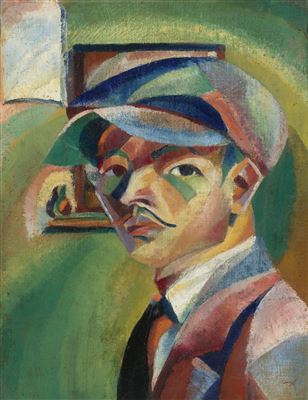
1906 Gee Village, near Canton, China - 1963 New York City. Known for: Modernist landscape, figure-genre painting, mural.
Known as a Modernist painter and the creator of a style he called "diamondism", composed of fragmented forms vividly colored, Yun Gee was born in Gee Village, now called Chu Village, near Canton,... Read full biography
Known as a Modernist painter and the creator of a style he called "diamondism", composed of fragmented forms vividly colored, Yun Gee was born in Gee Village, now called Chu Village, near Canton, China in 1906. At age 15, he arrived in San Francisco in 1921, joining his father, a merchant who... Read full biography
Known as a Modernist painter and the creator of a style he called "diamondism", composed of fragmented forms vividly colored, Yun Gee was born in Gee Village, now called Chu Village, near Canton, China in 1906. At age 15, he arrived in San Francisco in 1921, joining his father, a merchant who traveled there frequently from China. However, his mother remained behind with his younger brothers and sisters, and Yun Gee never saw her again. He was able to become an American citizen because of his... Read full biography
Known as a Modernist painter and the creator of a style he called "diamondism", composed of fragmented forms vividly colored, Yun Gee was born in Gee Village, now called Chu Village, near Canton, China in 1906. At age 15, he arrived in San Francisco in 1921, joining his father, a merchant who traveled there frequently from China. However, his mother remained behind with his younger brothers and sisters, and Yun Gee never saw her again. He was able to become an American citizen because of his father's claim that his own citizenship papers had been destroyed in the 1906 earthquake and fire. Yun Gee settled near Chinatown and enrolled at the California School of Fine Art under Gottardo Piazzoni and Otis Oldfield. Both of these men had strong... Read full biography
Known as a Modernist painter and the creator of a style he called "diamondism", composed of fragmented forms vividly colored, Yun Gee was born in Gee Village, now called Chu Village, near Canton, China in 1906. At age 15, he arrived in San Francisco in 1921, joining his father, a merchant who traveled there frequently from China. However, his mother remained behind with his younger brothers and sisters, and Yun Gee never saw her again. He was able to become an American citizen because of his father's claim that his own citizenship papers had been destroyed in the 1906 earthquake and fire. Yun Gee settled near Chinatown and enrolled at the California School of Fine Art under Gottardo Piazzoni and Otis Oldfield. Both of these men had strong influence on Gee, especially Oldfield who became a close, life-long friend. They took a sketching trip toget... Read full biography
Artist Biography
Biography page for Gee Yun ((1906 - 1963)), known for Modernist landscape, figure-genre painting, mural. Showing 2 biographical entries and 0 sample artworks.
Gee Yun - Artist Info
About Gee Yun
Name variants
Yun Gee, Zhu Yuanzhi
Biography from the Archives of askART
 Known as a Modernist painter and the creator of a style he called "diamondism", composed of fragmented forms vividly colored, Yun Gee was born in Gee Village, now called Chu Village, near Canton, China in 1906. At age 15, he arrived in San Francisco in 1921, joining his father, a merchant who traveled there frequently from China. However, his mother remained behind with his younger brothers and sisters, and Yun Gee never saw her again. He was able to become an American citizen because of his father's claim that his own citizenship papers had been destroyed in the 1906 earthquake and fire.
Yun Gee settled near Chinatown and enrolled at the California School of Fine Art under Gottardo Piazzoni and Otis Oldfield. Both of these men had strong influence on Gee, especially Oldfield who became a close, life-long friend. They took a sketching trip together in 1928 to the gold mining area of California. It was written that "Oldfield's Cezanne-inspired paintings would come to inform Gee's aesthetic. Lessons in forming volume from areas of contrasting warm and cool colors resonated through his work for the rest of his life." (yungee.com)
Gee became a part of the San Francisco avant-garde, which included poet Kenneth Rexroth and artists Dorr Bothwell, Ruth Cravath, John Ferrin and Oldfield. In 1926, he formed, along with several other artists dedicated to abstraction, the Modern Gallery, which bordered Chinatown and was located on Montgomery Street.
With this action, Gee renounced his earlier commitment to academic painting and burned all of his work that reflect the conservative method and style. That same year, he formed the Chinese Revolutionary Artist' Club, and gave classes in painting techniques and theory. It is thought that his theory of Diamondism was developed during this time.
Reflecting the early, uprooted period in his life is an oil painting, Where Is My Mother, dated 1927. It is "a portrait of himself weeping, next to two other people, one of whom is also crying." (Goodman, 194) Above them is an abstract landscape with a female figure and a ship in the distance.
Under the patronage of Prince and Princess Achille Murat, Yun Gee went to Paris in 1927 to pursue further study. Again he associated with prominent avant-garde persons and exhibited his painting at the Salon des Indépendants. He also had a solo exhibition at Galerie Bernheim-Jeune in 1929.
Influenced by a combination that included Taoist philosophy, Chinese love of word play, and fragmented references of Gertrude Stein, he frequently attached his own poetry to his paintings. There he married Princess Paule de Reuss, a poetess, and because of the marriage, her family disowned her.
For financial reasons, Gee was forced to return to New York during the Depression of the 1930's without his wife, and they divorced in 1932, which sent Gee into a deep depression and into the alcoholism he battled the remainder of his life. Although he exhibited in major galleries in New York City area, including the Brooklyn Museum, he stopped painting during this dark period in his life.
Living in New York from 1930 to 1936, he painted and wrote poetry, which met with indifference. Of this period it was written: "Despite his inclusion in exhibitions at the Brooklyn Museum in 1931, and at the Museum of Modern Art in 1932, Gee struggled greatly throughout the Depression. Remaining closely involved with the Chinese community, Gee was an active fundraiser for causes in China. He completed a large mural on K Street as a contribution to the Chinese Flood Relief Campaign.
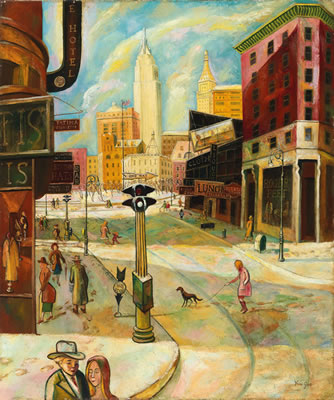
He participated in art programs sponsored by the WPA, such as the Easel Painter's Project. From this period onward, Gee would sporadically produce paintings and drawings with overtly political subject matter. One of his paintings included in MoMA's Murals by American Painters and Photographers is considered to be his masterwork. Wheels: Industrial New York did not fit neatly into the late Futurist or the Social Realist camp, but rather created a dynamic synthesis of cubist influences and an ironic sense of realism." (yungee.com)
He returned to Paris in 1936, and felt more accepted and received positive responses to his work, which was exhibited widely. But three years later, chased from Europe by the war, he settled in New York City, where he lived until his death in 1963. In 1942, he married Helen Wimmer, and they had a daughter, Li-lan, who became an artist. Wimmer and Gee were divorced in 1947, and several years Velma Aydelott became his companion for the remainder of his life. In the 1940's amidst much personal turmoil, Gee's painting career ended; he was diagnosed with schizophrenia.
Sources:
Website of the Artist, 2008
Edan Hughes, Artists in California, 1786-1940
Jonathan Goodman, "Yun Gee and Li-lan", Art in America, November 2008, p. 194Biography from Bonhams Hong Kong
Yun Gee's legendary life reads like a microcosm of the twentieth century. Born in 1906 in Guangdong, and impacted by the war and tumult of the era, he emigrated to America with his father, but he persisted his pursuit of art for his entire life, and his works shine with a living aura. This artist from China first stepped into the limelight in the Western art scene in the early 20th century.
In 1926, the California School of Fine Art, where Yun Gee was a student, appointed artist Otis Oldfield (1890–1969) as a professor. An avant-garde figure for his time, Oldfield sparked the light of the new in Yun Gee, who was then weary of old, stagnant styles. Within two months, Gee had incorporated Oldfield's signature "color zoning" technique to make breakthroughs in portraiture that had always eluded the Cubists. That same year, ten artists, including Gee, Oldifeld and others, established Modern Gallery, the first artist-run cooperative gallery on America's West Coast.
Modern Gallery quickly rose to fame in California. This new approach was a momentous event in the San Francisco art scene. The gallery's first exhibition focused on Gee. It was the first major exhibition in his career. This Asian-American who did not enjoy full status as a Western artist managed to sell almost all of the more than twenty works in the exhibition. The Prince and Princess Murat, visiting from Paris, came to the gallery at the introduction of one Mrs. Salinger, editor-in-chief of the prominent local art magazine, Argus. The Prince and Princess were astounded by Gee's grasp of avant-garde techniques and his ability to marshal them to express a unique style, in which fields of pure color were interlocked to depict the streets of San Francisco.
Gee's unique techniques, however, surpassed Cubism in their ability to express the subject. With their enthusiastic encouragement, Gee boarded a ship to Europe in 1927, determined to seek out his dreams in the world art capital of Paris, and to spread the artistic culture of China. Upon his arrival in Paris, Gee was quickly able to hold his first solo show at Galerie Carmine. At the exhibition's opening, Raymond Duncan, elder brother of Isadora Duncan, enthusiastically presented Zhu to the Parisian painting scene.
A local paper published a review: "Yun Gee is a Chinese painter of unlimited future potential. His works show solid skills, rich colors, and impressive wholeness. Though his techniques and colors are highly modern, the inspiration assuredly comes from the real China. Reserved and unassuming, it is entirely in keeping with Chinese artistic traditions."