Page loaded successfully. Showing biography for Georg Merkel.
Georg Merkel BIOGRAPHY
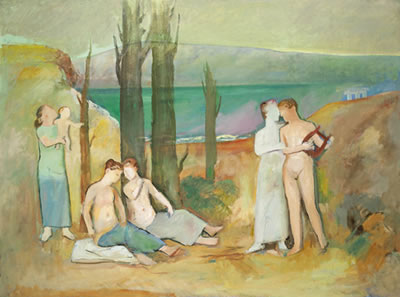
1881 Lemberg, Austria - 1976 Vienna, Austria. Known for: Landscape and idyllic figure painting.
Georg Merkel (1881, Lemberg - 1976, Vienna) came from a very poor family. He attended secondary school and then worked as a decorative painter. Thanks to the support of a friend, Merkel was able to... Read full biography
Georg Merkel (1881, Lemberg - 1976, Vienna) came from a very poor family. He attended secondary school and then worked as a decorative painter. Thanks to the support of a friend, Merkel was able to study painting at the Polish Academy for Arts and Sciences in Krakow from 1903 through 1905 under... Read full biography
Georg Merkel (1881, Lemberg - 1976, Vienna) came from a very poor family. He attended secondary school and then worked as a decorative painter. Thanks to the support of a friend, Merkel was able to study painting at the Polish Academy for Arts and Sciences in Krakow from 1903 through 1905 under Josef Mehoffer and Julian Falat. Except for a brief period around 1908/9, he spent the years of 1906 to 1914 in Paris, where he discovered the artistic output of not only the "Classicists" like Nicolas... Read full biography
Georg Merkel (1881, Lemberg - 1976, Vienna) came from a very poor family. He attended secondary school and then worked as a decorative painter. Thanks to the support of a friend, Merkel was able to study painting at the Polish Academy for Arts and Sciences in Krakow from 1903 through 1905 under Josef Mehoffer and Julian Falat. Except for a brief period around 1908/9, he spent the years of 1906 to 1914 in Paris, where he discovered the artistic output of not only the "Classicists" like Nicolas Poussain, Claude Lorrain and Puvis de Chavannes, but also of Cézanne and Picasso. While Merkel's picturesque landscapes and idyllic figure paintings are influenced by his study of French classicism, they distinguish themselves from those of his role... Read full biography
Georg Merkel (1881, Lemberg - 1976, Vienna) came from a very poor family. He attended secondary school and then worked as a decorative painter. Thanks to the support of a friend, Merkel was able to study painting at the Polish Academy for Arts and Sciences in Krakow from 1903 through 1905 under Josef Mehoffer and Julian Falat. Except for a brief period around 1908/9, he spent the years of 1906 to 1914 in Paris, where he discovered the artistic output of not only the "Classicists" like Nicolas Poussain, Claude Lorrain and Puvis de Chavannes, but also of Cézanne and Picasso. While Merkel's picturesque landscapes and idyllic figure paintings are influenced by his study of French classicism, they distinguish themselves from those of his role models through their lyrical message - a trait that would become a hallmark of Merkel's paintings. At the outbreak of war in 1914,... Read full biography
Artist Biography
Biography page for Georg Merkel ((1881 - 1976)), known for Landscape and idyllic figure painting. Showing 1 biographical entries and 0 sample artworks.
Georg Merkel - Artist Info
About Georg Merkel
Biography from Richard Rhoda Fine Art
Georg Merkel (1881, Lemberg - 1976, Vienna) came from a very poor family. He attended secondary school and then worked as a decorative painter. Thanks to the support of a friend, Merkel was able to study painting at the Polish Academy for Arts and Sciences in Krakow from 1903 through 1905 under Josef Mehoffer and Julian Falat. Except for a brief period around 1908/9, he spent the years of 1906 to 1914 in Paris, where he discovered the artistic output of not only the "Classicists" like Nicolas Poussain, Claude Lorrain and Puvis de Chavannes, but also of Cézanne and Picasso.
While Merkel's picturesque landscapes and idyllic figure paintings are influenced by his study of French classicism, they distinguish themselves from those of his role models through their lyrical message - a trait that would become a hallmark of Merkel's paintings.
At the outbreak of war in 1914, Merkel volunteered for the Austrian army. Because of a severe head wound, he went blind for several months. Following his dismissal from military services in 1917, he moved to Vienna where he would live and work for the next twenty years. The regaining of eyesight became the ultimate experience that influenced his later art.
In the interwar period, Merkel remained in Vienna and in 1938 he emigrated to France with his wife, the painter Louise Merkel-Romée. After the Second World War he lived partly in Paris and occasionally in Cagnes, southern France. His memberships included that of the Hagenbund from 1922 to 1926 and again from 1935 to 1938 and the Zinkenbacher Painter Colony. He was also a member of the Vienna Secession from 1945 and became an honorary member in 1961. He won the Prize of the City of Vienna for Art in 1961. In 1985, the Merkelgasse (Merkel Road) in the 22nd District Of Vienna was named after him. On the occasion of his 93rd birthday, he received the French order Chevalier de l'Ordre des Arts et Lettres.
Museums.
Österreichische Galerie Belvedere, Vienna
Kunstmuseum Linz, Austria
Kölnischer Kunstverein, Cologne
Essl Museum Klosterneuburg, Austria
Sources:
Kunsthandel Giese und Schweiger, Vienna
http://de.wikipedia.org/