Page loaded successfully. Showing biography for George Condo.
George Condo BIOGRAPHY
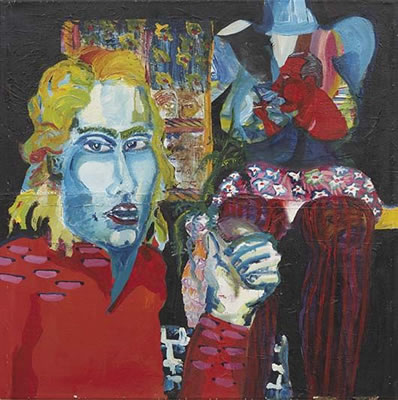
Born 1957 Concord, New Hampshire. Known for: Post-surreal, grotesque figure and portrait painting.
In the 1980's, George Condo, born in Concord, New Hampshire, arrived in New York, after having been in California, and became close friends with members of Andy Warhol's Factory including Julian... Read full biography
In the 1980's, George Condo, born in Concord, New Hampshire, arrived in New York, after having been in California, and became close friends with members of Andy Warhol's Factory including Julian Schnabel, Jean-Michel Basquiat and Keith Haring. He collaborated with the heroes of the Beat Generation,... Read full biography
In the 1980's, George Condo, born in Concord, New Hampshire, arrived in New York, after having been in California, and became close friends with members of Andy Warhol's Factory including Julian Schnabel, Jean-Michel Basquiat and Keith Haring. He collaborated with the heroes of the Beat Generation, William S. Burroughs and Allen Ginsberg. Of this time, it was written: "His work was governed by the reworking of the Old Masters, in a lyric universe in which the human being is decomposed in a... Read full biography
In the 1980's, George Condo, born in Concord, New Hampshire, arrived in New York, after having been in California, and became close friends with members of Andy Warhol's Factory including Julian Schnabel, Jean-Michel Basquiat and Keith Haring. He collaborated with the heroes of the Beat Generation, William S. Burroughs and Allen Ginsberg. Of this time, it was written: "His work was governed by the reworking of the Old Masters, in a lyric universe in which the human being is decomposed in a multiplicity of non-human beings merged from his own unconsciousness: 'I conceive artistic language as my own natural reactions, a combination of rational and irrational.' " (denoirmont). He worked together successfully with Burroughs, which included a... Read full biography
In the 1980's, George Condo, born in Concord, New Hampshire, arrived in New York, after having been in California, and became close friends with members of Andy Warhol's Factory including Julian Schnabel, Jean-Michel Basquiat and Keith Haring. He collaborated with the heroes of the Beat Generation, William S. Burroughs and Allen Ginsberg. Of this time, it was written: "His work was governed by the reworking of the Old Masters, in a lyric universe in which the human being is decomposed in a multiplicity of non-human beings merged from his own unconsciousness: 'I conceive artistic language as my own natural reactions, a combination of rational and irrational.' " (denoirmont). He worked together successfully with Burroughs, which included a visit to Burroughs in Lawrence, Kansas. Condo said: "We both disintegrated in each other's presence and became... Read full biography
Artist Biography
Biography page for George Condo ((Born 1957)), known for Post-surreal, grotesque figure and portrait painting. Showing 6 biographical entries and 0 sample artworks.
George Condo - Artist Info
About George Condo
Biography from the Archives of askART
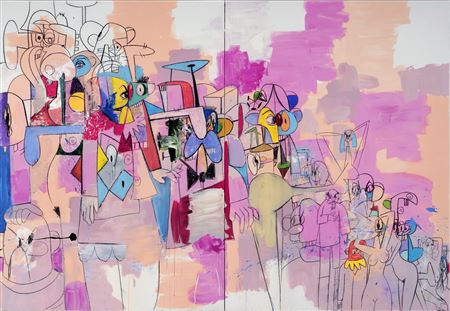 In the 1980's, George Condo, born in Concord, New Hampshire, arrived in New York, after having been in California, and became close friends with members of Andy Warhol's Factory including Julian Schnabel, Jean-Michel Basquiat and Keith Haring. He collaborated with the heroes of the Beat Generation, William S. Burroughs and Allen Ginsberg. Of this time, it was written: "His work was governed by the reworking of the Old Masters, in a lyric universe in which the human being is decomposed in a multiplicity of non-human beings merged from his own unconsciousness: 'I conceive artistic language as my own natural reactions, a combination of rational and irrational.' " (denoirmont)
He worked together successfully with Burroughs, which included a visit to Burroughs in Lawrence, Kansas. Condo said: "We both disintegrated in each other's presence and became a third being." However, each retained their individuality as well with Condo contributing a cartoon aspect to their conceptual sculpture of layered images.
Though his work, qualified as a "figurative abstraction", it is quite impossible to determinate a frontier between representation and abstraction, between academic art and avant-garde, between popular imagery and High Art. His female figures are described as ferocious and highly aggressive types and are intended to dispel any sense of submissiveness or timidity.
Condo, who remains known primarily for his cartoon-like portraits has also turned to sculpture with works that include jazz themes---monumental stainless steel letters spelling out the names of music legends like Miles Davis and Charlie Parker. His sculptural works also include abstract bronzes and 32 busts of invented deities, a group of works inspired by the 9-11 terrorist attacks.
George Condo was raised in a family where the father was a math and physics professor. For two years, he attended the University of Massachusetts at Lowell, where his father taught, and taking art history classes, became very enamored with Caravaggio and other Old Masters. He later did paintings that he called fake Old Masters, which had elements of abstraction and unique treatment that got the attention of younger artists. While in college, he also played bass guitar with a punk rock group called the Girls, and landed in New York City because of a music "gig".
However, in 1981, he moved to Los Angeles, and became friends with Roger Herman, a local artist. Herman's influence led to gallery representation and some sales, but by the mid 1980s, Condo was back in New York, the place he perceived as the center of action, and was offered gallery shows. From that time, his career has been a success underscored by special recognition such as receiving in 1999 the Academy Award in Art from the American Academy of Arts and Letters; the release in 2000 of a feature film titled Condo Paintings, directed by John McNaughton; and a visiting lectureship at Harvard University.
He also has stirred big-time controversy such as in England in 2006, when he entered a portrait painting of Queen Elizabeth in his attention-getting 'laugh-out-loud' style at the Tate Modern in London. He titled the work, Cabbage Patch Queen, "after the cutely homely kids' doll", and "the reaction was nuclear. . . . Royal Academy members were furious". From that event, he had a lot of fall out, but is still convinced that "Noble subjects can be painted in a jocular manner with no loss of dignity to the sitter." (Plagens, 185)
Condo has work is in permanent collections of major museums worldwide including the Museum of Modern Art, New York; The Solomon R. Guggenheim Museum and the Whitney Museum of American Art, New York; The Ludwig Museum, Cologne; etc.
He is married to Italian actress, Anna Condo, and they have two children. Although he is not fond of travel, they did live in Cologne from 1983 to 1984, and Paris from 1984 to 1985. The family lives on the upper East Side of New York City, which he likes because "there are no other artists around." (Plagens, 183)
Sources:
http://www.denoirmont.com/artistes/condogb.html
Art Forum, November 1994
Art & Auction, September 2003
Peter Plagens, "Fake Tiepolos and the Cabbage Patch Queen", ARTnews, Summer 2007, p. 183Biography from the Archives of askART
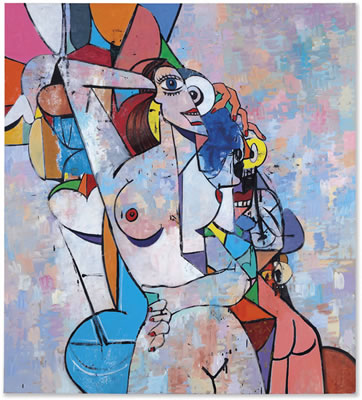 The following review is from The Wall Street Journal, January 29, 2011:
"George Condo Visits the Old Masters" By ELLEN GAMERMAN
A Renaissance lord crossed with a gorilla. A portrait of a lady with a tiny head. A Romantic poet with a clown nose. This week, New York's New Museum launched a major exhibit of works by George Condo, a contemporary artist best known for adapting the style of the Old Masters to his own portraits, creating a unique cast of grotesque characters.
On Wednesday afternoon, the day the exhibit opened, the 53-year-old artist visited one of his major sources of inspiration, the Frick Collection, a New York museum showcasing works from the Renaissance through the late 19th century. The Frick is close to Mr. Condo's Upper East Side home and studio, and he comes here often. Since he paints entirely from his imagination, rather than from photographs or models, he looks for technical guidance from the works by the long-dead masters on the gallery's walls. If he needs to paint a ribbon, for instance, he'll study a bow on a damsel's dress by the French Rococo painter Jean-Honoré Fragonard.
Mr. Condo's paintings, many of which sell for around $450,000, aim to play a trick on his audience: The artist bets that his characters will seem real despite their giant jug ears or mismatched gargoyle eyes because they've been created using techniques similar to those of classical painters whose works have long been accepted as believable.
Walking around the Frick in his paint-splattered shoes, he stopped at a 1631 oil painting by Rembrandt, "Nicolaes Ruts" (pictured right). Mr. Condo, who brought along his New Museum catalog, pointed to the cover image, pictured at far right: a clown with demented woodchuck teeth staring out of the frame and positioned in a similar pose. He's looking for "a feeling of classicism," he said.
Another bit of shared DNA between the works: In Rembrandt's merchant and Mr. Condo's clown, the same sides of the face are bathed in shadow and set against a lighter background; the other sides of each face are light and placed beside a darker background. Looking from the Rembrandt to his own strange work, Mr. Condo let out a guffaw: "I get a kick out of art," he said.
At this week's party for the exhibit, "George Condo: Mental States," the artist mingled with his recent collaborator, the hip-hop artist Kanye West. Mr. Condo created cover art for Mr. West's new album, "My Beautiful Dark Twisted Fantasy," painting several options, including surreal portraits of Mr. West, who rapped as he posed. The musician initially chose Mr. Condo's image of a white winged creature straddling a naked black figure for the cover art, but the album now sells in stores with Mr. Condo's painting of a ballerina.
Inside the Frick, Mr. Condo seemed far removed from rappers and art openings. He approached "The Progress of Love: Love Letters," by Fragonard, and studied a young woman's dress, which looked white even though it was created with gray and blue, with shadows in the folds of the skirt painted in yellow rather than a dark color. He pointed to his own 2004 painting, "The Cracked Cardinal," and described a similar use of color and shading.
Later, he noted the burnt sienna and blue-green that Fragonard used in another large work. Putting his face inches from the canvas, Mr. Condo admired the color combination: "That's something to think about for the next painting," he said. "It just looks so pretty."
Internet Source:
http://online.wsj.com/article/SB10001424052748704698004576104022986573698.html?mod=WSJ_LifeStyle_Lifestyle_5Biography from RoGallery
George Condo is as well known for his painterly portraits as he is for the bizarre cast of archetypal characters that inhabit them. His subjects are classically posed, dramatically lit, and surrounded by conflated fragments from the history of painting, such as bubbles, glass bottles, drapery, vegetables lifted from the still-life table, and vague empty settings to better project the subject of the picture. In the end, however, the entire world and inner life of his subjects derive completely from his imagination.Biography from Christie's New York, Rockefeller Center
"I describe what I do as psychological cubism…Picasso painted a violin from four different perspectives at one moment. I do the same with psychological states. Four of them can occur simultaneously. Like glimpsing a bus with one passenger howling over a joke they're hearing down the phone, someone else asleep, someone else crying – I'll put them all in one face"—George Condo (G. Condo, quoted in S. Jeffries, "George Condo: 'I Was Delirious. Nearly Died,'" The Guardian, February 10, 2014.
George Condo’s Mental Landscape is a monumentally scaled example of the artist’s practice, which is informed as much by the great painters of the past as by an intuitive and penetrating understanding of the human condition. P ainted with black and white acrylic paint and charcoal on board, Condo’s seemingly depraved scene plays out cinematically over the sprawling ten-foot painting. As if chronicling the aftermath of Bacchanalian revelry, Condo’s characters are variously humorous, sinister and distressed - often a combination of the three. At the far left, a woman, naked except for fishnet stockings and a pair of bunny ears, reaches for the back of a striped armchair on her hands and knees. Curly hair obscures her gnarled face, turned sideways at the viewer. A carnival tent-prison amalgam behind her contains a variety of tortured, abstracted faces that recall Picasso’s subversive cubist portraits of the early 1910s. A pair of motionless feet poking in from the picture’s leftmost edge suggest the vastness of the scene, implying more action just out of view. The center panel finds a man in the armchair, bottle and cigarette in hand, in three simultaneous states of being. He concurrently stares out at the viewer furiously, down at his smoldering cigarette, or to his left at the second nearly nude woman in the painting. His mangled, incomplete set of bared teeth and his sparse curly hair give him a menacing, confrontational quality. The long-limbed object of one of his multiple fixations, the second woman in the scene, exposes her backside to the viewer while gracefully holding a circular object in her outstretched left hand; a pearl bracelet decorates her wrist, and, along with her long, straight hair, distinguishes her from the other stocking-clad woman. A cracked egg shell rests on the ground, furthering the feeling of witnessing the fallout of an epic, possibly destructive, event. More strewn trash graces the right-hand panel, with a cocked mousetrap, a broken bottle and a few more eggshells rounding out the lower register. A vertical, midcentury television set stands next to a sinister Bozo the clown-style punching bag, whose snarling face is slashed out by a slap of white paint.
Mental Landscape’s clear rightward directionality deposits the viewer’s gaze into the only panel devoid of people; a repository of sorts, the final panel is a fitting destination after traversing the left and center segments. Condo’s panoramic scene strongly suggests, and maybe even encourages, a narrative reading – but stops just short of revealing it. The three principal players are familiar to one another, but seem to avoid direct interaction or any mutual acknowledgement. The basic contours of the scene are immediately clear, but what are we to make of the group of caged, tortured faces at the painting’s left edge? What is the crawling woman reaching for in, or behind, the central armchair? Where is all this taking place? A master of carefully composed ambiguity, Condo’s best paintings leave viewers probing incomplete truths and searching for scant morsels of visual information.
The human face, perhaps Condo’s most effective visual tool, is both a source of clarity and mystery. The myriad faces in Mental Landscape, from the poor souls trapped in the cage to the central figure enjoying a smoke and a drink in his chair, invite a broad range of readings. As is typical of Condo and his “psychological cubism”, the face is less a visual fact than a collection of contradicting emotions and states of mind. Indeed, the painting’s title makes reference to this fact, obliquely introducing the attractive possibility that the whole scene is a metaphor for the painter’s own psyche. Whether or not this is the case, the work is nevertheless an example of Condo’s career-long wink-and-nod engagement with predeceasing painters from Velázquez to Picasso. An explicit attempt to describe the human mind and condition with paint, Condo testifies in the open to what other painters were always after but rarely spoke about. Condo’s brazenness and assuredness in rendering the wrinkles and inconsistencies of the human mind distinguish him as a leading contemporary painter, and place him in the ring with other great modern painters-cum-psychoanalysts like Lucian Freud, Max Beckmann and Alice Neel. A heady mixture of surrealism, cubism, genre painting and portraiture, George Condo’s Mental Landscape is a substantial addition to the artist’s prodigious body of work.Biography from Phillips New York
George Condo was born in Concord, New Hampshire in 1957. Few artists have dedicated their careers as singularly to one genre as George Condo has to that of portraiture. He is drawn to the endless inquiries posed by the aesthetics and formal considerations of Caravaggio, Rembrandt and the Old Masters. Emerging on the New York art scene in the 1980s alongside contemporaries such as Keith Haring and Jean-Michel Basquiat, Condo developed a distinctive visual lexicon that is unmistakably his own. Student to Warhol, friend to Basquiat and collaborator with William S. Burroughs, Condo tracked a different path. The artist frequently cites Picasso as a predominant influence in his contemporary cubist compositions and joyous use of paint. George Condo is known for postmodernist compositions staked in wit and the grotesque, which draw the eye into a highly imaginary world.Biography from Phillips Hong Kong
Few artists have dedicated their careers as singularly to one genre as George Condo has to that of portraiture. He is drawn to the endless inquiries posed by the aesthetics and formal considerations of Caravaggio, Rembrandt and the Old Masters. Emerging on the New York art scene in the 1980s alongside contemporaries such as Keith Haring and Jean-Michel Basquiat, Condo developed a distinctive visual lexicon that is unmistakably his own. Student to Warhol, friend to Basquiat and collaborator with William S. Burroughs, Condo tracked a different path. The artist frequently cites Picasso as a predominant influence in his contemporary cubist compositions and joyous use of paint. Condo is known for postmodernist compositions staked in wit and the grotesque, which draw the eye into a highly imaginary world.