Page loaded successfully. Showing biography for George Keyt.
George Keyt BIOGRAPHY
1901 Ceylon (now Sri Lanka) - 1993. Known for: Painting.
George Keyt didn't start painting until he was 26, but he quickly went on to become an international giant of Modern art and arguably Sri Lanka's most celebrated 20th Century artist. His unique... Read full biography
George Keyt didn't start painting until he was 26, but he quickly went on to become an international giant of Modern art and arguably Sri Lanka's most celebrated 20th Century artist. His unique visual idiom combines European Modernist innovations with the ancient South Asian fresco techniques found... Read full biography
George Keyt didn't start painting until he was 26, but he quickly went on to become an international giant of Modern art and arguably Sri Lanka's most celebrated 20th Century artist. His unique visual idiom combines European Modernist innovations with the ancient South Asian fresco techniques found at Ajanta and Sigiriya. Despite his clear admiration for cubist and fauvist principles, his subject matter was almost always rooted in local tradition, depicting dancers, shepherdesses and gods,... Read full biography
George Keyt didn't start painting until he was 26, but he quickly went on to become an international giant of Modern art and arguably Sri Lanka's most celebrated 20th Century artist. His unique visual idiom combines European Modernist innovations with the ancient South Asian fresco techniques found at Ajanta and Sigiriya. Despite his clear admiration for cubist and fauvist principles, his subject matter was almost always rooted in local tradition, depicting dancers, shepherdesses and gods, often drawn from Hindu and Buddhist mythology. His subjects' enlarged, almond-shaped eyes are, perhaps, his most consistent stylistic signature, along with an emphasis on bold, crisp lines and a prolonged romance with cubist perspective (his work has... Read full biography
George Keyt didn't start painting until he was 26, but he quickly went on to become an international giant of Modern art and arguably Sri Lanka's most celebrated 20th Century artist. His unique visual idiom combines European Modernist innovations with the ancient South Asian fresco techniques found at Ajanta and Sigiriya. Despite his clear admiration for cubist and fauvist principles, his subject matter was almost always rooted in local tradition, depicting dancers, shepherdesses and gods, often drawn from Hindu and Buddhist mythology. His subjects' enlarged, almond-shaped eyes are, perhaps, his most consistent stylistic signature, along with an emphasis on bold, crisp lines and a prolonged romance with cubist perspective (his work has been exhibited alongside Picasso and Braque in galleries around the world). His earliest work was distinctly Gauginesque—sumpChristie's, Mumbai... Read full biography
Artist Biography
Biography page for George Keyt ((1901 - 1993)), known for Painting. Showing 3 biographical entries and 0 sample artworks.
George Keyt - Artist Info
About George Keyt
Biography from the Archives of askART
 George Keyt didn't start painting until he was 26, but he quickly went on to become an international giant of Modern art and arguably Sri Lanka's most celebrated 20th Century artist. His unique visual idiom combines European Modernist innovations with the ancient South Asian fresco techniques found at Ajanta and Sigiriya. Despite his clear admiration for cubist and fauvist principles, his subject matter was almost always rooted in local tradition, depicting dancers, shepherdesses and gods, often drawn from Hindu and Buddhist mythology. His subjects' enlarged, almond-shaped eyes are, perhaps, his most consistent stylistic signature, along with an emphasis on bold, crisp lines and a prolonged romance with cubist perspective (his work has been exhibited alongside Picasso and Braque in galleries around the world).
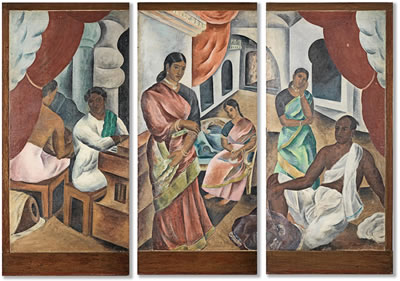
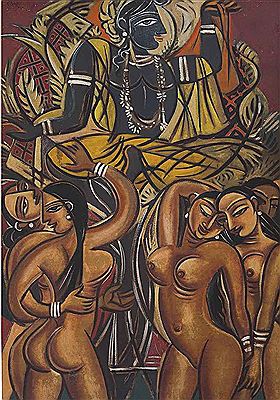
His earliest work was distinctly Gauginesque—sumptuous pastorals and figure studies free from overt perspectival abstraction, populated by luxuriant nudes and semi-nudes swaddled in robes, limbs graceful and provocatively intertwined. By the early 1930s, the cubism that would forever alter the character of his paintings began to emerge in his work. Still, Keyt perpetually re-invented his craft, adopting and discarding countless subtle variations in style across seven decades. His famous black-and-white line drawings depicting Sri Krishna and his lover have been reprinted millions of times since he made them in 1947.
Keyt was Sinhalese-Dutch by birth and lived in his native Sri Lanka almost his entire life. He wrote poetry in English and converted to Buddhism as a young man. In 1978, he lived in London for six weeks where, according to his obituary in The Independent, he "visited many museums and art galleries, went to Stratford-upon-Avon to see Shakespeare, called at the Ashmolean Museum in Oxford, and made a pilgrimage to Gadds Hill to see Charles Dickens's house."
He married three times and died in Colombo at the age of 92.Biography from Saffronart
Born in Sri Lanka in 1901, George Keyt started exhibiting in the 1920's and the work from this period is strongly influenced by Buddhist and Hindu iconography. The 1930's saw him preoccupied with the depiction of episodes from the Buddhist Jataka or Birth stories, culminating in the representation of the life and times of the Buddha on the walls of the circumambulatory shrine room of Gautami Vihara in Borella in 1940. At the same time he was also exposed to the influence of Western art, in particular the early cubist landscapes of Picasso and Braque, as well as Picasso's distortion of the human figure. It was Keyt's unique achievement to fuse these influences into a new artistic vocabulary. In 1954 his work was exhibited at the ICA (London) by Sir Herbert Read and afterwards the exhibition travelled to the Art Institute of Rotterdam. His work is to be found in the permanent collections of the Victoria and Albert Museum, London, The British Museum, as well as various public collections in India and Sri Lanka. Obituaries featured in The Independent and The Times in England following his death in Colombo in 1993.Biography from Christie's New York, Rockefeller Center
Born in Ceylon (now Sri Lanka) in 1901, George Keyt studied at Trinity College in Kandy. The unmistakable visual language that Keyt developed over the course of his career combined influences from European Modernist movements such as Cubism and Fauvism with those from the ancient South Asian frescoes he saw at the Ajanta and Sigiraya caves. The artist was also strongly influenced by Buddhist and Hindu ethos and iconography. Keyt is particularly known for his dynamic and evocative paintings of women. An example of his work is the early painting from 1936 which portrays a voluptuous nude female figure resting by the sea, and reflects the strong influence that traditional Hindu temple sculpture from sites like Khajuraho, Bhubhaneshwar and Konark, as well Cubist painting techniques had on his formative work. Using bold geometric forms and calligraphic lines, Keyt achieves a "highly personal curvilinear rhythm, contrasting graceful movements, delineation of round and flat forms on the same picture plane and a feeling of highly intense sensuality." (L.P. Sihare, 'Keyt - Asian Painter', George Keyt, A Centennial Anthology, Colombo, 2001, p. 31)