Page loaded successfully. Showing biography for George McManus.
George McManus BIOGRAPHY

1882 St. Louis, Missouri - 1954 Hayward, California. Known for: Illustrator-cartoons.
George McManus was a fun-loving and gregarious man, who came to resemble his most successful creation, Jiggs of Bringing Up Father. McManus tried all sorts of comic strips before he discovered the... Read full biography
George McManus was a fun-loving and gregarious man, who came to resemble his most successful creation, Jiggs of Bringing Up Father. McManus tried all sorts of comic strips before he discovered the right one. As soon as he created Jiggs and Maggie and Bringing Up Father in 1913, he settled down to... Read full biography
George McManus was a fun-loving and gregarious man, who came to resemble his most successful creation, Jiggs of Bringing Up Father. McManus tried all sorts of comic strips before he discovered the right one. As soon as he created Jiggs and Maggie and Bringing Up Father in 1913, he settled down to become a millionaire cartoonist. McManus was born in St. Louis, and was working as an office boy in the art department of the St. Louis Republic by age 15. He was soon doing the sort of graphic... Read full biography
George McManus was a fun-loving and gregarious man, who came to resemble his most successful creation, Jiggs of Bringing Up Father. McManus tried all sorts of comic strips before he discovered the right one. As soon as he created Jiggs and Maggie and Bringing Up Father in 1913, he settled down to become a millionaire cartoonist. McManus was born in St. Louis, and was working as an office boy in the art department of the St. Louis Republic by age 15. He was soon doing the sort of graphic reporting expected of newspaper artists before photographs could be reproduced drawing hangings and the scenes of murders, suicides, and assorted disasters. Early in the 20th century, and acting on a bootblacks tip, McManus bet $100 on a horse running at... Read full biography
George McManus was a fun-loving and gregarious man, who came to resemble his most successful creation, Jiggs of Bringing Up Father. McManus tried all sorts of comic strips before he discovered the right one. As soon as he created Jiggs and Maggie and Bringing Up Father in 1913, he settled down to become a millionaire cartoonist. McManus was born in St. Louis, and was working as an office boy in the art department of the St. Louis Republic by age 15. He was soon doing the sort of graphic reporting expected of newspaper artists before photographs could be reproduced drawing hangings and the scenes of murders, suicides, and assorted disasters. Early in the 20th century, and acting on a bootblacks tip, McManus bet $100 on a horse running at 30-to-1 odds. When he won, he set out for Manhattan. The New York World hired him in 1905. An advantage of this job was that his work was... Read full biography
Artist Biography
Biography page for George McManus ((1882 - 1954)), known for Illustrator-cartoons. Showing 2 biographical entries and 0 sample artworks.
George McManus - Artist Info
About George McManus
Biography from the Archives of askART
 George McManus was a fun-loving and gregarious man, who came to resemble his most successful creation, Jiggs of Bringing Up Father. McManus tried all sorts of comic strips before he discovered the right one. As soon as he created Jiggs and Maggie and Bringing Up Father in 1913, he settled down to become a millionaire cartoonist.
McManus was born in St. Louis, and was working as an office boy in the art department of the St. Louis Republic by age 15. He was soon doing the sort of graphic reporting expected of newspaper artists before photographs could be reproduced drawing hangings and the scenes of murders, suicides, and assorted disasters. Early in the 20th century, and acting on a bootblacks tip, McManus bet $100 on a horse running at 30-to-1 odds. When he won, he set out for Manhattan.
The New York World hired him in 1905. An advantage of this job was that his work was reprinted in Joseph Pulitzers other paper, the St. Louis Post-Dispatch, which was McManus hometown newspaper.
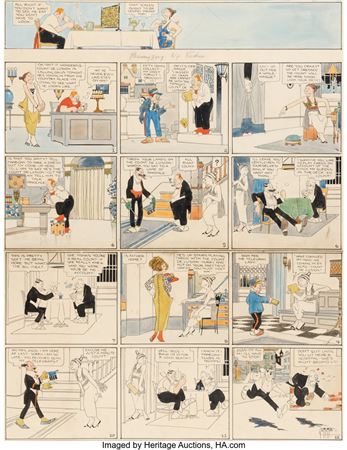
McManus drew a variety of short-lived comics Snoozer, The Merry Marcelline, Ready Money Ladies, Cheerful Charlie, and Let George Do It before he hit his stride with The Newlyweds. His style was fully developed by 1905. In 1912 he was recruited by William Randolph Hearst, Pulitzers chief rival in the circulation wars, and brought his strip The Newlyweds with him to New York, retitling it Their Only Child. His first creation for Hearst was Outside the Asylum, which lasted a month. He also drew Rosies Beau before finding his forte in 1913 with Bringing Up Father. At first it appeared only three or four days a week. The Sunday version of Bringing Up Father came out on April 14, 1918. The gag strip pitted the unaffected lowbrow desires of vaulting social pretensions in an epic of husband and wife strife that would outlast its creator.
In the very first episode, he established the formula that was to serve him well for forty-one years. Immigrant worker Jiggs and his wife Mary have come into a lot of money (by what means, the reader isnt told). Mary uses the wealth to unlock the doors of the upper crust of society, while Jiggs remains unchanged and unfazed, yearning only for a night at Dinty Moores tavern, playing cards and pool, and eating his favorite dish of corned beef and cabbage. The tone was set in the inaugural strip, when Mary insists that Jiggs dress up before the arrival of Miss Loose Change, a high society lass coming to meet their son.
Over the years, there were slight variations on this formula of a family trying to adjust to high-society life. By the 1920s, Maggie (Mary had acquired the more familiar name) was reacting furiously to Jiggs interruptions of her attempts at social climbing, and he was often shown leaving the house in a hail of dishes, or rolling pins. In many a strip he pulled the wool over Maggies eyes, escaping from the house, immaculately dressed, and making his way to Dinty Moores.
McManus was skilled at depicting female anatomy, hairstyles, and clothing. His women were often shown as gorgeous and perfectly coifed in the Gibson style, and in the latest fashions. Many of his strips had a sensuality about them, showing women in silhouette, the light shining through their dresses, or sitting in provocative positions. He filled his strips with ornate decorations, wallpapers, vases, and pictures on the walls that often had animated figures emerging from them and carrying on their own antics. He had keen knowledge of architectural design, and his assistant Zeke Zekeley, felt Japanese artists who liked clean lines and solids blacks heavily influenced McManus.
Apart from his ability to play seemingly infinite variations of his strips central theme, McManus had an inventive and graphic imagination. His line was fine and delicate, and once his style matured, Bringing Up Father was distinguished by his copious, decorative detail in rococo backgrounds and ornate props the filigree of a city skyline, the graceful curlicues in the design of a stair-railing, or in the pattern of Maggies dress and by the judicious and telling placement of solid blacks. He displayed some of the most elegant penmanship in cartooning.
McManus, one of the highest paid cartoonists in the country, moved to Southern California early in his career. He settled in Beverly Hills to live a life that rivaled that of the movie stars, with whom he rubbed many an elbow. After his death, King Features took over the production of his strip, and Vernon Greene drew the strip until his own death in 1965.
When George McManus died, Bringing up Father was appearing in five hundred newspapers in forty-six countries.Biography from the Archives of askART
 George McManus was born in St Louis, MO on Jan. 1, 1882. McManus was a resident of NYC before moving to California in the early 1930s. He was a resident of Hollywood until his death on Oct. 22, 1954. He is best known for his comic strips "Bringing Up Father" and "Maggie and Jiggs." Member: Society of Illustrators; Bohemian Club.
Exh: Cartoonist Club (LA), 1928.