Page loaded successfully. Showing biography for George Morrison.
George Morrison BIOGRAPHY
1919 Chippewa City, Minnesota - 2000 Red Rock near Grand Marais, Minnesota. Known for: Abstract expressionost painting, modernist Indian, collage.
George Morrison was a member of the Grand Portage Band of the Minnesota Chippewa Tribe. He was born in 1919 in Chippewa City, Cook County, Minnesota, near the Grand Portage Indian Reservation.... Read full biography
George Morrison was a member of the Grand Portage Band of the Minnesota Chippewa Tribe. He was born in 1919 in Chippewa City, Cook County, Minnesota, near the Grand Portage Indian Reservation. Morrison was one of 12 children in a poor household. His father worked as a trapper and used his fluent... Read full biography
George Morrison was a member of the Grand Portage Band of the Minnesota Chippewa Tribe. He was born in 1919 in Chippewa City, Cook County, Minnesota, near the Grand Portage Indian Reservation. Morrison was one of 12 children in a poor household. His father worked as a trapper and used his fluent knowledge of the Ojibwe language to interpret court proceedings. As a child, he spent months in a full body cast recovering from a surgery; it was during this period of recuperation that he began to... Read full biography
George Morrison was a member of the Grand Portage Band of the Minnesota Chippewa Tribe. He was born in 1919 in Chippewa City, Cook County, Minnesota, near the Grand Portage Indian Reservation. Morrison was one of 12 children in a poor household. His father worked as a trapper and used his fluent knowledge of the Ojibwe language to interpret court proceedings. As a child, he spent months in a full body cast recovering from a surgery; it was during this period of recuperation that he began to draw. Morrison briefly attended a Native American boarding school in Hayward, Wisconsin.[5] Due to poor health, Morrison returned to Minnesota and attended a Native American sanatorium in Onigum, Minnesota and the Gillette State Hospital for Crippled... Read full biography
George Morrison was a member of the Grand Portage Band of the Minnesota Chippewa Tribe. He was born in 1919 in Chippewa City, Cook County, Minnesota, near the Grand Portage Indian Reservation. Morrison was one of 12 children in a poor household. His father worked as a trapper and used his fluent knowledge of the Ojibwe language to interpret court proceedings. As a child, he spent months in a full body cast recovering from a surgery; it was during this period of recuperation that he began to draw. Morrison briefly attended a Native American boarding school in Hayward, Wisconsin.[5] Due to poor health, Morrison returned to Minnesota and attended a Native American sanatorium in Onigum, Minnesota and the Gillette State Hospital for Crippled Children in St. Paul.[3] He attended Grand Marais High School, graduating in 1938, and th... Read full biography
Artist Biography
Biography page for George Morrison ((1919 - 2000)), known for Abstract expressionost painting, modernist Indian, collage. Showing 3 biographical entries and 0 sample artworks.
George Morrison - Artist Info
About George Morrison
Biography from the Archives of askART
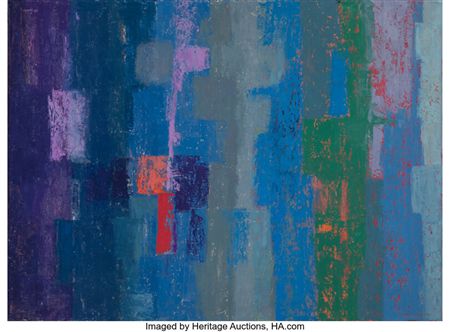 George Morrison was a member of the Grand Portage Band of the Minnesota Chippewa Tribe. He was born in 1919 in Chippewa City, Cook County, Minnesota, near the Grand Portage Indian Reservation.Morrison was one of 12 children in a poor household. His father worked as a trapper and used his fluent knowledge of the Ojibwe language to interpret court proceedings. As a child, he spent months in a full body cast recovering from a surgery; it was during this period of recuperation that he began to draw.Morrison briefly attended a Native American boarding school in Hayward, Wisconsin.[5] Due to poor health, Morrison returned to Minnesota and attended a Native American sanatorium in Onigum, Minnesota and the Gillette State Hospital for Crippled Children in St. Paul.[3] He attended Grand Marais High School, graduating in 1938, and then the Minnesota School of Art, now the Minneapolis College of Art and Design, graduating in 1943.Having been chosen to receive the Ethel Morrison Van Derlip Traveling Scholarship, Morrison studied at the Art Students League from 1943 to 1946 in New York City, where he became part of a circle of abstract expressionists and was exposed to artistic styles such as cubism and surrealism.In 1947, Morrison took a teaching position at the Cape Ann Art School; the following summer Morrison and Albert Kresch took over the school and renamed it the Rockport Art School.[3] Morrison met his first wife, Ada Reed, in Provincetown, Massachusetts. The two were married in 1948.In 1952, after receiving a Fulbright scholarship, he studied in Paris at the Ecole des Beaux-Arts and Antibes, and at the University of Aix-Marseilles. In 1953, he was awarded a John Hay Whitney Fellowship and moved to Duluth, Minnesota.He lived in Duluth, Minnesota for years and then moved back to New York City in 1954, where he became acquainted with prominent American expressionists: Willem de Kooning, Franz Kline and Jackson Pollock. He then taught in Minneapolis, Duluth, Dayton, Ohio at the Dayton Art Institute, Ithaca (Cornell University), Pennsylvania (Penn State), Iowa State Teachers College, and New York City. While teaching at the Dayton Art Institute Morrison met his second wife, Hazel Belvo.From 1963 to 1970, Morrison taught at the Rhode Island School of Design.In 1968, Morrison won the grand prize at the Fourth Invitational Exhibition of Indian Arts and Crafts in Washington, D.C. In 1969, he was awarded an Honorary Master of Fine Arts at the Minneapolis College of Art and Design.Beginning in 1970, he taught American Indian studies and art at the University of Minnesota until he retired in 1983. During the mid-1970s, Morrison and his wife acquired land near Grand Portage, Minnesota on Lake Superior, which they named Red Rock. This became their home and studio. Morrison suffered some life-threatening illnesses, including being diagnosed with Castleman's disease in 1984, but kept on working until he died at Red Rock in April 2000.In 1999, Morrison was awarded the title of Master Artist by the Eiteljorg Fellowship for Native American Fine Art.Morrison learned the established Western methods of representational painting during his time at the Minneapolis School of Art. However, during his time at the Art Students League in New York City Morrison's style became more modernist and abstract.Morrison acknowledged a variety of influences in his art, including cubism, surrealism, and abstract expressionism. In his drawings and paintings, Morrison used abstract forms to represent organic figures. Morrison commonly used landscapes and mosaic patterns in his paintings. For his wood collages, Morrison would gather driftwood along shorelines. Morrison's totem works were formally designed and glued to a piece of plywood that was the backbone of the piece.In addition to European and North American artistic movements, Morrison also was inspired by pre-Columbian art and architecture and Australian Aboriginal art.Morrison's work was part of Stretching the Canvas: Eight Decades of Native Painting (2019–21), a survey at the National Museum of the American Indian George Gustav Heye Center in New York.Twin Cities Tile and Marble Company became experts in moving Morrison's beautiful granite Tableau – A Native American Mosaic. It's been moved from the entrance to the IDS Center (1992), to the front of the Minneapolis Central Library (2004), to between 11th and 12th Streets (2020), all on Nicollet in downtown Minneapolis.The United States Postal Service released five Morrison paintings in a series of Forever Stamps on April 22, 2022. Among the paintings featured on the Morrison Forever stamps are Sun and River (1949), Phenomena Against the Crimson: Lake Superior Landscape (1985), Lake Superior Landscape (1981), Spirit Path, New Day, Red Rock Variation: Lake Superior Landscape (1990), and Untitled (1995).[4]Selected solo exhibitions• 1948–1960: Grand Central Moderns Gallery - New York City, NY
• 1949: Hart Gallery - Duluth, MN
• 1950: Ed Weiner Gallery - Provincetown, MA
• 1954: University of Minnesota - Duluth, MN
• 1955: Shorter College - Rome, GA
• 1957: University of Georgia - Athens, GA
• 1960: Dayton Art Institute - Dayton, OH
• 1961: State College of Iowa (the University of Northern Iowa) - Cedar Falls, IA
• 1962: Cornell University - Ithaca, NY; Antioch College - Yellow Springs, OH
• 1967: Academy of Fine Arts - Lynchburg, VA
• 1973–1974: George Morrison: Drawings, traveling exhibition: Walker Art Center - Minneapolis, MN; Heard Museum - Phoenix, AZ; Art Museum of South Texas - Corpus Christi, TX; Amon Carter Museum of Western Art (now known as the Amon Carter Museum of American Art) - Fort Worth, TX
• 1976: Minneapolis Institute of Arts - Minneapolis, MN; Bethel College - Saint Paul, MN
• 1978: Macalester College - Saint Paul, MN; University of Wisconsin–Stout - Menomonie, WI; Carl N. Gorman Museum, University of California - Davis, CA
• 1983: University of Minnesota - University Art Museum, Minneapolis, MN
• 1984: "George Morrison: Paper Collages," Tweed Museum of Art - University of Minnesota, Duluth, MN;
• 1987–1988: "Horizon: Small Painting Series 1980-87," Minnesota Museum of American Art - St. Paul, MN
• 1990: "Standing in the Northern Lights: George Morrison, A retrospective," circ., Tweed Museum of Art - University of Minnesota, Duluth and the Minnesota Museum of Art, St Paul, MN.
• 1998: "Morrison's Horizon," Minneapolis Institute of Arts, Minnesota Artists Exhibition Program, Minneapolis, MN
• 2010: "From the Minnesota Museum of American Art", Bockley Gallery, Minneapolis, Minnesota• 2013–2014: Modern Spirit: The Art of George Morrison, traveling solo retrospective curated by the Minnesota Museum of American Art - Plains Art Museum, Fargo, ND; National Museum of the American Indian, George Gustav Heye Center; Eiteljorg Museum of American Indians and Western Art; Heard Museum; Minnesota History CenterSource:Wikipedia, 2022Biography from the Archives of askART
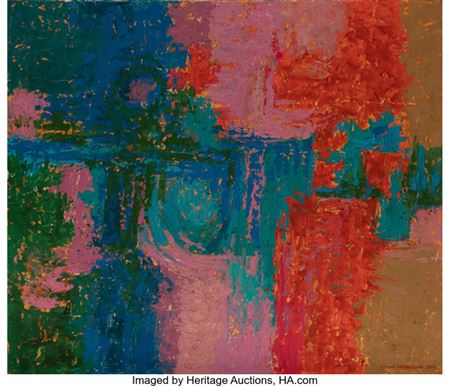 From Grand Marais, Minnesota, George Morrison was an abstract-expressionist painter and sculptor, known for his wood collages and paintings inspired by Lake Superior. His focus was on texture: "I like the so-called magical surface of a painting, the marks the painter makes". (234-Herskovik)
His training was in traditional art but in the late 1930s and early 1940s, he became established as an Abstract Expressionist and "for year was better known outside Native American art circles than within". (375-Lester).
He was born on the Grand Portage Ojibwa Reservation in northern Minnesota and earned a scholarship to study commercial art in Minneapolis. He graduated from the Minneapolis College of Art and Design, went to New York City to the Art Students League, and then to Paris on a Fulbright Scholarship.
For 20 years he lived in New York and also taught at the Rhode Island School of Design, but returned to Minnesota in 1970. There he founded the Indian Studies Program at the University of Minnesota and was a professor of art until 1983. After that, he moved to the North Shore of Lake Superior until his death.
He became the first artist honored with the Eiteljorg Fellowship for Native American Fine Art from the Eiteljorg Museum in Indianapolis, Indiana, and in 1992, the Tweed Museum at the University of Minnesota in Duluth and the Minnesota Museum of American Art in St. Paul gave him a retrospective exhibition. In 2003, a solo exhibition is planned at the Smithsonian Museum of the American Indian.
Source:
Marika Herskovic, Editor, American Abstract Expressionism of the 1950s
Jeanne Snodgrass, American Indian Painters
Patrick Lester, Biographical Directory of Native American PaintersBiography from Kramer Gallery, Inc.
Born in northern Minnesota in the Grand Portage band of Chippewa (Ojibway) Indians, George Morrison made abstract paintings, wood collages, and sculptures that enlarged the notion of Native American art beyond the stereotypical Indian subject matter.
Morrison had a traditional Ojibway upbringing on the Grand Portage reservation before attending an Indian boarding school in Wisconsin. He studied art at the Minneapolis School of Art (today the Minneapolis College of Art and Design) and the Art Students League in New York. Living and working in New York in the 1950s and 60s, he participated in the prime of the Abstract Expressionist movement with richly colored abstract paintings and Surrealist drawings
Morrison taught art at the Rhode Island School of Design in the 1960s. On returning to his home state in 1970, he taught in the studio art and Indian studies programs at the University of Minnesota until retirement in 1983. His late works included large relief sculptures, as wide as twenty feet, composed of found and prepared wooden elements collaged together. He also made a series of commissioned wooden column-like sculptures he called "Totems," and painted many small (one foot wide or less), thickly-painted abstractions known as the "Horizons" series. Morrison's art was featured in a debut exhibition (with Allan Houser) at the Smithsonian's National Museum of the American Indian in 2004.
Written and submitted by Thomas O'Sullivan, museum curator and freelance writer.
Citations
Galt, Margot Fortunato: TURNING THE FEATHER AROUND: MY LIFE IN ART (1998)
Highwater, Jamake: THE SWEET GRASS LIVES ON: FIFTY CONTEMPORARY NORTH AMERICAN INDIAN ARTISTS (1980)
Lowe, Truman T.: NATIVE MODERNISM: THE ART OF GEORGE MORRISON AND ALLAN HOUSER (2005)
Museums
National Museum of the American Indian, Washington DC
Minneapolis Institute of Arts, Minneapolis MN
Tweed Museum of Art, University of Minnesota, Duluth MN
Heard Museum, Phoenix AZ