Page loaded successfully. Showing biography for Georges Minne.
Georges Minne BIOGRAPHY
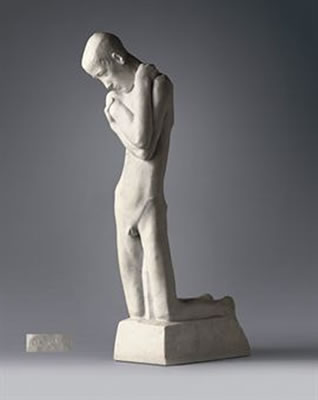
1866 - 1941. Known for: Sculpture and painting.
Georges Minne was born in 1866. From 1882 to 1884, Minne studied at the Academy of Fine Arts in Ghent. At the age of twenty, he made his first sculptures: ‘Couple entwined' and ‘Mother weeping her... Read full biography
Georges Minne was born in 1866. From 1882 to 1884, Minne studied at the Academy of Fine Arts in Ghent. At the age of twenty, he made his first sculptures: ‘Couple entwined' and ‘Mother weeping her dead child' (1886, private collection). Finding them devoid of academicism, his teacher Louis Van... Read full biography
Georges Minne was born in 1866. From 1882 to 1884, Minne studied at the Academy of Fine Arts in Ghent. At the age of twenty, he made his first sculptures: ‘Couple entwined' and ‘Mother weeping her dead child' (1886, private collection). Finding them devoid of academicism, his teacher Louis Van Biesbroeck expressed his dissatisfaction. However, Minne's innovative character, his uneasy nature, and a sensitivity towards mysticism attracted the attention and admiration of Maurice Maeterlinck. The... Read full biography
Georges Minne was born in 1866. From 1882 to 1884, Minne studied at the Academy of Fine Arts in Ghent. At the age of twenty, he made his first sculptures: ‘Couple entwined' and ‘Mother weeping her dead child' (1886, private collection). Finding them devoid of academicism, his teacher Louis Van Biesbroeck expressed his dissatisfaction. However, Minne's innovative character, his uneasy nature, and a sensitivity towards mysticism attracted the attention and admiration of Maurice Maeterlinck. The two formed a friendship as well as with the circle of symbolist poets like Grégoire Le Roy, Charles van Lerberghe and Emile Verhaeren, for whom he illustrated several of their works from 1888. The eloquence of silence fills the early work of... Read full biography
Georges Minne was born in 1866. From 1882 to 1884, Minne studied at the Academy of Fine Arts in Ghent. At the age of twenty, he made his first sculptures: ‘Couple entwined' and ‘Mother weeping her dead child' (1886, private collection). Finding them devoid of academicism, his teacher Louis Van Biesbroeck expressed his dissatisfaction. However, Minne's innovative character, his uneasy nature, and a sensitivity towards mysticism attracted the attention and admiration of Maurice Maeterlinck. The two formed a friendship as well as with the circle of symbolist poets like Grégoire Le Roy, Charles van Lerberghe and Emile Verhaeren, for whom he illustrated several of their works from 1888. The eloquence of silence fills the early work of Maeterlinck. Now, this silence, all of Minne's works are inundated with it, much more than his life. Whether drawings with simple lines or deep shadows,... Read full biography
Artist Biography
Biography page for Georges Minne ((1866 - 1941)), known for Sculpture and painting. Showing 2 biographical entries and 0 sample artworks.
Georges Minne - Artist Info
About Georges Minne
Biography from Cornette De Saint Cyr
Georges Minne was born in 1866. From 1882 to 1884, Minne studied at the Academy of Fine Arts in Ghent. At the age of twenty, he made his first sculptures: ‘Couple entwined' and ‘Mother weeping her dead child' (1886, private collection). Finding them devoid of academicism, his teacher Louis Van Biesbroeck expressed his dissatisfaction. However, Minne's innovative character, his uneasy nature, and a sensitivity towards mysticism attracted the attention and admiration of Maurice Maeterlinck. The two formed a friendship as well as with the circle of symbolist poets like Grégoire Le Roy, Charles van Lerberghe and Emile Verhaeren, for whom he illustrated several of their works from 1888. The eloquence of silence fills the early work of Maeterlinck. Now, this silence, all of Minne's works are inundated with it, much more than his life. Whether drawings with simple lines or deep shadows, let this sense of the work: the man who preached penance and humility, sank down on his knees, he took his head in his hands and the expression of the wrinkled face, with the eyes drawn apart fixed on the mystery, expresses the astonishment and the anxiety in front of the enormous mission which is devolved to him. The different figures of the “Kneeling” of this period emerged from the same conception. In a movement of abandonment, they threw themselves on their knees and listen to the voice of their boiling blood, the eddy of rising passions from which they will not escape, and, in their anguish at life, they threw their arms to- above the chest. It is a gesture which must protect what is purest in their intimacy, against the tragedy of the life which they glimpse and in front of which they feel too weak. The idea of being called to experience what roses experience, as it is realized here in plastic forms suitable to the idea! Slender and bent bodies, hard joints of adolescents, arms held together in almost parallel movements, head heavily tilted, light modeling, slow and melodious rhythm. In these forms, resulting from long mediations, carried by the artist until all individuality has disappeared and only the essential and the universal remain there, everything is so frail and so placid that one thinks to feel floating the souls around them. In 1898, the “Agenouillé de la fontaine” came out of Minne's workshop, obeying roughly the same movement and at the same pace as the first “Agenouillé” of 1896. This one is even more disarticulated and emaciated, more hollowed out in planes, with hard edges, protruding ribs, pointed shoulders, and above all it is more spiritualized, abstracted from familiar shapes and gestures, so as not to be 'an idea, and a message, but admirably expressed, according to the strictest plastic rules. This work will inspire the `Fountain of the knees' (one of the bronze versions of which is kept at the Musée d'Orsay), presented for the first time at the exhibition of the `Free Aesthetic' of 1899, five brothers who are only reflections of the same image. This image of Narcissus, as Karel van de Woestyne admirably stated, is probably Georges Minne's masterpiece.Biography from Montefiore Auction House
Georges Minne (Belgium, 1866 – 1941) was a Belgian Symbolist sculptor, draftsman and graphic artist, known for his expressive figurative sculptures. Minne studied painting at the Royal Academy of Fine Arts in Ghent and the Académie Royale des Beaux-Arts in Brussels. In 1886 he made his first visit to Paris where he was introduced to the French Symbolists who inspired his work. He turned to making sculpture, acquiring his first studio and began crafting human figures. His sculptures depicted grieving mothers, introspective male youths, and women with their children, as well as biblical stories and figures lost in prayer, made of marble, stone, wood, and bronze.
Minne has his first exhibition in 1989 at the tri-annual Salon of Ghent, and from 1890 on, he exhibited annually, first at the arts group Les XX, then later La Libre Esthétique in Brussels. He achieved international renown only with his participation in the Wiener Secession in 1900, where he showed, among others, the Kneeling Youth and the Fountain with Kneeling Youths from 1898, the highpoint in the oeuvre of the artist and also in the symbolist sculpture of the fin de siècle. In 1910 he established his own bronze foundry in Ghent, which was managed by his son.