Page loaded successfully. Showing biography for Georges Vantongerloo.
Georges Vantongerloo BIOGRAPHY
1886 Antwerp, Holland - 1965 Paris, France. Known for: Neo-plasticism sculpture, painting, architecture, writing.
The following biographies are described by M.D. Silverbrooke who submitted them: . "The first is from Net Industries; they specifically provide for others to use their information as long as you cite... Read full biography
The following biographies are described by M.D. Silverbrooke who submitted them: . "The first is from Net Industries; they specifically provide for others to use their information as long as you cite them as the source. The other three are from MOMA, Tate and Guggenheim museums." . BIOGRAPHIES.... Read full biography
The following biographies are described by M.D. Silverbrooke who submitted them: . "The first is from Net Industries; they specifically provide for others to use their information as long as you cite them as the source. The other three are from MOMA, Tate and Guggenheim museums." . BIOGRAPHIES. Georges Vantongerloo 1886 -1965. Belgian sculptor, painter, architect, and writer on art, active mainly in France, one of the pioneers of a mathematical approach to abstract art. In 1917 he joined the De... Read full biography
The following biographies are described by M.D. Silverbrooke who submitted them: . "The first is from Net Industries; they specifically provide for others to use their information as long as you cite them as the source. The other three are from MOMA, Tate and Guggenheim museums." . BIOGRAPHIES. Georges Vantongerloo 1886 -1965. Belgian sculptor, painter, architect, and writer on art, active mainly in France, one of the pioneers of a mathematical approach to abstract art. In 1917 he joined the De Stijl* group and turned from the conventionally naturalistic style he had previously practiced to abstract sculptures in which he applied the principles of Neo-Plasticism* to three dimensions (Interrelation of Volumes, 1919, Tate, London). From 1919... Read full biography
The following biographies are described by M.D. Silverbrooke who submitted them: . "The first is from Net Industries; they specifically provide for others to use their information as long as you cite them as the source. The other three are from MOMA, Tate and Guggenheim museums." . BIOGRAPHIES. Georges Vantongerloo 1886 -1965. Belgian sculptor, painter, architect, and writer on art, active mainly in France, one of the pioneers of a mathematical approach to abstract art. In 1917 he joined the De Stijl* group and turned from the conventionally naturalistic style he had previously practiced to abstract sculptures in which he applied the principles of Neo-Plasticism* to three dimensions (Interrelation of Volumes, 1919, Tate, London). From 1919 to 1927 he lived in the French Riviera resort of Menton and then for the rest of his life in Paris, where he was a... Read full biography
Artist Biography
Biography page for Georges Vantongerloo ((1886 - 1965)), known for Neo-plasticism sculpture, painting, architecture, writing. Showing 1 biographical entries and 0 sample artworks.
Georges Vantongerloo - Artist Info
About Georges Vantongerloo
Name variants
Georges Van Tongerloo
Biography from the Archives of askART
 The following biographies are described by M.D. Silverbrooke who submitted them:
"The first is from Net Industries; they specifically provide for others to use their information as long as you cite them as the source. The other three are from MOMA, Tate and Guggenheim museums."
BIOGRAPHIES
Georges Vantongerloo 1886 -1965
Belgian sculptor, painter, architect, and writer on art, active mainly in France, one of the pioneers of a mathematical approach to abstract art. In 1917 he joined the De Stijl* group and turned from the conventionally naturalistic style he had previously practiced to abstract sculptures in which he applied the principles of Neo-Plasticism* to three dimensions (Interrelation of Volumes, 1919, Tate, London). From 1919 to 1927 he lived in the French Riviera resort of Menton and then for the rest of his life in Paris, where he was a member of Cercle et Carre (1) and one of the founders of Abstraction-Creation (2). From 1928 he began to design ambitious (and unrealized) architectural projects, including a 'Skyscraper City' (1930), whose cubiform structure resembles that of his sculptures. In the 1940s his sculpture became more varied as he began using wire and Perspex (3), exploring effects of reflection and refraction. His paintings were based on horizontal and vertical lines until 1937, when he introduced rhythmic curving lines, rejecting his friend Mondrian's idea that only constructions based on the right angle reflect the harmony of the universe.
Source: Net Industries - http://arts.jrank.org/pages/14168/Georges-Vantongerloo.html#ixzz1BN6y8d00
Museum of Modern Art, New York
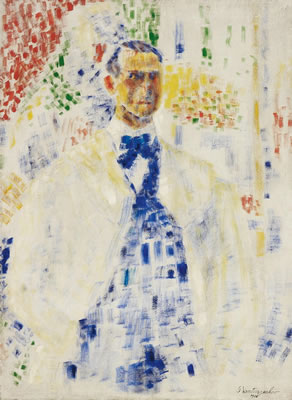
Belgian sculptor and painter. He trained at the Academy of Fine Arts in Antwerp (1900-04) and at the Académie Royale des Beaux-Arts in Brussels (1906-9). During World War I he moved to The Hague as a refugee. In 1915 he met Jules Schmalzigaug, who introduced him to Cubism* and Futurism*. His sculpture of this period consists of impressionistic representations of the human body, while his painting reflects a debt to Pointillism* (e.g. Sitting Man, 1917; priv. col., see Gast, p. 234).
In 1918 Vantongerloo became associated with the journal De Stijl*; in two of its issues he published a series of articles titled 'Réflections', in which he formulated theories about art and the role of the artist. These articles reveal his absolute belief in abstraction and a predilection for mystic and pseudo-scientific theories and concepts. Largely derived from his interest in the writings of the philosopher M. H. J. Schoenmaekers, these beliefs led Vantongerloo to visualize space as a combination of the volumes of objects and the voids that surround them.
After meeting Theo van Doesburg in 1918, Vantongerloo moved towards greater geometric and biomorphic abstraction in his sculpture. Familiarity with van Doesburg's work and ideas led Vantongerloo to construct four small sculptures collectively titled Construction in the Sphere (version, priv. col., on loan to The Hague, Gemeentemus.), in which Impressionism* has given way to geometric abstraction*, without, however, totally relinquishing recognizable motifs. In these works the human figure is reduced to geometric forms, such as the sphere, cube and pyramid. In one instance the figure is transformed into an amorphous, bulging mass with which Vantongerloo suggests movement; he appears to have been influenced by Boccioni, although there is no evidence that he knew that sculptor. After World War I Vantongerloo returned to Brussels and in 1919 he produced two stone sculptures, Interrelation of Volumes (version, London, Tate; for illustration see Stijl, De), constructed from horizontal and vertical interlocking rectangular forms; van Doesburg recognized these works as the three-dimensional realization of the principles of De Stijl.
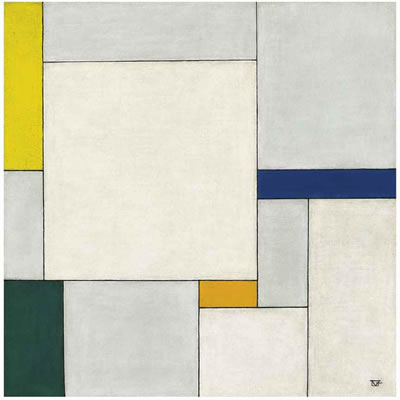
In 1920 Vantongerloo moved to Menton in southern France and there developed a theory of colour in which the three primary colours favoured by De Stijl artists were exchanged for the seven main colours of the spectrum. In addition, mathematical formulae and equations played an increasingly important part in his work. His sculptures still consisted of rectangular forms, but their construction was more open. A similar development took place in his paintings, where some of the rectangular blocks produced by the irregular grid were left white. At this time Vantongerloo began designing interiors, furniture and ceramics, as well as utopian architectural projects (villas, airports and bridges) that were never realized.
Vantongerloo gradually began to move away from De Stijl, although he remained true to most of its principles. In 1928 he moved to Paris and became a driving force behind the emergent movements Cercle et Carré (1) (1930) and Abstraction-Création (2) (1931-6). Although Vantongerloo gradually distanced himself from De Stijl and went so far, after van Doesburg's death, as to deny that he had ever been associated with the movement, it was not until 1937 that dramatic changes occurred in his paintings: his reliance on a rectilinear grid was replaced by rounded forms (circle segments and ovals), drawn as thin coloured lines against a white background, softening the severe character of his compositions.
From 1937 to 1945 Vantongerloo produced only paintings. When he took up sculpture again, his compositions became progressively more playful, comprising loose constructions of painted wire, reminiscent of atomic nuclei and the orbits of electrons around them. In this period he favoured such modern materials as Perspex (3) and plastic, in the form of imaginary heavenly bodies and comets, reflecting his continuing preoccupation with the concept of space.
Nicolette Gast
From Grove Art Online © 2009 Oxford University Press
Source: Museum of Modern, Art New York - http://www.moma.org/collection/artist.php?artist_id=6091
Tate Modern
Painter, sculptor, architect and writer. Born in Antwerp. Studied sculpture and architecture at the Academies in Antwerp and Brussels; began as a sculptor in a conventional naturalistic style. Was drafted into the Belgian Army in 1914, and interned in Holland after the fall of Antwerp. Met van Doesburg in 1916, joined the de Stijl* group in 1917, contributed to the review published by the movement 1917-20 and began to make abstract sculptures applying the principles of Neo-Plasticism* to three dimensions. Returned to Brussels in 1918; then lived 1920-7 in Menton, 1927 onwards in Paris. Published L'Art et son Avenir, a collection of essays on his mathematical theories of art, 1924. Made abstract paintings with vertical-horizontal compositions until 1937, then pictures with rhythmical, curving lines. Designed projects for an airport and a bridge 1928-30. Friendships with Mondrian, later with Max Bill and Pevsner. Co-founder and Vice-President of the group Abstraction-Creation (2) 1931-7. Began in the 1940s to widen his scope, making wire sculptures of lines in space and later also small works in transparent Perspex (1) exploring effects of reflection, refraction, etc. First one-man exhibition at the Galerie de Berri, Paris, 1943. Died in Paris.
Published in:
Ronald Alley, Catalogue of the Tate Gallery's Collection of Modern Art other than Works by British Artists, Tate Gallery and Sotheby Parke-Bernet, London 1981, pp.741-2
Source: Tate Modern -http://www.tate.org.uk/servlet/ArtistWorks?cgroupid=999999961&artistid=2094&page=1&sole=y&collab=y&attr=y&sort=default&tabview=bio
Guggenheim
b. 1886, Antwerp; d. 1965, Paris
Georges Vantongerloo was born on November 24, 1886, in Antwerp. He studied about 1900 at the Académie des Beaux-Arts of Antwerp and of Brussels. He spent the years 1914-18 in the Netherlands, where his work attracted the attention of the queen. While working on architectural designs there, Vantongerloo met Piet Mondrian, Bart van der Leck, and Theo van Doesburg and collaborated with them on the magazine De Stijl*, which was founded in 1917. Soon after his return to Brussels in 1918 he moved to Menton, France. In France he developed a close friendship with the artist and architect Max Bill, who was to organize many Vantongerloo exhibitions. In 1924 Vantongerloo published his pamphlet L'Art et son avenir in Antwerp.
In 1928 the artist-architect-theorist moved from Menton to Paris; there in 1931 he became vice-president of the artists association Abstraction-Création (2), a position he held until 1937. His models of bridges and a proposed airport were exhibited at the Musée des Arts Décoratifs in Paris in 1930. In 1936 he participated in the exhibition Cubism and Abstract Art at the Museum of Modern Art in New York. His first solo show was held at the Galerie de Berri in Paris in 1943. Vantongerloo shared an exhibition with Max Bill and Antoine Pevsner in 1949 at the Kunsthaus Zürich. His seventy-fifth birthday was observed with a solo exhibition at the Galerie Suzanne Bollag in Zurich in 1961. The following year Bill organized a large Vantongerloo retrospective for the Marlborough New London Gallery in London. Vantongerloo died on October 5, 1965, in Paris.
Source: Guggenheim - http://www.guggenheimcollection.org/site/artist_bio_159.html
Footnotes:
(1) Cercle et Carré - French abstract group founded in Paris in 1929 by critic and artist Michel Seuphor and artist Joaquín Torres García. They published a periodical of the same name and held a major group exhibition in 1930. This included 130 works by a wide range of abstract artists. The group strongly supported new developments in abstract art and in particular promoted the mystical tendency within it. Cercle et Carré was absorbed by Abstraction-Creation when the latter was founded in 1933, but Torres García continued the publication in Montevideo in his native Uruguay. Source: Tate Modern - http://www.tate.org.uk/collections/glossary/definition.jsp?entryId=65
(2) Abstraction-Creation - Association of abstract artists set up in Paris in 1931 with aim of promoting abstract art through group exhibitions. Rapidly acquired membership of around 400. Leaders were Herbin and Vantongerloo, but every major abstract painter took part including such figures as Gabo, Kandinsky and Mondrian. In Britain members of the modernist groupings the Seven and Five Society and Unit One, kept in close touch with Abstraction-Création. Their chief members were Hepworth, Moore, Nicholson, Nash and Piper. Abstraction-Création embraced the whole field of abstract art, but tended towards the more austere forms represented by Concrete art, Constructivism and Neo-Plasticism. Regular exhibitions were held until 1936 and five annual publications were issued. Source: Tate Modern - http://www.tate.org.uk/collections/glossary/definition.jsp?entryId=10
(3) Perspex (Polymethyl methacrylate) is a transparent thermoplastic. It is generically known as acrylic glass. Some other brand names are Plexiglas and Lucite. (see AskART glossary entry for Plexiglas). Source: Joe Bunin - http://ezinearticles.com/?Perspex-Sheet:-Its-History-And-Uses&id=5554245
* For more in-depth information about these terms and others, see AskART.com Glossary http://www.askart.com/AskART/lists/Art_Definition.aspx.