Page loaded successfully. Showing biography for Gerald Ira Diamond Cassidy.
Gerald Ira Diamond Cassidy BIOGRAPHY

1869 Covington, Kentucky - 1934 Santa Fe, New Mexico. Known for: Western-Indian genre and historical mural painting.
Gerald Cassidy, known for his subjects of the Southwest including Indian portraits and for his lithography, was born in Covington, KY., and grew up in Cincinnati, Ohio. He studied at the Mechanic... Read full biography
Gerald Cassidy, known for his subjects of the Southwest including Indian portraits and for his lithography, was born in Covington, KY., and grew up in Cincinnati, Ohio. He studied at the Mechanic Institute in Cincinnati and with Frank Duveneck at the Cincinnati Art Academy. He worked as an Art... Read full biography
Gerald Cassidy, known for his subjects of the Southwest including Indian portraits and for his lithography, was born in Covington, KY., and grew up in Cincinnati, Ohio. He studied at the Mechanic Institute in Cincinnati and with Frank Duveneck at the Cincinnati Art Academy. He worked as an Art Director at a lithography firm in New York City and during this time, studied briefly at the National Academy of Design and the Art Students League. Diagnosed with tuberculosis at age 20, Cassidy went to... Read full biography
Gerald Cassidy, known for his subjects of the Southwest including Indian portraits and for his lithography, was born in Covington, KY., and grew up in Cincinnati, Ohio. He studied at the Mechanic Institute in Cincinnati and with Frank Duveneck at the Cincinnati Art Academy. He worked as an Art Director at a lithography firm in New York City and during this time, studied briefly at the National Academy of Design and the Art Students League. Diagnosed with tuberculosis at age 20, Cassidy went to a sanitarium in New Mexico, a move that introduced him to life in the West. He first earned his living by painting portraits of Indians and scenes of the Southwest that were intended to be reproduced on postcards. When his health got better, he moved... Read full biography
Gerald Cassidy, known for his subjects of the Southwest including Indian portraits and for his lithography, was born in Covington, KY., and grew up in Cincinnati, Ohio. He studied at the Mechanic Institute in Cincinnati and with Frank Duveneck at the Cincinnati Art Academy. He worked as an Art Director at a lithography firm in New York City and during this time, studied briefly at the National Academy of Design and the Art Students League. Diagnosed with tuberculosis at age 20, Cassidy went to a sanitarium in New Mexico, a move that introduced him to life in the West. He first earned his living by painting portraits of Indians and scenes of the Southwest that were intended to be reproduced on postcards. When his health got better, he moved to Denver. and there established his reputation as a lithographer by doing work that was used for magaz... Read full biography
Artist Biography
Biography page for Gerald Ira Diamond Cassidy ((1869 - 1934)), known for Western-Indian genre and historical mural painting. Showing 10 biographical entries and 0 sample artworks.
Gerald Ira Diamond Cassidy - Artist Info
About Gerald Ira Diamond Cassidy
Name variants
Ira Diamond Gerald Cassidy
Biography from the Archives of askART
 Gerald Cassidy, known for his subjects of the Southwest including Indian portraits and for his lithography, was born in Covington, KY., and grew up in Cincinnati, Ohio. He studied at the Mechanic Institute in Cincinnati and with Frank Duveneck at the Cincinnati Art Academy. He worked as an Art Director at a lithography firm in New York City and during this time, studied briefly at the National Academy of Design and the Art Students League.
Diagnosed with tuberculosis at age 20, Cassidy went to a sanitarium in New Mexico, a move that introduced him to life in the West. He first earned his living by painting portraits of Indians and scenes of the Southwest that were intended to be reproduced on postcards. When his health got better, he moved to Denver. and there established his reputation as a lithographer by doing work that was used for magazine illustrations, murals, and ads.
In 1912, he married the sculptor and writer Ina Sizer Davis, who became a noted author of numerous articles on New Mexico art colonies. The couple settled in Santa Fe where Cassidy began a project to document the culture of Pueblo Indians. The commission to do this work came from Edgar L Hewitt, Director of the School of American Archaeology. Hewitt regarded the life of the Indians as the counterpoint to the materialism of white civilization. Cassidy became so committed to this project that he decorated his home with altar paintings from the ruined Nambe mission church.
In Santa Fe, he was only the third artist of English origin to establish residency there. During this time, he changed his signature from Gerald Ira Diamond Cassidy to Gerald Cassidy, placing the Tewa Indian sun symbol (symbol of circle with four lines) between his first and last name. He also painted many landscapes and large historic murals for commercial buildings including the Indian Arts Building.
A highlight of his career occurred in 1915 when he was awarded the Grand Prize and Gold Medal for his murals in the Indian Arts Building, at the Panama-California International Exposition, San Diego, California.
Nineteen years later, in 1934, Cassidy met an untimely death from lead poisoning while working on a mural for the Federal Building in Santa Fe.
His work is represented in national and international museums including the Freer Collection, Washington, D. C., Museum of Fine Arts, Santa Fe, NM, San Diego Museum, San Diego, CA, City Art Museum, Baroda, Bombay, India, City Art Museum, Berlin, Germany, and The Luxembourg, Paris.
Source:
Michael David Zellman, 300 Years of American Art
Peter Falk, Editor, Who Was Who in American Art
Edan Hughes, Artists in California 1786-1940Biography from the Archives of askART
 The following is from Robin Lynn Biel:
"Depiction of Snake Dance"
By Robin Lynn Biel
Published in: Art Matters Guide to The Philadelphia Region's Magazine of the Arts & Antiques Montgomery Newspapers, September 2000, pg. 20
Recently our firm has encountered an extremely handsome painting, The Answered Prayer, (1915) by Gerald Cassidy (1879-1934). He is best known for his American Indian genre paintings. We were asked to examine the Cassidy painting, which has hung over our clients' fireplace in their home since 1917.
The Answered Prayer is signed in the lower right corner with the artist's mar k above the signature. The medium is oil on burlap with heavily textured brush strokes. The rather large work, 28"x 48", depicts a Hopi Indian with outstretched arms praying to a sky of clouds in the imagery of faces. On the back of the painting is a letter which reads:
"The Answered Prayer by Gerald Cassidy. Hopi Indians of Arizona each year hold a religious ceremony called commonly the Snake Dance. This is a ceremony which lasts for nine days and on the ninth day ending in a spectacular dance on the snake plaza of the village. At the close, the snakes are released to return to mother nature in the center of the earth, carrying to her the prayers and the adulation of the Indians. The snake dance is really an elaborate prayer for rain which is so greatly needed by the Hopi for their corn.
In the Answered Prayer is shown the approaching thunderstorm just at the close of the ceremony when the snake priest is out on the plain releasing the snakes after the dance on the top of the mesa shown in the distance with the village of Walipi on top of the cliff. The rain storm is the answer to their religions ceremony".
The label also states that the painting was included in the Pennsylvania Academy of Fine Arts 113th Annual Exhibit in 1918.Biography from the Archives of askART
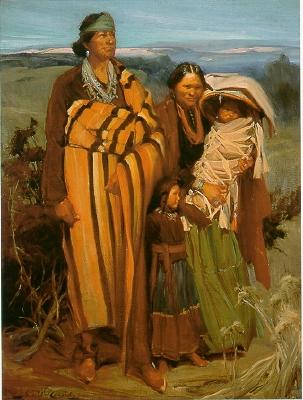 Born on Nov. 10, 1879 in Cincinnati, OH. Cassidy studied with Duveneck at the Cincinnati Art Academy, and in NYC at the NAD and ASL. Ill with tuberculosis, at the turn of the century he settled in New Mexico where he became nationally known for his Indian and western scenes. He was active in the Los Angeles area from 1913 through the late 1920s. He died in Santa Fe, NM on Feb. 12, 1934.
Exh: Panama-Calif. Int'l Expo (San Diego), 1916 (grand prize for murals); Kanst Gallery (LA). 1921; Pasadena Art Inst., 1928; LACMA, 1928; Stendahl Gallery (LA), 1929.
In: mural, Indian Arts Bldg (San Diego); Bancroft Library (UC Berkeley); San Diego Museum; Univ. of NM.Biography from the Archives of askART
The following information is from Stacia Lewandowski.
I am the author of the book, Light, Landscape and the Creative Quest: Early Artists of Santa Fe.
There has been a long-standing discrepancy on the birth date for Gerald Cassidy, one of those early artists. As part of my research for the book, I went to the cemetery, in Santa Fe, where he is buried and found his gravestone that included his birth and death dates. The gravestone creation would have been overseen by his wife, Ina Sizer Cassidy.
Most people repeat his birth date as 1879, but in fact it was 1869.Biography from Mark Sublette Medicine Man Gallery
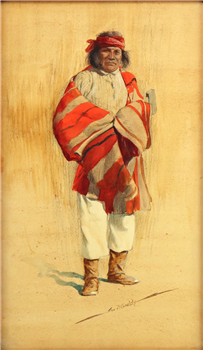 Gerald Cassidy was a fiercely driven artist of the American West whose body of work is an earnest, humble and skillful rendering of the peoples and locales of the southwestern desert.
Born in Kentucky and raised in Cleveland, Cassidy received his training from Frank Duveneck at the Institute of Mechanical Arts, the teacher of an entire generation of artists including Joseph Henry Sharp and Walter Ufer. He continued his studies at the Arts Students League in New York and was an engraving firms art director by the time he was twenty years old.
At the same moment that Cassidy was first finding success he contracted a life-threatening case of pneumonia and was moved to a sanitarium in Albuquerque. It was here that he first saw the people and places of the southwest, the subject matter that he would dedicate his entire life's work to after this point. His first work using Indian and Western subjects was heavily art deco, and a deco edge would remain in his work even as it developed into a more solidly realist style.
Cassidy moved from Albuquerque to Denver to work as a commercial artist, but it didn't last; Cassidy returned to Santa Fe in 1912, becoming a founding member of the Santa Fe Artists' Colony. He painted the Navajo in works that were primarily transferred to postcards or posters. At the 1915 Panama-California International Exposition in San Diego Cassidy was awarded the gold medal for his murals, the largest award he would win in his lifetime.
During the mid-twenties Cassidy traveled in Europe, and his pieces were well thought of by the European public. Pablo Picasso chose one of Cassidy's pieces from a show for inclusion in the Luxembourg Palace in Paris.
In 1934, while painting a mural for the WPA, Cassidy contracted lead poisoning and died. It was a terrible, abrupt ending to an artist who had all of the prerequisite skills to become one of the dominant painters of the West in America.Biography from Nedra Matteucci Galleries
GERALD CASSIDY (1879-1934)
Born in Kentucky, Ira Diamond Gerald Cassidy was raised in Cincinnati in a large family strongly influenced by the arts. Cassidy received his first training at the Institute of Mechanical Arts under Frank Duveneck (the noted teacher of a generation of U.S. artists including Joseph Sharp and Walter Ufer). He continued his studies at the Arts Students League in New York and by his mid twenties was equipped with the skills with which to become a successful painter and lithographer.
Cassidy moved to Denver, finding it the perfect location to pursue parallel careers in commercial illustration and easel painting. Cassidy soon discovered his life's inspiration in the history, landscape and cultures of the West. In 1898 a severe case of pneumonia developed into a nearly fatal bout with tuberculosis. Cassidy moved to Albuquerque, known for its healthful environment, and soon was able to resume his painting. By 1912 he and his wife, noted author Ina Sizer Cassidy, settled in Santa Fe, becoming members of its beginning arts colony.
Cassidy is known for the flowing brushwork, distinctive compositions and clear, luminous colors of his paintings. He frequently sketched at the Pueblos of the region, and his ability to capture both the action and spirit of his subjects led to many important mural and portrait commissions throughout the United States. A trip to Europe and Africa in 1926 resulted in international acclaim, leading many museums to select his work for their collections. Picasso personally chose one of Cassidy's paintings for the Luxembourg Palace in Paris.
The artist's untimely death in 1934 tragically shortened a brilliant career as one of America's foremost painters and as a prominent artist of the Santa Fe colony. His graceful compositions of the Southwest are a timeless legacy.Biography from Altermann Galleries and Auctioneers, I
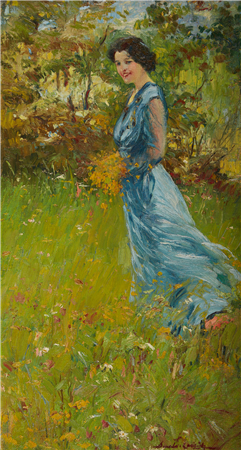 Ira Diamond Gerald Cassidy
Born: Covington, Kentucky 1879
Died: Santa Fe, New Mexico 1934
Santa Fe painter, illustrator, printmaker, muralist
Son of a builder, Cassidy grew up in Cincinnati. He was the pupil of Duveneck at the Institute of Mechanical Arts when he was 12. By the time he was 20, he was art director of a New York City lithographer. Sticken by pneumonia in 1899, he entered a sanitarium in Albuquerque where he first painted the Southwest, changing his signature from Ira Diamond Cassidy to Gerald Cassidy. When he recovered sufficiently, he moved to Denver as a commercial artist and lithographer specializing in theatrical subjects. After returning briefly to New York City where he studied at the National Academy of Design and the Art Students League, he married Ina Sizer Davis and settled in Santa Fe in 1912, following Carlos Vierra (1904) and Kenneth Chapman (1909). He was also active in Los Angeles, California from 1913-1921.
Intending to devote his talent to recording Indian life in the context of New Mexican light and color, his first Indian drawings reproduced on post cards were sophisticated and art nouveau rather than the typical Victorian. Recognition came by 1915 with his mural The Cliff Dwellers of the Southwest. In the 1920s his small on-the-spot landscapes were most prized, as Cassidy's style resisted the influence of the New Mexico modernist. He traveled abroad in 1926, visiting Europe and North Africa. While in France, he utilized 19125 sketches of Navajo subjects to paint two oils, one commissioned by the Santa Fe Ry and the other for the French Government. Cassidy dies of poisoning while working on a mural for the Santa Fe Federal Building.
Resource: SAMUELS' Encyclopedia of ARTISTS of THE AMERICAN WEST,
Peggy and Harold Samuels, 1985, Castle PublishingBiography from Caldwell Gallery Hudson
The following biography has been provided by The Caldwell Gallery.
Gerald Cassidy, born in 1879, was a painter and leading lithographer. He studied at the Cincinnati Academy in 1891 and briefly at the National Academy of Design and the At Students League. Cassidy worked in New York City as an art director for a city lithographer when he developed Tuberculosis and was forced to move to a warmer climate. In 1890, he headed west to Albuquerque and was the founder of the Santa Fe Art Colony in 1912. He specialized in Western scenes of Navajos that were often reproduced as postcards.
When his health improved, Cassidy moved to Denver and established a national reputation as a lithographer, working on magazine illustrations, murals posters and advertisements. His highest acclaim was gained in 1915 when he was awarded the golf metal at the Panama-California International Exposition for his murals at the San Diego Indian Arts Building. Cassidy died of poisoning while working for the WPA on a mural.Biography from Adobe Gallery
When Gerald Cassidy was stricken by pneumonia in 1899, he entered a sanitarium in Albuquerque, New Mexico where he first painted the Southwest, changing his signature from Ira Diamond Cassidy to Gerald Cassidy. He married Ina Sizer Davis and settled in Santa Fe in 1912, following artists Carlos Vierra (1904) and Kenneth Chapman (1909). In Santa Fe, he was only the third artist of English origin to establish residency there.
He painted many landscapes and large historic murals for commercial buildings including the Indian Arts Building, at the Panama-California International Exposition, San Diego, California.
In 1934, Cassidy met an untimely death from lead poisoning while working on a mural for the Federal Building in Santa Fe.Biography from Kelly D. Kennedy Fine Art LLC
 Gerald Cassidy (1879-1934), a Cincinnati native, relocated to New Mexico as a young man, primarily to thwart the tuberculosis expected to take his life within six months. Cassidy’s health improved so dramatically from the relocation that he eventually enjoyed the liberty of travel – and even set up shop for several years as a lithographer in Denver, Colorado. Ultimately, though, Cassidy found Colorado less salubrious, and returned to New Mexico – first to Albuquerque, then to Santa Fe.
Cassidy sought to be authentic in his representation of indigenous tribes. Accordingly, he would spend stretches of time immersed in their communities. His willingness to work the land and practice traditional art alongside Native American mentors gave him rare access to tribal practices. Cassidy was so taken with the cultures he experienced, that he even began incorporating a Tewa-Indian sun symbol into his signature.
The combination of a Northern art-school pedigree and a novel Southwestern subject helped Cassidy’s art become a common sight at exhibitions across the US and Europe. He was especially recognized for his murals – one of which earned him the grand prize and gold medal at the Panama-California Exposition in 1915.
In 1934, while working on murals for the Civil Works Administration, Cassidy suffered a fatal accident in his adopted hometown of Santa Fe. The February cold had caused Cassidy to hole up in his studio, with the toxic combination of paints and a heater. His premature death from carbon-monoxide poisoning was lamented in publications as distant as the New York Times, which proudly reported that Cassidy’s work was even in the Louvre.
*In the early 20th century, the arid South was a common prescription for ill Northerners. Artist Nicolai Fechin would find himself in New Mexico for similar reasons over two decades later.
About the Art
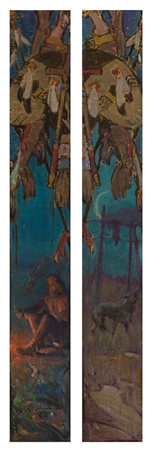
In the left panel, a trapper sits in contemplation before a campfire. In the right panel, a wolf howls in frustration before a Native American burial. In these mirrored studies for “Dawn of the West,” Gerald Cassidy is working out the challenges of conveying Golden, Colorado’s multiple histories in one large work. It was the mid-1920s, and the artist had been commissioned to paint a life-sized mural memorializing Harry Rubey, a local banker. Naturally, the center panel would pay homage to the gold rush that gave the city its name, and the banker his currency. But the flanking panels were Cassidy’s opportunity to expand the narrative and acknowledge the region’s other historic populations.
Of particular interest is the right panel’s subject: It is a Native American warrior’s corpse, weatherproofed with wrappings, elevated against marauding animals, adorned with tribal remembrances, and offered to the sky. Because Cassidy strove for authenticity in his rendering of Native American life, the shields gracing the top halves of the panels were likely drawn from observation. Of the two tribes – Ute and Arapaho – associated with the region of Golden, Colorado, Ute is the one Cassidy is most likely referencing. A Ute warrior’s shield had a buffalo-hide core and buckskin covering, often with feathers dangling from its face. Cassidy has depicted the shields with a geometric design of black and yellow, the same color pairing reportedly favored by Ute warriors for their battle paint.
Sources:
"Gerald Cassidy, Artist, 54, Dies." New York Times (1923-Current File), Feb 13, 1934.
Loft, Fran. "Public Art Thrives in Golden - Dawn of the West." Denver Post online (Your Hub), November 09, 2017.
"Native American Burial." Blackhawk Museum article, blackhawkmuseum.org.
Noel, Thomas J., Guide to Colorado Historic Places: Sites Supported by the Colorado Historical Society’s State Historical Fund. Englewood, CO: Westcliffe Publ., 2006.
Paterek, Josephine. Encyclopedia of American Indian Costume. New York: W.W. Norton & Company, 1994.
Redish, Laura, and Orrin Lewis. American Indians in Colorado map. Native Languages of the Americas. 1998. native-languages.org.
Yarrow, H. C. "A Further Contribution to the Study of the Mortuary Customs of the North American Indians." First Annual Report of the Bureau of Ethnology to the Secretary of the Smithsonian Institution 1879-1880, 1881. Project Gutenberg.