Page loaded successfully. Showing biography for Giorgio Morandi.
Giorgio Morandi BIOGRAPHY
1890 Bologna, Italy - 1964 Bologna, Italy. Known for: Modernist interior, landscape, self portrait and still life painting.
Giorgio Morandi was born in Bologna, Italy in 1890. He lived his entire life in Bologna in an apartment with three unmarried sisters. He never married. Although early in his career he had contributed... Read full biography
Giorgio Morandi was born in Bologna, Italy in 1890. He lived his entire life in Bologna in an apartment with three unmarried sisters. He never married. Although early in his career he had contributed paintings that demonstrate purely formal interests, he soon realized that his true metier was... Read full biography
Giorgio Morandi was born in Bologna, Italy in 1890. He lived his entire life in Bologna in an apartment with three unmarried sisters. He never married. Although early in his career he had contributed paintings that demonstrate purely formal interests, he soon realized that his true metier was philosophy. In the early 1920s he was briefly allied with deChirico as a "metaphysical painter" of strange objects in false perspective. But he was clearly uncomfortable with the stark drama of DeChirico's... Read full biography
Giorgio Morandi was born in Bologna, Italy in 1890. He lived his entire life in Bologna in an apartment with three unmarried sisters. He never married. Although early in his career he had contributed paintings that demonstrate purely formal interests, he soon realized that his true metier was philosophy. In the early 1920s he was briefly allied with deChirico as a "metaphysical painter" of strange objects in false perspective. But he was clearly uncomfortable with the stark drama of DeChirico's style. Morandi began his process of creation by collecting empty bottles, jugs, boxes, vases and other containers. There is undoubtedly significance in his choice of objects originally designed to enclose or support other things. His studio was... Read full biography
Giorgio Morandi was born in Bologna, Italy in 1890. He lived his entire life in Bologna in an apartment with three unmarried sisters. He never married. Although early in his career he had contributed paintings that demonstrate purely formal interests, he soon realized that his true metier was philosophy. In the early 1920s he was briefly allied with deChirico as a "metaphysical painter" of strange objects in false perspective. But he was clearly uncomfortable with the stark drama of DeChirico's style. Morandi began his process of creation by collecting empty bottles, jugs, boxes, vases and other containers. There is undoubtedly significance in his choice of objects originally designed to enclose or support other things. His studio was famously dusty; no doubt he liked the dust because it softened light and color. He died in Bologna in 1964. Written and submitted by... Read full biography
Artist Biography
Biography page for Giorgio Morandi ((1890 - 1964)), known for Modernist interior, landscape, self portrait and still life painting. Showing 2 biographical entries and 0 sample artworks.
Giorgio Morandi - Artist Info
About Giorgio Morandi
Biography from the Archives of askART
 Giorgio Morandi was born in Bologna, Italy in 1890. He lived his entire life in Bologna in an apartment with three unmarried sisters. He never married. Although early in his career he had contributed paintings that demonstrate purely formal interests, he soon realized that his true metier was philosophy. In the early 1920s he was briefly allied with deChirico as a "metaphysical painter" of strange objects in false perspective. But he was clearly uncomfortable with the stark drama of DeChirico's style.
Morandi began his process of creation by collecting empty bottles, jugs, boxes, vases and other containers. There is undoubtedly significance in his choice of objects originally designed to enclose or support other things. His studio was famously dusty; no doubt he liked the dust because it softened light and color.
He died in Bologna in 1964.
Written and submitted by Jean Ershler Schatz, artist and researcher from Laguna Woods, California.
Sources include:
Master Paintings from the Phillips Collection
Mark Stevens in Newsweek, December 7, 1981
ARTnews, November 1999Biography from Koller Zurich
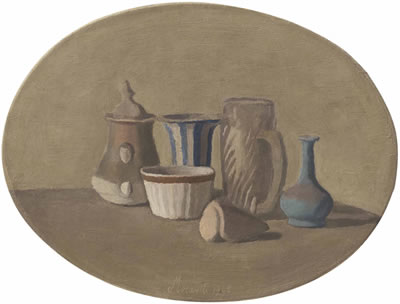
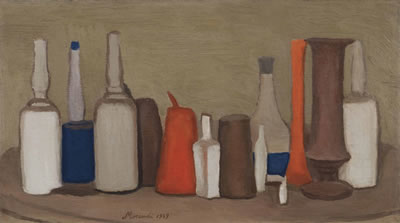
The fact that the still-life belongs to Morandi, like the brush belongs to the painter, is reflected in the artist's catalogue raisonné. Dedicating the bulk of his career to still-life elements, he mainly portrayed bottles, glasses and vessels of everyday use more than any other artist, which amongst other things earned him the nickname "the bottle painter".
The artist was influenced by his Italian forefathers of the Quattrocento. Among them, Masaccio, Paolo Uccello and Pierro della Francesco were the most important: their frescos' simple, coherent structure, combined with a virtually sculptural depiction of volume, had a formative influence on Morandi. He also tried to orientate himself on Modern masters such as Cézanne, and eventually managed to create his own art with a highly recognizable quality. For Morandi, the ultimate goal was the arrangement of the vessels and the creation of a perfect and harmonious composition in the process. The peaceful tranquillity that suffuses his work is underscored by his special color palette made up of earthy tones. Pencil works and watercolors are very important components of the artist's development and ultimately lead to the final oil paintings. The pencil work serves to find the composition and the watercolor to eventually find the color harmony. This underscores the fact that Morandi was a very precise artist who strove for perfection.