Page loaded successfully. Showing biography for Gordon Cope.
Gordon Cope BIOGRAPHY
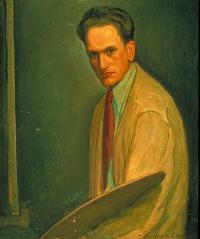
1906 Salt Lake City, Utah - 1999. Known for: Portrait, landscape, and coastal view painting.
Born in Salt Lake City, Utah, Gordon Cope became a portrait and landscape painter and teacher in Utah and later in California. Much of his reputation was linked to the pre-World War II WPA program,... Read full biography
Born in Salt Lake City, Utah, Gordon Cope became a portrait and landscape painter and teacher in Utah and later in California. Much of his reputation was linked to the pre-World War II WPA program, which boosted the careers of many 'starving' artists. In Utah, he studied with A.B. Wright, 1916 to... Read full biography
Born in Salt Lake City, Utah, Gordon Cope became a portrait and landscape painter and teacher in Utah and later in California. Much of his reputation was linked to the pre-World War II WPA program, which boosted the careers of many 'starving' artists. In Utah, he studied with A.B. Wright, 1916 to 1923; La Conte Stewart; and in Arizona, 1923-1924, with Lawrence Squires. From 1924 to 1928, he traveled in Europe where he studied the Old Masters in museums in England, France Switzerland, Italy,... Read full biography
Born in Salt Lake City, Utah, Gordon Cope became a portrait and landscape painter and teacher in Utah and later in California. Much of his reputation was linked to the pre-World War II WPA program, which boosted the careers of many 'starving' artists. In Utah, he studied with A.B. Wright, 1916 to 1923; La Conte Stewart; and in Arizona, 1923-1924, with Lawrence Squires. From 1924 to 1928, he traveled in Europe where he studied the Old Masters in museums in England, France Switzerland, Italy, Belgium and Holland. He spent the last year, 1928, as a student at the Julian Academy in Paris. Returning to Utah, he became head of the art department in 1931 at Latter Day Saints University and also held other teaching positions in Utah including with... Read full biography
Born in Salt Lake City, Utah, Gordon Cope became a portrait and landscape painter and teacher in Utah and later in California. Much of his reputation was linked to the pre-World War II WPA program, which boosted the careers of many 'starving' artists. In Utah, he studied with A.B. Wright, 1916 to 1923; La Conte Stewart; and in Arizona, 1923-1924, with Lawrence Squires. From 1924 to 1928, he traveled in Europe where he studied the Old Masters in museums in England, France Switzerland, Italy, Belgium and Holland. He spent the last year, 1928, as a student at the Julian Academy in Paris. Returning to Utah, he became head of the art department in 1931 at Latter Day Saints University and also held other teaching positions in Utah including with the Mountain School of Art and the Art Barn School, which he served as Director. He did numerous po... Read full biography
Artist Biography
Biography page for Gordon Cope ((1906 - 1999)), known for Portrait, landscape, and coastal view painting. Showing 2 biographical entries and 0 sample artworks.
Gordon Cope - Artist Info
About Gordon Cope
Biography from the Archives of askART
 Born in Salt Lake City, Utah, Gordon Cope became a portrait and landscape painter and teacher in Utah and later in California. Much of his reputation was linked to the pre-World War II WPA program, which boosted the careers of many 'starving' artists.
In Utah, he studied with A.B. Wright, 1916 to 1923; La Conte Stewart; and in Arizona, 1923-1924, with Lawrence Squires. From 1924 to 1928, he traveled in Europe where he studied the Old Masters in museums in England, France Switzerland, Italy, Belgium and Holland. He spent the last year, 1928, as a student at the Julian Academy in Paris.
Returning to Utah, he became head of the art department in 1931 at Latter Day Saints University and also held other teaching positions in Utah including with the Mountain School of Art and the Art Barn School, which he served as Director. He did numerous portraits of Utah notables.
During the Depression years of the 1930s, he was one of the original ten artists with the Utah Public Works of Art Project. His special assignment was "sculpture and sketches of early Indian life." (Swanson, 127). He was also involved in the state's Public Art Project, administered by the Federal Emergency Relief Administration, and that entities' major accomplishment was the completion of murals for the Utah State Capitol. One of the artists, Dan Burke, recalled that at the end of this project, after the murals were mounted, "it was discovered that a painting stained cloth had been left on a shelf at the base of the dome. Cope armed with a long fishing rod, spent the greater part of a day at casting before the undecorative object was landed." (Swanson, 127)
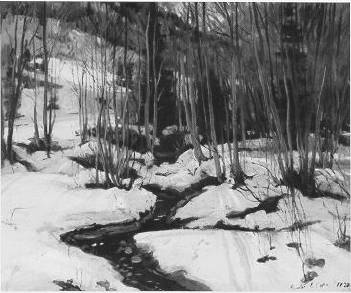
In California, Cope apparently had great success for his "vigorous impressionistic realism. His Sierra Snow Scene, painted when he was seventy-two years old, has a scale, boldness and subtlety usually lost by older artists." (Swanson, 182)
Sources include:
Vern Swanson, Robert Olpin, William Seifrit, Utah Art
Peter Hastings Falk, editor, Who Was Who in American Art
Peggy and Harold Samuels, The Illustrated Encyclopedia of Artists of the American West
Biography from Anthony's Fine Art
Having trained as a youth with well-known Utah artists such as Alma .B. Wright and LeConte Stewart, Gordon Nicholson Cope quickly became recognized as a major Utah artist of the Great Depression. Although he now resides in San Francisco, Cope was born in Salt Lake City in 1906 and spent much of his life in Utah.
Cope gained much of his artistic training from diverse environments and influences. Following his training with the previously mentioned artists, Cope spent the next year, 1924, working with Lawrence Squires in Arizona. To expand his knowledge and training, Cope traveled to Europe, where he studied the "old masters" such as Da Vinci, Michelangelo, and Raphael. From 1924 to 1928, Cope studied in England, France, Italy, Switzerland, Belgium, Holland, and worked for a year at the Acadamie Julian, where many early Utah artists had studied.
Two years after returning home to Utah, Cope began the Art Department at the LDS University and worked there until 1931. Cope continued working as a painter while maintaining a career in art education. As an educator, Cope was employed with the Mountain School of Art from 1932 - 1933; and during 1939 - 1941, Cope was the Director of the Art Barn School (which became the Salt Lake Art Center), as well as continuing with the Mountain School of Art.
Gordon Cope now resides in San Francisco.
Cope donated much of his time to civic duty during the 1930s. During Roosevelt's term, the President created the Works Projects Administration (WPA) as part of his New Deal. According to Roosevelt, one aim of the administration was to account for what artistic material existed in America. The administration included ten artists, one of whom was Gordon Cope. He also was involved with other governmental work under the Federal Emergency Relief Administration, which included the completion of murals for the state capitol dome.
Cope's work is often termed "vigorous, impressionistic realism," (Swanson 182) displaying regionalism in genre scenes. In his A Record of Times, Cope displays life on the Uintah-Ouray Indian Reservation and exhibits his style and interest in genre scenes. Cope is also known for his portraits of notorious Utah figures and for his landscape paintings, such as Utah Hills.
Much of Gordon Cope's time and work was dedicated to the progress of Utah art through his use of Utah subject matter as well as through literal service within the Utah art community.
Biography courtesy of the Springville Museum of Art