Page loaded successfully. Showing biography for Gottardo Fidele Ponziano Piazzoni.
Gottardo Fidele Ponziano Piazzoni BIOGRAPHY
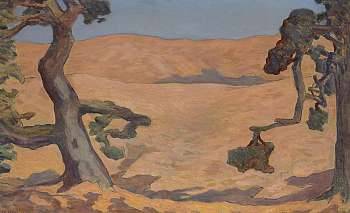
1872 Intragna, Switzerland - 1945 Carmel Valley, California. Known for: Landscape and seascape painting, etching, mural.
A painter, etcher, muralist, and sculptor, Gottardo Piazzoni was a highly prominent, active figure in the Northern California art world in the early 20th Century. Many of his paintings were... Read full biography
A painter, etcher, muralist, and sculptor, Gottardo Piazzoni was a highly prominent, active figure in the Northern California art world in the early 20th Century. Many of his paintings were plein-air, impressionist style California landscapes that were simple in composition and quiet in tone,... Read full biography
A painter, etcher, muralist, and sculptor, Gottardo Piazzoni was a highly prominent, active figure in the Northern California art world in the early 20th Century. Many of his paintings were plein-air, impressionist style California landscapes that were simple in composition and quiet in tone, reflective of his search for refuge from an increasingly mechanized society. He also created a number of paintings in the Symbolist style that expressed an ideal, dreamlike world of muted, restful colors.... Read full biography
A painter, etcher, muralist, and sculptor, Gottardo Piazzoni was a highly prominent, active figure in the Northern California art world in the early 20th Century. Many of his paintings were plein-air, impressionist style California landscapes that were simple in composition and quiet in tone, reflective of his search for refuge from an increasingly mechanized society. He also created a number of paintings in the Symbolist style that expressed an ideal, dreamlike world of muted, restful colors. Piazzoni was a teacher at the California School of Fine Art in San Francisco from 1919 to 1935, and established in that city the Piazzoni Atelier d'Art on Sacramento Street. One of his major public accomplishments was the painting of fourteen large... Read full biography
A painter, etcher, muralist, and sculptor, Gottardo Piazzoni was a highly prominent, active figure in the Northern California art world in the early 20th Century. Many of his paintings were plein-air, impressionist style California landscapes that were simple in composition and quiet in tone, reflective of his search for refuge from an increasingly mechanized society. He also created a number of paintings in the Symbolist style that expressed an ideal, dreamlike world of muted, restful colors. Piazzoni was a teacher at the California School of Fine Art in San Francisco from 1919 to 1935, and established in that city the Piazzoni Atelier d'Art on Sacramento Street. One of his major public accomplishments was the painting of fourteen large murals on the grand staircase of the downtown San Francisco Public Library. Completed in 1932, five of them depicted the "sea", and five the "lan... Read full biography
Artist Biography
Biography page for Gottardo Fidele Ponziano Piazzoni ((1872 - 1945)), known for Landscape and seascape painting, etching, mural. Showing 4 biographical entries and 0 sample artworks.
Gottardo Fidele Ponziano Piazzoni - Artist Info
About Gottardo Fidele Ponziano Piazzoni
Biography from the Archives of askART
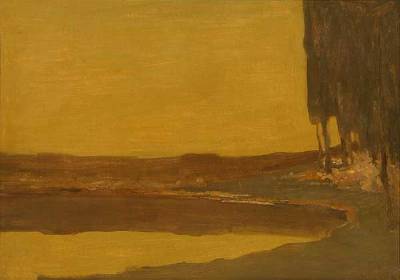 A painter, etcher, muralist, and sculptor, Gottardo Piazzoni was a highly prominent, active figure in the Northern California art world in the early 20th Century. Many of his paintings were plein-air, impressionist style California landscapes that were simple in composition and quiet in tone, reflective of his search for refuge from an increasingly mechanized society. He also created a number of paintings in the Symbolist style that expressed an ideal, dreamlike world of muted, restful colors.
Piazzoni was a teacher at the California School of Fine Art in San Francisco from 1919 to 1935, and established in that city the Piazzoni Atelier d'Art on Sacramento Street. One of his major public accomplishments was the painting of fourteen large murals on the grand staircase of the downtown San Francisco Public Library. Completed in 1932, five of them depicted the "sea", and five the "land".
He was born in Intragna, Switzerland to Swiss-Italian parents and got his early schooling in Locarno, Italy, where he was much impressed by local mural artists who decorated the churches of that city. In 1887, he emigrated to California with his mother to join his father who had established a dairy farm in Carmel Valley. He persuaded his parents to let him go to San Francisco to get art training, and from 1891 to 1893, he took art studies at the San Francisco School of Design under Arthur Mathews and Raymond Yelland, and won a Gold Medal for drawing.
He then went to Paris for three years to study at the Academie Julian with Benjamin Constant, Henri Martin, and Jean-Paul Laurens and from 1896 to 1898, studied with Jean-Leon Gerome at the Ecole des Beaux-Arts. In Paris, he shared studios with Douglas Tilden and Granville Redmond, with whom he would remain life-long friends in California.
Returning to San Francisco, he shared a studio for ten years with Arthur Putnam and was a member of numerous organizations including the Bohemian Club and the San Francisco Society of Etchers. His first major solo exhibition was in April 1905 at the Mechanics Institute Pavilion, and he made enough money to return to Europe, this time with his bride, Beatrice Del Mue, and Arthur Putnam and his wife. The couples traveled for the next two years through Italy, France, and Switzerland.
In 1907, the Piazzoni's returned to San Francisco to deal with his studio that had been destroyed by fire. Relocating from Sacramento Street to Presidio Avenue, he began the first of his many mural commissions that reflected his commitment to the integration of art and architecture. He also gave studio classes, conducted plein-air painting excursions, traveled extensively in California for landscape subjects, began a series of monotypes, and took on teaching responsibilities at CSFA.
Piazzoni died at his home in Carmel Valley, and in 1959, the California Historical Society held a retrospective of his work.
Sources:
Artists in California 1786-1940 by Edan Hughes and
"Plein Air Painters of California, The North" edited by Ruth Westphal.Biography from the Archives of askART
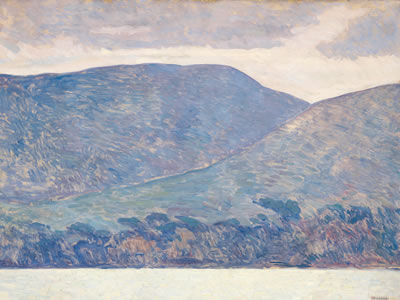 Gottardo Piazzoni (1872-1945). (San Francisco/Carmel)
Bay area artist who sketched in SLO area in 1902.
Born in Switzerland, Piazzoni came to California at age fourteen to join his father on his dairy farm in the Carmel Valley. He studied art in San Francisco and Paris and kept a studio in San Francisco. His signature style was “modern” for its era – landscapes and figures simplified to basic shapes and colors. Exhibited On the Cayucos Shore at the San Francisco Artists Society in 1905 (Schwartz, 1990, p. 97).
Source: Nancy Dustin Wall Moure, MORRO BAY (including LOS OSOS, BAYWOOD PARK and CAYUCOS) ART AND PHOTOGRAPHY BEFORE 1960 (Publications in [Southern] California Art, vol. 13, no. I), Los Angeles: Dustin Publications, 2016.Biography from Hauk Fine Arts
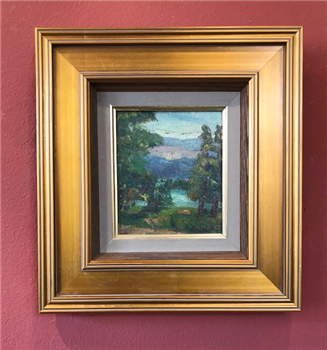 Gottardo Piazzoni, in addition to being a prominent early California artist, was responsible for introducing deaf-mute artist Granville Redmond to silent film great Charlie Chaplin, in the process influencing the art of the great filmmaker.
The introduction was made in 1918 and resulted in a relationship that would last until Redmond’s death in 1935.
For nearly seventeen years Redmond and Chaplin carried on a unique and exuberant friendship – Chaplin quickly learned to sign – that may have turned sour at the end.
But until then, Chaplin became a great fan and collector of Redmond’s art.
One man, the great filmmaker, was of the speaking world but preferred the silent world, delaying for several years before he needed to begin making talking films.
The other, the mute artist who is now recognized as an important figure in American painting, was seeking entrance, especially for his art, into the speaking world.
Chaplin used Redmond in many of his films, including City Lights and It’s a Dog’s Life. He also found collectors for Redmond’s paintings and was himself a prolific collector of the artist’s work.
Redmond, in turn, was a natural mime and pantomimist and Chaplin found he could learn from him. Some of Chaplin’s famous bits of film business, such as The Dance of the Oceana Rolls and The Gold Rush were Redmond inspired.
The late Mireille Piazzoni Wood (1911-2006), Piazzoni’s daughter, was delighted when, as a teenager, she saw Chaplin perform The Dance of the Oceana Rolls in the 1925 Chaplin’ hit – because she had seen the routine before.: ?``When I was a little girl, Granville would come to our house in San Francisco and perform that routine at our dinner table,’’ she told me years ago. `` It made us laugh. When Chaplin did it in The Gold Rush, I recognized it immediately.’’
Chaplin, who once used the routine to amuse Winston Churchill, talked Redmond into moving his artist’s studio into space on Chaplin’s film studio.
In researching a play I wrote on the relationship of Chaplin, Redmond and Piazzoni, `The Floating Hat, I came across a revealing article in the November, 1925 edition of The Silent Worker, a publication for the American deaf community.
It was written by A.V. Ballin, a distinguished deaf journalist of the time, who visited Redmond in his studio on Chaplin’s film lot. Ballin refered to it as ``a studio within a studio, so to speak,’’ and quoted an earlier article by another writer who also visited the studio within a studio:
``My host (Redmond) scribbled something on his conversation pad and made a gesture of introduction: `Mr. Charles Chaplin,’’ who was seated nearby, studying a Redmond’ painting titled Low Tide’ on an easel.
``I could look at it for hours,’’ Chaplin told the writer, ``it means so many things.’’
And he went on philosophically:
``You know, something puzzles me about Redmond’s pictures. There’s such a wonderful joyousness about them all. Look at the gladness in that sky, the riot of color in those flowers. Sometimes I think that the silence in which he lives has developed in him some sense, some great capacity for happiness in which we others are lacking.’’
Ballin mentions Redmond’s influence of Chaplin’s performance art, writing:
``The intimacy between Redmond and Chaplin is thick enough to influence the latter’s acting in motion pictures. It is quite apparent. Did you notice that Chaplin makes many gestures resembling those of a deaf-mute, and never opens his mouth to mimic speaking words – words which cannot be heard and understood; and which, if important, would have to be repeated as sub-titles – a most boresome and wasteful method of explaining anything in motion pictures.’’
Chaplin and Redmond may eventually have had a falling out, because despite their years of friendship, and their mutual friendship with Piazzoni, when Chaplin wrote his autobiography it did not contain a word about Redmond.
This is a shame because the deaf community has always taken great pride in the Redmond-Chaplin relationship, one reason Gallaudet University has taken The Floating Hat into its collection.
Many Chaplin supporters seem to ignore the Chaplin-Redmond relationship, perhaps not liking the fact that Redmond had an influence on Chaplin’s performing art . . . something that Mireille Piaazoni Wood was witness to as a child in San Francisco, in her home and on the movie screen.
By Steven Hauk of Hauk Fine ArtsBiography from Mitchell Brown Fine Art, Inc.
In an interview with Max Stern, Gottardo Piazzoni was asked, "And what is your religion?" To which he replied, "I think it is California."
Piazzoni was well known for his many small paintings. James Coran and Walter Nelson-Rees refer to one such work in their collection in which Piazzoni has "masterfully captured the barren, often oak-dotted coastal hills of Northern California, which, in summer when their grass cover is dry and the Pacific fog rolls in to obscure the sun, switch from gleaming gold to baked brown." After an exhibition in San Francisco in 1917, one critic called them "landscape miniatures", and noted that the artist had "caught a single aspect of nature in an appealing mood, and rendered the salient impression strongly and serenely. They are to the art of painting what the short story is to fiction, or the lyric to poetry."
Painter, etcher, muralist and sculptor, Piazzoni was a prominent figure in the art world of Northern California in the early 20th century. In the 1930's he summarized his artistic beliefs: "I have devoted my life to a study of landscape…not to a copy of the natural scene, but to an expression of what it means to me. I am concerned not with the external aspect of the landscape, but with its inward life." Some historians start the history of California Modernism with Piazzoni's Symbolist work. He regarded nature as a respite from an increasingly mechanized society and his subtle, lyrical interpretations of the Northern California landscape are characterized by their simplicity and quiet mood.
Born in Switzerland in 1872, his father made a fortune in Australia before immigrating to the United States, where he settled in the Monterey area. The young Piazzoni was educated at the Ginnasio in Locarno, where he was first impressed by local mural artists who decorated chapels and churches of the city, before joining his father in California in 1887. He studied at the California School of Design with Raymond Yelland and Arthur Mathews, and in 1894 traveled to Paris where he attended the Academie Julian and the Ecole des Beaux-Arts. By 1901 he had returned to California and established two studios in San Francisco, where he became an active member of the art community. He belonged to many organizations including the Bohemian Club, the Club Beaux Arts, and the San Francisco Art Association, and received numerous awards and prizes while exhibiting widely in the U.S. and Europe.
He received the first of his mural commissions for the First National Bank Building of San Francisco in 1908. His mural work reflected his belief in the integration of art and architecture, and one of his most well-known public accomplishments was the fourteen large murals for the grand staircase of the San Francisco Public Library. Completed in 1932, the five murals depicting "The Land" and five more depicting "The Sea" were recently painstakingly removed from the old Main Library, restored, and installed at the new de Young Museum in San Francisco.
References: Boas, Nancy, The Society of Six, San Francisco, 1988 Coran, James L and Nelson-Rees, Walter A., If Pictures Could Talk, California, 1989 Moure, Nancy Dustin Wall, California Art: 450 Years of Painting & Other Media, Los Angeles, 1998 Westphal, Ruth L., Plein Air Painters of California: The North, California, 1986