Page loaded successfully. Showing biography for Gottfried Graf.
Gottfried Graf BIOGRAPHY
1881 Mengen - 1938 Stuttgart. Known for: Painting.
Gottfried Graf belonged since the First World War until the mid-1920s to the pioneers of modern art in southwestern Germany. Graf was born in Mengen, in the district of what is today Sigmaringen, and... Read full biography
Gottfried Graf belonged since the First World War until the mid-1920s to the pioneers of modern art in southwestern Germany. Graf was born in Mengen, in the district of what is today Sigmaringen, and after school clerk of the Royal Württembergische Post. He quickly realized that this profession was... Read full biography
Gottfried Graf belonged since the First World War until the mid-1920s to the pioneers of modern art in southwestern Germany. Graf was born in Mengen, in the district of what is today Sigmaringen, and after school clerk of the Royal Württembergische Post. He quickly realized that this profession was not suitable for him and turned to the arts. Between 1904 and 1908 he graduated from the Royal Württemberg Academy and the School of Applied Arts Stuttgart, which he graduated with a state exam as a... Read full biography
Gottfried Graf belonged since the First World War until the mid-1920s to the pioneers of modern art in southwestern Germany. Graf was born in Mengen, in the district of what is today Sigmaringen, and after school clerk of the Royal Württembergische Post. He quickly realized that this profession was not suitable for him and turned to the arts. Between 1904 and 1908 he graduated from the Royal Württemberg Academy and the School of Applied Arts Stuttgart, which he graduated with a state exam as a drawing teacher. After a long study trip to Italy Graf resumed his studies in 1909 as a student of Christian Landenberger, Adolf Hölzel and Heinrich Altherr at the Academy in Stuttgart. In 1913 he traveled to southern France, where he met Jaques... Read full biography
Gottfried Graf belonged since the First World War until the mid-1920s to the pioneers of modern art in southwestern Germany. Graf was born in Mengen, in the district of what is today Sigmaringen, and after school clerk of the Royal Württembergische Post. He quickly realized that this profession was not suitable for him and turned to the arts. Between 1904 and 1908 he graduated from the Royal Württemberg Academy and the School of Applied Arts Stuttgart, which he graduated with a state exam as a drawing teacher. After a long study trip to Italy Graf resumed his studies in 1909 as a student of Christian Landenberger, Adolf Hölzel and Heinrich Altherr at the Academy in Stuttgart. In 1913 he traveled to southern France, where he met Jaques Villon and Albert Gleizes. This journey meant that Graf dealt intensively with Cubism in th... Read full biography
Artist Biography
Biography page for Gottfried Graf ((1881 - 1938)), known for Painting. Showing 1 biographical entries and 0 sample artworks.
Gottfried Graf - Artist Info
About Gottfried Graf
Biography from Nagel Auktionen
Gottfried Graf belonged since the First World War until the mid-1920s to the pioneers of modern art in southwestern Germany. Graf was born in Mengen, in the district of what is today Sigmaringen, and after school clerk of the Royal Württembergische Post. He quickly realized that this profession was not suitable for him and turned to the arts.
Between 1904 and 1908 he graduated from the Royal Württemberg Academy and the School of Applied Arts Stuttgart, which he graduated with a state exam as a drawing teacher. After a long study trip to Italy Graf resumed his studies in 1909 as a student of Christian Landenberger, Adolf Hölzel and Heinrich Altherr at the Academy in Stuttgart. In 1913 he traveled to southern France, where he met Jaques Villon and Albert Gleizes. This journey meant that Graf dealt intensively with Cubism in the following years.
After the war, Gottfried Graf, together with Willi Baumeister, Edmund Daniel Kinzinger, Albert Müller, Oskar Schlemmer and Hans Spiegel, founded the "Üechtgruppe". In the same year, the group organized the "I. Herbstschau Neuer Kunst" with the participation of the Berlin artists' association "Sturm" and important French and Italian artists in Stuttgart. On the artist's 50th birthday in 1931, Julius Baum arranged a large exhibition at the Ulm Museum. It was taken over in large part by the Kunstverein Stuttgart. This is followed by an exhibition participation in the Vienna Secession. During the National Socialist dictatorship, many of Gottfried Graf's works were defamed as 'degenerate' and removed from the museums. Finally, he also had to give up teaching. In 1938 Gottfried Graf died in Stuttgart.
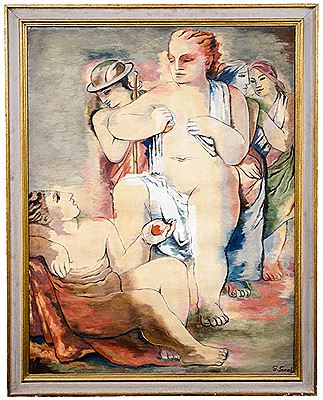
In the monumental painting "Judgment of Paris", Count depicts the moment in which Paris has passed judgment and Aphrodite holds out the apple of Eris. Hera and Athena, the two disregarded goddesses are already turning away from the scene. They already seem to discuss their joint action against the couple. Hermes, who has accompanied the goddesses to Paris, takes on the role of a little interested extras. The composition is characterized by the depictions of the goddess Hera and the son of the King Paris. The massive, slightly covered Hera triumphs. Her right leg is slightly angled and leads to Paris. The colorfulness and size of the two acts make them appear as a unity that stands out from the rest of the people and the background. In the foreground is the present, which the couple can still enjoy, but in the background it already indicates what the future will bring.