Page loaded successfully. Showing biography for Greg Colson.
Greg Colson BIOGRAPHY

Born 1956 Seattle, Washington. Known for: Sculpture-assemblage, mixed media, popular mythology themes.
The following information is from the artist, April 2013. BIOGRAPHY: GREG COLSON. Birth 1956 (Seattle, WA.). Education &n... Read full biography
The following information is from the artist, April 2013. BIOGRAPHY: GREG COLSON. Birth 1956 (Seattle, WA.). Education &n... Read full biography
The following information is from the artist, April 2013. BIOGRAPHY: GREG COLSON. Birth 1956 (Seattle, WA.). Education &n... Read full biography
The following information is from the artist, April 2013. BIOGRAPHY: GREG COLSON. Birth 1956 (Seattle, WA.). Education &n... Read full biography
The following information is from the artist, April 2013. BIOGRAPHY: GREG COLSON. Birth 1956 (Seattle, WA.). Education &n... Read full biography
Artist Biography
Biography page for Greg Colson ((Born 1956)), known for Sculpture-assemblage, mixed media, popular mythology themes. Showing 2 biographical entries and 0 sample artworks.
Greg Colson - Artist Info
About Greg Colson
Biography from the Archives of askART
 The following information is from the artist, April 2013.
BIOGRAPHY: GREG COLSON
Birth 1956 (Seattle, WA.)
Education 1978 BA California State University, Bakersfield
1980 MFA Claremont Graduate School
Lives and works in Venice, CA.
Selected Museum Collections
Getty Research Institute, Los Angeles, CA.
Hammer Museum, Los Angeles, CA. Hirshhorn Museum and Sculpture Garden, Washington, D.C.
Los Angeles County Museum of Art
Metropolitan Museum of Art, New York, NY
Moderna Museet, Stockholm, Sweden
Museum of Contemporary Art, Los Angeles
Museum of Contemporary Art, San Diego
Panza Collection, Varese, Italy
Sammlung Rosenkranz, Berlin, Germany
Vancouver Art Gallery, British Columbia, Canada
Whitney Museum of American Art, New York, NYBiography from the Archives of askART
 Greg Colson is an American artist best known for wall sculptures constructed of salvaged materials. Colson has had solo exhibitions throughout the United States and Europe, including Sperone Westwater (New York), Patrick Painter (Los Angeles), Galleria Cardi (Milan), Kunsthalle Lophem (Bruges, Belgium), Konrad Fischer (Düsseldorf), and the Lannan Museum (Lake Worth, Florida).
Colson's work is in many public collections, including the Metropolitan Museum of Art (New York), the Whitney Museum of American Art (New York), the Museum of Contemporary Art (Los Angeles), the Hirshhorn Museum and Sculpture Garden (DC), the Panza Collection (Lugano, Switzerland), Sammlung Rosenkranz (Berlin), and the Moderna Museet (Stockholm).
Colson was born in Seattle, Washington (1956) and grew up in Bakersfield, California with his parents and two brothers Jeff and Doug. His father Lewis Colson was a social worker, but was also a skilled mechanic and inventive with makeshift repairs and adapting materials to new uses - which inspired his son's appreciation of the ordinary and the rejected. The severe industrial environment of the Bakersfield area, and its accompanying attitudes and outlook, also affected Colson - particularly in its contrast to the large urban/cultural centers he would later inhabit as an artist. As a student at California State University Bakersfield, Colson was moved by the frustrated meaning he found in the work of Pieter Bruegel the Elder, Bruce Nauman, Ed Ruscha, John McCracken, Kazimir Malevich, and R. Crumb. He later earned an M.F.A. at Claremont Graduate School. He works and lives in Venice, California with his wife Dinah Kirgo.
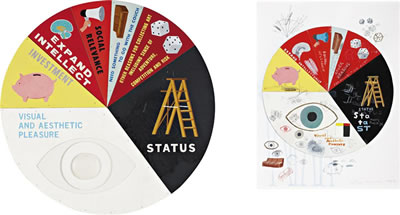
Among Colson's body of work is a series of "stick maps" of cities such as Cleveland, San Jose and Baton Rouge. These sculptures are built of found lengths of various materials; ski poles, curtain rods, plastic plumbing pipe, wood molding - the structure becoming a metaphor for the manifold influences on a city. In another series of constructed "pie chart" paintings (based on socio-cultural surveys), Colson mocks the deluge of analysis that is so much a part of our daily existence by playing up the material and iconographic elements to such a degree that any actual understanding is subverted. Roberta Smith put it like this in her early New York Times review: "In nearly all of Mr. Colson's works, the combination of modesty and grandiosity, of mental exactness and physical imprecision adds up to an odd, sad beauty. Elliptical as they are, his pieces often seem to scrutinize the conflict between the active center and deserted margins of industrialized society"
Source:
"Greg Colson", Wikipedia, http://en.wikipedia.org/wiki/Greg_Colson