Page loaded successfully. Showing biography for Gustav Stickley.
Gustav Stickley BIOGRAPHY
1858 Osceola, Wisconsin - 1942 Syracuse, New York. Known for: Furniture design and making-arts and crafts movement.
Gustav Stickley (March 9, 1858 - April 21, 1942) was a furniture maker and architect as well as the leading spokesperson for the American Craftsman movement, a descendant of the British Arts and... Read full biography
Gustav Stickley (March 9, 1858 - April 21, 1942) was a furniture maker and architect as well as the leading spokesperson for the American Craftsman movement, a descendant of the British Arts and Crafts movement. Gustav Stickley (originally Gustave, with an e ) was born on March 9, 1858, to German... Read full biography
Gustav Stickley (March 9, 1858 - April 21, 1942) was a furniture maker and architect as well as the leading spokesperson for the American Craftsman movement, a descendant of the British Arts and Crafts movement. Gustav Stickley (originally Gustave, with an e ) was born on March 9, 1858, to German immigrant parents. He went to work while still a child, earning his journeyman's license in stonemasonry at the age of 12. When his father deserted the family in the 1870's, Gustav, the eldest child in... Read full biography
Gustav Stickley (March 9, 1858 - April 21, 1942) was a furniture maker and architect as well as the leading spokesperson for the American Craftsman movement, a descendant of the British Arts and Crafts movement. Gustav Stickley (originally Gustave, with an e ) was born on March 9, 1858, to German immigrant parents. He went to work while still a child, earning his journeyman's license in stonemasonry at the age of 12. When his father deserted the family in the 1870's, Gustav, the eldest child in a large family, became their sole support. In 1875, he was given a job in his uncle's chair factory, where he soon realized that this -- working in wood -- was what he was meant to do. And so, in 1884, he left his uncle's employ along with his... Read full biography
Gustav Stickley (March 9, 1858 - April 21, 1942) was a furniture maker and architect as well as the leading spokesperson for the American Craftsman movement, a descendant of the British Arts and Crafts movement. Gustav Stickley (originally Gustave, with an e ) was born on March 9, 1858, to German immigrant parents. He went to work while still a child, earning his journeyman's license in stonemasonry at the age of 12. When his father deserted the family in the 1870's, Gustav, the eldest child in a large family, became their sole support. In 1875, he was given a job in his uncle's chair factory, where he soon realized that this -- working in wood -- was what he was meant to do. And so, in 1884, he left his uncle's employ along with his younger brothers, Charles and Albert, to start his own retail and wholesale furniture business, the Stickley Furniture Company, in Binghamton... Read full biography
Artist Biography
Biography page for Gustav Stickley ((1858 - 1942)), known for Furniture design and making-arts and crafts movement. Showing 1 biographical entries and 0 sample artworks.
Gustav Stickley - Artist Info
About Gustav Stickley
Biography from the Archives of askART
 Gustav Stickley (March 9, 1858 - April 21, 1942) was a furniture maker and architect as well as the leading spokesperson for the American Craftsman movement, a descendant of the British Arts and Crafts movement.
Gustav Stickley (originally Gustave, with an e ) was born on March 9, 1858, to German immigrant parents. He went to work while still a child, earning his journeyman's license in stonemasonry at the age of 12. When his father deserted the family in the 1870's, Gustav, the eldest child in a large family, became their sole support.
In 1875, he was given a job in his uncle's chair factory, where he soon realized that this -- working in wood -- was what he was meant to do. And so, in 1884, he left his uncle's employ along with his younger brothers, Charles and Albert, to start his own retail and wholesale furniture business, the Stickley Furniture Company, in Binghamton, New York. Two years later, the brothers added a chair factory to their business. It was here that the Craftsman style was born, after the styles of Shaker, Colonial and Windsor. In an age of machine-made, highly ornamental furniture, Stickley envisioned a return to the simplicity and quality of handmade goods. This vision was influenced by Stickley's interest in the Arts & Crafts Movement, which was steadily gaining popularity in Europe, and especially England, where William Morris was a leading voice. It was from Morris' writings that Stickley derived his belief in "the prominence of the structural idea, by which means an object frankly states the purpose for which it was intended."
In 1888, Gustav left the business he and his brothers had started to begin his own company. During these years he had met and married Eda Ann Simmons, the woman who was to be his wife for the next 30 years, and they had become the parents of a daughter, Barbara. While in Binghamton, he would become involved in other enterprises which only added to his wealth and stature. Most notable were stints as Vice President of the Binghamton Street Railroad, and as Director of Manufacturing Operations at New York State Prison in Auburn. This success enabled him, in 1892, to build a new factory in Eastwood, New York, a suburb of Syracuse. Then, in 1899, at the age of 41, he formed the Gustav Stickley Company, from which his Craftsman line of furniture would be born.
In 1901, Stickley founded The Craftsman, a periodical which began by expounding the philosophy of the English Arts & Crafts movement but which matured into the voice of the American movement. He worked with architect Harvey Ellis to design house plans for the magazine, which published 221 such plans over the next fifteen years. He also established the Craftsman Home Builders Club in 1903 to spread his ideas about domestic organic architecture.
These ideas had an enormous influence on Frank Lloyd Wright.
Stickley believed that:
* A house ought to be constructed in harmony with its landscape, with special attention paid to selecting local materials;?
* An open floor plan would encourage family interaction and eliminate unnecessary barriers;?* Built-in bookcases and benches were practical and ensured that the house would not be completely reliant on furniture from outside;?
* Artificial light should be kept to a minimum, so large groupings of windows were necessary to bring in light.
Between 1900 and 1916 a style of furniture featuring "...a severely plain and rectilinear style which was visually enriched only be expressed structural features and the warm tones of the wood..." gained popularity in the U.S. This furniture, referred to as "mission oak," was an "...American manifestation of the Arts and Crafts movement..." (Cathers, Furniture of the American Arts and Crafts Movement).
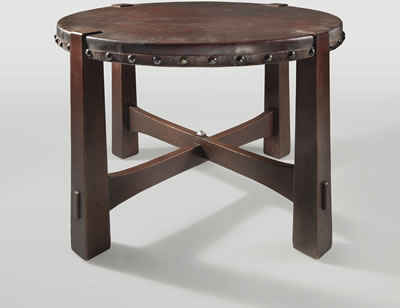
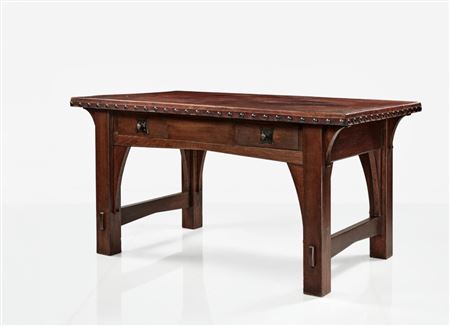
Stickley began making furniture in the mission oak style with the founding of the Craftsman Workshops in Eastwood, New York (now a part of Syracuse, New York) in 1904. His furniture was all handmade rather than machine made, crafted to be simple and useful; it was primarily built from native American oak, joinery was exposed, upholstery was carried out with natural materials (canvas and leather), wood could be varnished but never painted, and there were no unnecessary lines.
He moved his headquarters to New York City in 1905 and planned to establish a boarding school for boys in Morris Plains, New Jersey (what is now Parsippany, New Jersey). Craftsman Farms was designed to be self-sufficient, with vegetable gardens, orchards, dairy cows and chickens. The main house there is constructed from chestnut logs and stone found on the property, and exemplifies Stickley's building philosophy.
As he wrote in The Craftsman:? "There are elements of intrinsic beauty in the simplification of a house built on the log cabin idea. First, there is the bare beauty of the logs themselves with their long lines and firm curves. Then there is the open charm felt of the structural features which are not hidden under plaster and ornament, but are clearly revealed, a charm felt in Japanese architecture....The quiet rhythmic monotone of the wall of logs fills one with the rustic peace of a secluded nook in the woods." [1]
Although initially conceived of as a clubhouse for students, financial troubles forced Stickley to live there with his family instead. The planned boarding school never became a reality.
Stickley was a poor businessman, and the American public began to reject his simple furniture in favor of revival styles; in 1915 he filed for bankruptcy, stopping publication of The Craftsman in 1916 and selling Craftsman Farms in 1917.
In recent years, Stickley style has become popular once more. In 1988, Barbra Streisand paid $363,000 for a Stickley sideboard from Craftsman Farms; magazines such as Style 1900 and American Bungalow cater to those interested in the Arts and Crafts movement.
Gustav's brothers Leopold (Lee), Albert, Charles and John George Stickley were also important figures in the Arts and Crafts movement.
References
Cathers, David M. (1981). Furniture of the American Arts and Crafts Movement. The New American Library, Inc.
Cathers, David M. (2003). Gustav Stickley. Phaidon Press.
Hewitt, Mark Alan. (2001). Gustav Stickley's Craftsman Farms: The Quest for an Arts and Crafts Utopia. Syracuse University Press.
Smith, Mary Ann. (1992). Gustav Stickley: The Craftsman. Dover Publications. ISBN
Source: Arts and Crafts Tile.com
http://www.artsandcraftstile.com/art-tile/Arts_&_Crafts_History/Gustav_Stickley.htm