Page loaded successfully. Showing biography for Hannelore Baron.
Hannelore Baron BIOGRAPHY

1926 Dillingen/Saar, Germany - 1987 New York City. Known for: Abstract collages, wood assemblage, textiles.
Hannelore Baron (June 8, 1926 – April 28, 1987) was an artist whose work has become known for the highly personal, book-sized, abstract collages and box constructions that she began exhibiting in the... Read full biography
Hannelore Baron (June 8, 1926 – April 28, 1987) was an artist whose work has become known for the highly personal, book-sized, abstract collages and box constructions that she began exhibiting in the late 1960s. Born in Dillingen/Saar, Germany, she and her family fled persecution in Nazi Germany,... Read full biography
Hannelore Baron (June 8, 1926 – April 28, 1987) was an artist whose work has become known for the highly personal, book-sized, abstract collages and box constructions that she began exhibiting in the late 1960s. Born in Dillingen/Saar, Germany, she and her family fled persecution in Nazi Germany, illegally crossing the border into Luxembourg in 1939. In 1941 Baron's family sailed from Lisbon to New York and settled in the Bronx, New York City. By the time she graduated from the Staubenmiller... Read full biography
Hannelore Baron (June 8, 1926 – April 28, 1987) was an artist whose work has become known for the highly personal, book-sized, abstract collages and box constructions that she began exhibiting in the late 1960s. Born in Dillingen/Saar, Germany, she and her family fled persecution in Nazi Germany, illegally crossing the border into Luxembourg in 1939. In 1941 Baron's family sailed from Lisbon to New York and settled in the Bronx, New York City. By the time she graduated from the Staubenmiller Textile High School in Manhattan, Baron was avidly reading eastern philosophy, making increasingly abstract paintings and probably already experiencing the symptoms of claustrophobia and depression that would lead to a series of nervous breakdowns... Read full biography
Hannelore Baron (June 8, 1926 – April 28, 1987) was an artist whose work has become known for the highly personal, book-sized, abstract collages and box constructions that she began exhibiting in the late 1960s. Born in Dillingen/Saar, Germany, she and her family fled persecution in Nazi Germany, illegally crossing the border into Luxembourg in 1939. In 1941 Baron's family sailed from Lisbon to New York and settled in the Bronx, New York City. By the time she graduated from the Staubenmiller Textile High School in Manhattan, Baron was avidly reading eastern philosophy, making increasingly abstract paintings and probably already experiencing the symptoms of claustrophobia and depression that would lead to a series of nervous breakdowns throughout her life. In the late 1950s Baron combined a variety of techniques and began making her first collages. Occupied with raising tw... Read full biography
Artist Biography
Biography page for Hannelore Baron ((1926 - 1987)), known for Abstract collages, wood assemblage, textiles. Showing 3 biographical entries and 0 sample artworks.
Hannelore Baron - Artist Info
About Hannelore Baron
Biography from the Archives of askART
 Hannelore Baron (June 8, 1926 – April 28, 1987) was an artist whose work has become known for the highly personal, book-sized, abstract collages and box constructions that she began exhibiting in the late 1960s. Born in Dillingen/Saar, Germany, she and her family fled persecution in Nazi Germany, illegally crossing the border into Luxembourg in 1939. In 1941 Baron's family sailed from Lisbon to New York and settled in the Bronx, New York City.
By the time she graduated from the Staubenmiller Textile High School in Manhattan, Baron was avidly reading eastern philosophy, making increasingly abstract paintings and probably already experiencing the symptoms of claustrophobia and depression that would lead to a series of nervous breakdowns throughout her life.
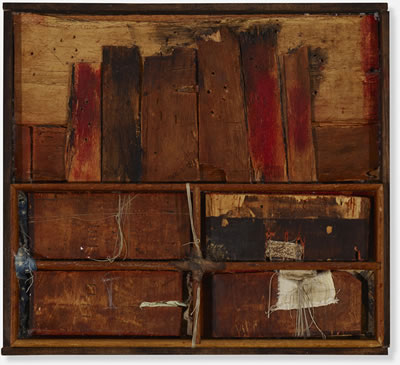
In the late 1950s Baron combined a variety of techniques and began making her first collages. Occupied with raising two children (daughter Julie and son Mark) and beset by psychological problems, Hannelore nevertheless exhibited her work and in 1969, the year of her one-person exhibition at Ulster County Community College, she began to make the box constructions that would become her signature. In the early 1970s, Baron established a studio and devoted her time and energy completely to her artwork until her death in 1987. Hannelore Baron was self-taught.
Although her compositions are completely abstract, she considered them to be both personal and political statements. In her own words, "Everything I’ve done is a statement on the, as they say, human condition...the way other people march to Washington, or set themselves on fire, or write protest letters, or go to assassinate someone. Well, I’ve had all the same feelings that these people had about various things, and my way out, because of my inability to do anything else for various reasons, has been to make the protest through my artwork..."
Throughout the 1970s and 1980s her work garnered critical acclaim, along with gallery and museum exhibitions in the United States, Europe and Japan. In 1995, her work was the subject of a one-person exhibition at the Solomon R. Guggenheim Museum in New York. In 2001 her work was the subject of a traveling exhibition curated by Ingrid Schaffner and organized by the Smithsonian Institution Traveling Exhibition Service.
Her works can be found in the collections of The Museum of Modern Art, New York; the Solomon R. Guggenheim Museum, New York; the Whitney Museum of American Art, New York; the Los Angeles County Museum of Art, Los Angeles, The Art Institute of Chicago, Chicago, the San Francisco Museum of Modern Art, San Francisco, the Museum of Fine Arts, Boston; and Israel Museum, Jerusalem.
Source:
"Hannelore Baron", Wikipedia, 21 Jan. 2016Biography from Jack Rutberg Fine Arts, Inc.
Born Jewish in Germany, Baron experienced a frightful childhood during Hitler’s reign. Hannelore and her brother were sent to a special school for Jews only. The family’s apartment was ransacked and her father beaten. This sparked a period of flight and border crossing, with the family first entering Luxembourg, making their way to Lisbon before emigrating to New York in 1941.
After studying textiles and delving into Chinese philosophy, Buddhism and Taoism, Baron took up painting, eventually working in collage and then years later, after the birth of her children, landing on her signature style, that of wood assemblages.
Her former traumatic experiences are revealed in the collage and assemblage boxes in numerous ways. From splats of paint that may appear as blood, to secret symbolic letters or numbers that seem to have meaning but mainly signify hidden messages. Each piece has a provocative yet beautiful aura, that emanates from the art of mixed media. She uses color and black and white drawings, paint, printed etchings, cloth that is torn, strings of various widths and boxes, all of which seem to tell a story.
In Untitled, (1981), the mixed media assemblage box is made with different width and size string, inside and out of the enclosed box. There is string in the shape of what appears to be reading glasses and other pieces that appear taut as cable, along with painted paper and other mixed media inside. All are hidden in the box nicely enclosed by a string as if magically transposing the ingredients into a journey presented as a somewhat ominous art gift.
“I think of Hannelore’s works as talismans," says gallerist Jack Rutberg. "The alchemy of her collages and assemblages has certain perfection without being mannered. It’s hard to think of a hand having intruded in their making. The simultaneous poetry and gravitas in this work seems to have been conjured into being, rather than crafted. There’s a raw power that is so beautifully tempered by a delicate and fragile poignancy.”
In Untitled, (1982), the collage presents imprints of something that has happened and something that is about to happen. Some of these imprints are literal marks that have a provocative intensity, while others may be a symbolic shape, such as that of a person watching. Animal figures, trees and impressions of people may represent life, while her presentation pulls one into her sense of exposing time, and suggesting the spirit of art as the universal clock.
Says Rutberg,“There’s a fragility to the materials that attracted Hannelore; fabrics string, discarded scraps of wood, exotic paper; all materials that seemed to be as delicate as the artist’s own psyche; all reused materials, saved from ‘extinction’ and repurposed in the service of creating something poignant.”Biography from Auctionata, Inc. (CLOSED)
Hannelore Baron was born in Germany in 1926. Baron and her family settled in New York in 1941. Plagued by claustrophobia and depression, she turned to art making in the 1950's.
Baron held her first solo exhibition in 1969. In 1995, Baron’s work was the subject of a one-person exhibition at the Solomon R. Guggenheim Museum in New York. Her work can be found in the collections of the Museum of Modern Art, the Whitney Museum of American Art, the Los Angeles County Museum of Art, the Art Institute of Chicago, the Museum of Fine Arts, Boston, and the Israel Museum.
She was renowned for her abstract collages and box constructions of highly personal nature. She was a self-taught artist, and gained much critical acclaim throughout her career.
Hannelore Baron passed away in 1987.