Page loaded successfully. Showing biography for Hans Coper.
Hans Coper BIOGRAPHY

1920 Chemnitz, Saxony, Germany - 1981 Frome, Somerset, England. Known for: Abstract functional ceramics, studio pottery, teaching.
‘I am a potter, but he was an artist’ commented Lucie Rie in an interview in 1988. (1) Two of Britain’s most eminent studio potters, Rie and Hans Coper shared a workshop until 1958 and remained great... Read full biography
‘I am a potter, but he was an artist’ commented Lucie Rie in an interview in 1988. (1) Two of Britain’s most eminent studio potters, Rie and Hans Coper shared a workshop until 1958 and remained great friends until Coper’s premature death in 1981. Although their styles were always distinct, the... Read full biography
‘I am a potter, but he was an artist’ commented Lucie Rie in an interview in 1988. (1) Two of Britain’s most eminent studio potters, Rie and Hans Coper shared a workshop until 1958 and remained great friends until Coper’s premature death in 1981. Although their styles were always distinct, the effect of each was invariably influential on the other. Born in 1902, Lucie Gomperz grew up in the rich intellectual environment of early twentieth-century Vienna. The daughter of a prominent ear, nose... Read full biography
‘I am a potter, but he was an artist’ commented Lucie Rie in an interview in 1988. (1) Two of Britain’s most eminent studio potters, Rie and Hans Coper shared a workshop until 1958 and remained great friends until Coper’s premature death in 1981. Although their styles were always distinct, the effect of each was invariably influential on the other. Born in 1902, Lucie Gomperz grew up in the rich intellectual environment of early twentieth-century Vienna. The daughter of a prominent ear, nose and throat specialist, she was educated at home. In 1922, she entered the Kunstgewerbeschule, the art school attached to the Wiener Werkstätte, and was immediately ‘lost’ to the potter’s wheel. Taught by Michael Powolny, she did work that attracted the... Read full biography
‘I am a potter, but he was an artist’ commented Lucie Rie in an interview in 1988. (1) Two of Britain’s most eminent studio potters, Rie and Hans Coper shared a workshop until 1958 and remained great friends until Coper’s premature death in 1981. Although their styles were always distinct, the effect of each was invariably influential on the other. Born in 1902, Lucie Gomperz grew up in the rich intellectual environment of early twentieth-century Vienna. The daughter of a prominent ear, nose and throat specialist, she was educated at home. In 1922, she entered the Kunstgewerbeschule, the art school attached to the Wiener Werkstätte, and was immediately ‘lost’ to the potter’s wheel. Taught by Michael Powolny, she did work that attracted the attention of Josef Hoffmann, one of the co-founders of the Wiener Werkstätte, and he sent some of... Read full biography
Artist Biography
Biography page for Hans Coper ((1920 - 1981)), known for Abstract functional ceramics, studio pottery, teaching. Showing 3 biographical entries and 0 sample artworks.
Hans Coper - Artist Info
About Hans Coper
Biography from the Archives of askART
 ‘I am a potter, but he was an artist’ commented Lucie Rie in an interview in 1988. (1) Two of Britain’s most eminent studio potters, Rie and Hans Coper shared a workshop until 1958 and remained great friends until Coper’s premature death in 1981. Although their styles were always distinct, the effect of each was invariably influential on the other.
Born in 1902, Lucie Gomperz grew up in the rich intellectual environment of early twentieth-century Vienna. The daughter of a prominent ear, nose and throat specialist, she was educated at home. In 1922, she entered the Kunstgewerbeschule, the art school attached to the Wiener Werkstätte, and was immediately ‘lost’ to the potter’s wheel.
Taught by Michael Powolny, she did work that attracted the attention of Josef Hoffmann, one of the co-founders of the Wiener Werkstätte, and he sent some of her pots to the Exposition des Arts Decoratifs et Modernes in Paris in 1925.
Dividing her time between ski slopes and the potter’s wheel, she married the businessman Hans Rie in 1926, but increasingly devoted herself to the development of her own artistic style.
Focusing on domestic wares and working in earthenware, Rie searched for a modernist aesthetic. Lacking convenient access to a kiln, she raw glazed her pots, in other words applied glaze to un-fired clay and then fused form and glaze in one firing. Initially a practical choice, it later became an essential feature of Rie’s pottery.
Following the incorporation of Austria into Nazi Germany in 1938, Rie and her husband left for England. While Hans moved on to the United States, Lucie decided to stay in London and set up house and studio in Albion Mews in Bayswater. The couple amicably divorced in 1940.
_____
Born in Chemnitz, Saxony, in 1920, Hans Coper lost his youth in 1936 when his Jewish father killed himself to ease the plight of his non-Jewish wife and that of their two sons. Having briefly studied textile engineering in Dresden, Coper left Nazi Germany in 1939 and took refuge in England. Here he was arrested, interned as an enemy alien and shipped to Canada.
In 1941, he returned to Britain and joined the Pioneer Corps. At the end of World War II, Coper had two daughters, no wife and no work. In 1946, he went to Albion Mews and asked Rie for work. Fortunate for the two of them, she took him on and taught him to pot.
Working side by side, Rie and Coper first continued to make ceramic buttons and then focused on the production of domestic wares, often signed together. While the economic situation gradually improved, sales were not easy. At that time Bernard Leach dominated the revival of studio pottery in Britain with his rustic pots, which were in demand rather than Rie’s more urban wares.
Still, Coper encouraged Rie to prevail and to take Leach’s advice selectively. Success arrived, first in the invitation for Rie to exhibit at the Festival of Britain in 1951 and then for the Lucie Rie Pottery to supply Heal’s department store with tableware.
At the same time Rie’s and Coper’s personal styles started to diverge: while hers remained functional in focus, his became increasingly sculptural in ambition. Eventually, in 1958, Coper decided to set up his own studio, first at Hammersmith in London, then at Digswell House in Hertfordshire and, finally, near Frome in Somerset.
While he continued to pot and exhibit throughout his life, he also devoted himself to teaching, first at the Camberwell School of Art* and then the Royal College of Art.* By contrast, some part-time teaching at the Camberwell School of Arts aside, Rie never took to teaching. Rather, she preferred to explore new forms, such as her flared bottles, and to exhibit. In 1967, the Arts Council dedicated a major exhibition to her. One of the vases in the Fitzwilliam Museum was exhibited on this occasion.
Rie was awarded an OBE the year after, a CBE in 1981 and a DBE in 1990. Already well into her eighties, she continued to work and had another major exhibition in Tokyo in 1990. Organized by the fashion designer Issey Miyake, it effectively showed her minimalist pots next to his sculptural clothes.
Rie died at Albion Mews in 1995.
In 1994, the Metropolitan Museum in New York dedicated an exhibition to Rie and Coper entitled "Lucie Rie / Hans Coper: Masterworks by Two British Potters." Three years later, in 1997, the Barbican Art Gallery in London followed suit, showing ‘Lucie Rie & Hans Coper: Potters in Parallel’.
UCP
1 ‘Hands on the wheel of fate’, The Guardian, 31 August 1988
Selected Bibliography
The Metropolitan Museum of Art, with an introduction by J. Stewart Johnson, Lucie Rie / Hans Coper: Masterworks by Two British Potters, catalogue of an exhibition held at The Metropolitan Museum of Art, New York, 1994
M. Coatts (ed.), Lucie Rie & Hans Coper: Potters in Parallel, catalogue of an exhibition held at the Barbican Art Gallery, London, 1997
C. Frankel, Modern Pots: Hans Coper, Lucie Rie & their Contemporaries, University of East Anglia Press, 2002
Source:
"Dame Lucie Rie and Hans Coper, The Fitzwilliam Museum, Web, Jan. 2018
* For more in-depth information about these terms and others, see AskART.com. Glossary http://www.askart.com/AskART/lists/Art_Definition.aspx.Biography from the Archives of askART
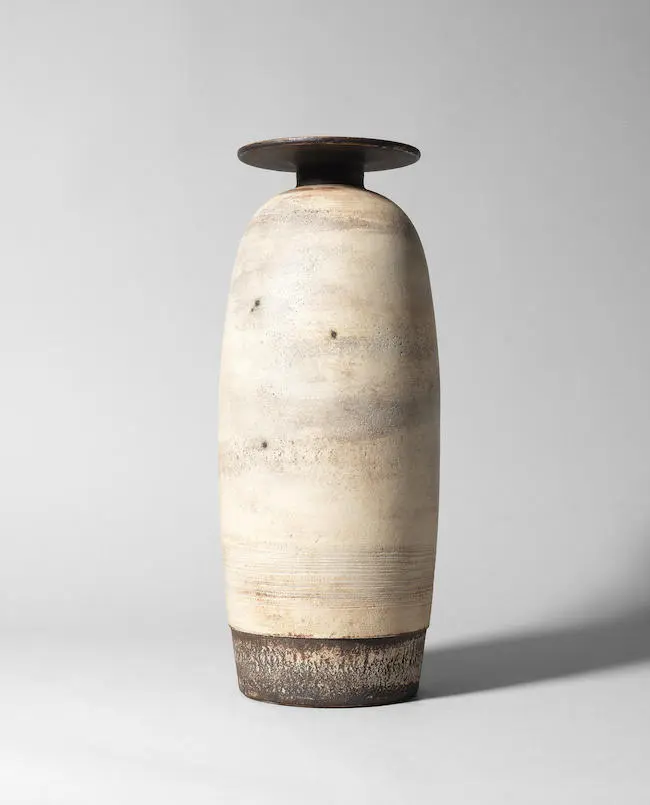 Hans Coper (8 April 1920[1] – 16 June 1981), was an influential German-born British studio potter. His work is often coupled with that of Lucie Rie due to their close association, even though their best known work differs dramatically, with Rie's being less sculptural, while Coper's was much more abstract, but also always functional.
The latter point was noted by M. S. Thomas in his recent book The Essential Potness. Coper always made functional vessels, principally containers for flowers (vases), fruit (bowls), candles (candle holders) including work for Coventry Cathedral and Sussex University meeting house. He made a small group of Figures in the fifties, which were not vessels and were never put on sale (see Tony Birks).
Coper was born in Chemnitz, Germany, and fled to Britain in 1939. He was interned as an enemy alien, and held in Canada for two years; on return to Britain in 1942, he served as a conscientious objector in the Non-Combatant Corps.
In 1946, with no previous experience in ceramics, he began working as an assistant in the studio of Lucie Rie. It is from this time you will find tea sets and cups and saucers made by both Rie and Coper. By the time he left in 1958 to establish his own studio at Digswell House in Hertfordshire, he was already well known as a potter in his own right, experimenting with much more abstract forms that were at the time considered very ahead of their time.
Because of the success of his work, he went on to become a leading figure in the 20th century studio pottery movement. Throughout the 1960s he taught pottery at the Camberwell School of Art and the Royal College of Art. He died in Frome, Somerset in 1981 of amyotrophic lateral sclerosis.
Coper would characteristically throw his work on the potter's wheel, then alter and assemble pieces by hand to achieve the finished form. Thus, although made on the wheel, his work has a sculptural quality, but is always functional. The surfaces of his pots tend to be roughly textured and coloured with oxides, especially manganese oxide. His distinctive pots take on recognizable "forms" he termed Spade, Bud, Cup, Egg, Flower and Arrow.
Coper's work was widely exhibited and collected even in his lifetime. Today, it is found in the collections of major museums around the world, including the Metropolitan Museum of Art, the Victoria and Albert Museum, Museum de Fundatie, the Sainsbury Collection, and York Art Gallery, as well as in private collections worldwide. Among his best known works is the set of three 7-foot candlesticks on the high altar at Coventry Cathedral, commissioned in 1962.
Source;
C. Frankel, Modern Pots: Hans Coper, Lucie Rie & their Contemporaries, University of East Anglia Press, 2002.
Published on Wikipedia (Hans Coper), Jan. 2018
* For more in-depth information about these terms and others, see AskART.com. Glossary http://www.askart.com/AskART/lists/Art_Definition.aspx.Biography from Phillips London
Hans Coper, a ceramic artist, learned his craft in London under Lucie Rie after emigrating from Germany in 1939. He gained recognition for his work exhibited in the "Festival of Britain" in 1951. Coper favored compound shapes and textured surfaces achieved through slips. He admired ancient objects and modernists like Brancusi and Giacometti. In his later career, he created small "Cycladic" pots reminiscent of Bronze Age Greece clay figures.